Main image: composition based on a photograph by Felix Arnaudin
This July saw one of the worst fires in the Landes region, in the Biscarrosse area near Bordeaux, with 3,600 hectares of forest burnt and 198 buildings destroyed in the space of a week. Around 200,000 people were evacuated.
The Landes region is known for its vast pine forests. However, it is important to note that this was not always the case. Now, due to the nature of these trees and the way they were planted, combined with the extremely dry conditions caused by the latest heatwave resulting from the climate crisis, the risk of fire and its spread has increased. But as we have said, climate change is man-made, and so are these pine forests (see the analogy with ‘Megapinery in Argentine Patagonia: Territorial invasion, fires and water scarcity’).
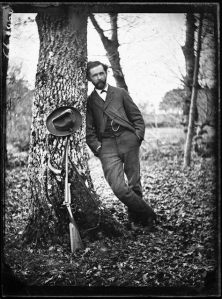
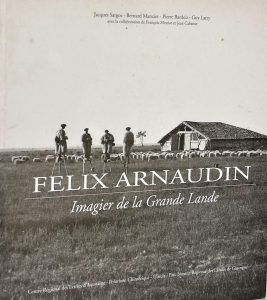
The book ‘Felix Arnaudin – Imagier de la Grande Lande’¹ compiles not only images from the past, but also the ideas and criticisms of this photographer and writer regarding the project to reforest the Landes with pine trees. In his critique, Felix Arnaudin (1844–1921) already referred to the pine reforestation of the Landes as an ‘industrial plantation’. The Landes is considered the largest man-made forest in Western Europe, covering an estimated area of 10,000 square kilometres. And so, Arnaudin also poited out that plantation became ‘a violent catalyst for destructive fire and wind’.
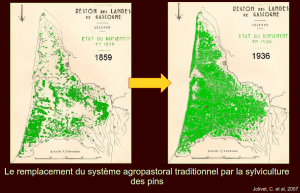
The book was written by Jacques Sargos and published by the Centro Regional des Lletres d’Aquitaine, which shares Arnaudin’s point of view: “This vast pine plantation was established in the 18th century in the Pays de Buch region of Gironde to prevent erosion and improve soil quality. Most of the region now occupied by the Landes Forest was sparsely inhabited marshland until the 19th century, when the law of June 19, 1857, put an end to traditional grazing and promoted large-scale reforestation to restore the landscape and foster regional economic development.”
According to Arnaudin and Sargos, the mega-plantation was driven by another motive: to establish a large-scale economic activity that would satisfy the objectives of capitalists, but also to colonize an area capitalists considered isolated from civilization. The Landes was viewed as a desert, and its inhabitants as savages.
The pine species chosen for this purpose was Pinus pinaster (maritime pine), which apparently is native to southern Europe and the Mediterranean, even though the Landes are located on the Atlantic coast, where conditions are very different.
“Landa” in Basque means “land,” although its origin is pre-Indo-European (hence also the Germanic/English word “land,” as in Disneyland… translated into Spanish as “landia”… PINOLANDIA!) and apparently exists in Gaulish as well to denote… “uninhabited/uncultivated area”!! That is not the Basque meaning, and according to the same Wikipedia entry, in Gascon it means “moors” or “heathlands.” In the Occitan dialect of Gascony, a pine forest is called a pinhadar. And we also have in euskara (Basque) “landare” (plant) and “landatu” (to plant).
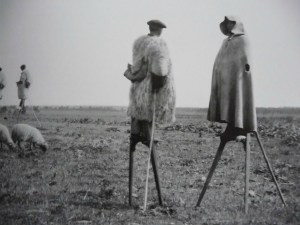
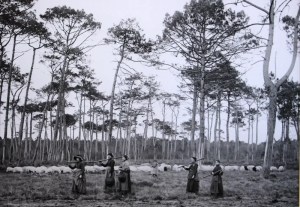
In Arnaudin’s photos, you can observe several distinctive features:
The most interesting is that the shepherds of the Landes (those “wild” ones) used stilts. The reason was that this allowed them to move through the sandy terrain and wetlands, but above all because it enabled them to survey vast expanses of that plain (this is another very important feature of the landscape and geology, especially when compared to Euskal Herria (the Basque Country), which is very mountainous). But once the pine forests took hold and the pines replaced the pastures the stilts became useless.
Thus, the pine forests in the Landes represented an environmental colonization—a colonization of the landscape, the territory, but also of its people and their culture.
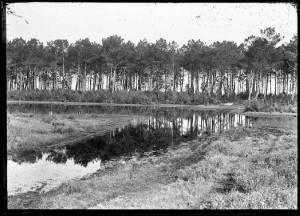
Another distinctive feature is that pine trees are also present, but as just one species among many. This pine, therefore, is not so much an exotic species; rather, it coexisted with other species—oaks, alders, birches, willows, cork oaks, and holly—though obviously not on the current scale or in the current proportion. Today, there are also patches of native (diverse) forest.
NOTES
1Sargos, Jacques, Manciet, Bernard, Bardou, Pierre, Latry, Guy. Felix Arnaudin – Imagier de la Grande Lande. Centre Régional des Lettres d’Aquitaine. 1993
Text by Jacques Sargos on Felix Arnaudin and industrial pine planting
‘Some utopians naively believed that wheat could be sown in the sands of the Landes, and they failed. But then came Napoleon III, the finest of the Bonaparte clan, for he was at least a good agronomist and a good builder; Napoleon III decided on several unstoppable measures. The construction of the Bordeaux–Bayonne railway through the Grande Lande. The passing of an exceptional law—the Act of 19 June 1857—which, under the pretext of public health, compelled local authorities to drain their heathlands and plant them with pine trees. A network of farm tracks and irrigation channels was also established. Finally, near the Sabrine marshes, a vast imperial estate was established, conceived as a laboratory and showcase for the regeneration of the country. The Solférino estate and the management of the works in the Landes department were entrusted to Henri Crouzet, chief engineer of the Department of Bridges and Roads. Unfortunately, during the implementation of the 1857 Act, he was unable to prevent the onset of rampant speculation which, within a few years, destroyed the essential elements of the pastoral system. A monoculture forest thus replaced the traditional balance between pine trees, fields and livestock.
» And so the largest moorland in old France disappeared. And so, it seemed, even its memory would be lost. Progress is not characterised by modest triumphs. It was not enough to have planted a beautiful and extensive forest: it was also necessary to have put an end to a sort of nightmare. Republican propaganda, following in the footsteps of imperial propaganda, did not hesitate, in order to magnify the victory, to denigrate the defeated moorland. In the past, it had been nothing more than a pestilential swamp where a few starving savages languished. In place of that nothingness, the State had created a prosperous province where gold flowed from the trees in the form of resin and where one was intoxicated by balsamic scents. Gradually, the memory of the Great Landes faded, buried beneath a vain mythology.
» In 1912, the publication of ‘Chants populaires de la Grande Lande ‘—one of the great works of regional ethnography— enabled Félix Arnaudin to strike a discordant note amidst the chorus of self-congratulation that had arisen from the creation of the Landes forest:
» “How many beloved things, of which a fragment is lost every day, or which have already vanished and are now nothing more than a memory! The Landes themselves, above all, where, distant, half-extinct, all the more magnificent in their silence, floated the slow lament of the the shepherd or the stable boy lost in the vastness of space. The slow lament of the shepherd or the stable boy lost in the vastness of space, and also, so sweet to hear near the silent parks, the fresh song of the heather-cutters, resonating in the lethargy of their pale late-season afternoons; the infinite moor, entirely abandoned to pastoral life, and seemingly asleep, yet new times have come to brutally shatter the spell, in its ancient dream, forever, of immensity and solitude… Now, the moor no longer exists. In place of the magnificent wilderness, the enchantment of our ancestors, unfurling beneath the desert sky its nakedness from the most remote ages, the flat and boundless expanse, where the eye was perpetually dazzled by the void, where the soul, expanded, intoxicated, at times overflowing with new and youthful joys, at times submerged in ineffable and dearly cherished sorrows, has been replaced by the forest—the industrial forest!—with all its ugliness (intensive agriculture, ‘to maximise profit’, sowing in straight rows, nauseatingly banal, irrational to boot, a violent catalyst for destructive fire and wind), whose suffocating curtain, spread far and wide where once such a serene and radiant order reigned, relentlessly limits the view, dulls the mind and annihilates all its growth.’
“
“Surprise! In the writings of one of his acquaintances, the former wasteland was no longer ‘that land of mud and melancholy, that sinister steppe whose ugliness seemed beyond doubt’. Moreover, the pine forest – whose charms had been lavishly praised in the spirited verses of certain regionalist bards, also bearded, such as Messrs Jean Rameau and Maurice Martin – was now accused of having obscured a magnificent landscape with its banality.
’ Is Arnaudin’s opinion perhaps marred by excessive bitterness or bias? (It should be noted, however, that the writer condemns the gloomy plantations of the industrial forest, not the old woods where pines and oaks grew intermingled). In 1852, the president of the Landes Agricultural Society, Édouard Perris, already regarded the pine forest as dreary and monotonous, and complained of the ‘suffocating and unbearable heat caused by the still air, which becomes even hotter as it grows denser with resinous vapours’. ‘Among the pines,’ Édouard Perris continues, ‘my heart sinks; my eyes search for boundaries and clearings, and I long for the moor as one longs for the day after a bad night.’
“Should we, then, suppress our own happiness when we find ourselves amongst the pines? And should we burn these inspired pages in which François Mauriac speaks of the trees of the Landes as living beings, martyrs over whom the heavens bend, leaving stars clinging to their branches? Certainly not. It is up to each individual to love or shun the forest, to judge it – its monotony, whether painful or fascinating. From Félix Arnaudin’s comments, let us remember that progress can never be absolute: the heathland, even if unproductive and condemned by modernity, could be beautiful in the eyes of its inhabitants. As for the pine trees, it was by no means a historical fact that aesthetic superiority took precedence over their economic virtues.
(…)

’ Faced with the materialism of the bourgeoisie and its limited pleasures derived from petty gain, the writer finds himself in the wilderness, a symbol of primeval splendour, spiritual elevation and social irrelevance. Félix Arnaudin was not a pioneer in expressing these themes. But in Aquitaine, he embodied the highest flowering of romantic non-conformity. Can the same considerations be applied to moral judgements as to landscapes? Did the fact that the forest had enriched the inhabitants of the Landes region make them better people, or at least happier? Here, once again, Arnaudin rejects the image of bestial and wretched beings replaced by graceful peasants. Through his presentation of folk songs, he evokes a people of unexpected joy and kindness: ‘For on the moor, on the good and happy moor of yesteryear, there was much singing. I say “happy”, and I am aware of all the objections that will be raised; but I stand by it: back then, : back then people used to sing, and one does not sing where one suffers, at least not with such devotion. Now, there is no feeling left; that broad, wholesome joy which seemed to be the very essence of our people’s character has vanished: just as the inhabitants of the Landes twenty or thirty years ago were so open and sociable, cheerful and pleasant despite their sometimes harsh circumstances, so too the inhabitants of the present generation—a singular result of their social emancipation—appear dissatisfied and haughty, even hostile and mocking, in their relative comfort. And one realises that this abrupt transformation, the causes of which no longer require analysis, is unsettling’ and baffles the elderly, who struggle to reconcile their ideas with the new ones and observe the current state of affairs with sadness. In the face of those who used the poverty of the region’s former inhabitants as an argument to condemn them all the more, Félix Arnaudin did not hesitate to resort to blatant bad faith: ‘One does not sing where one suffers, at least not with such abandon!’ Whilst happiness does not necessarily go hand in hand with opulence, it is difficult for it to flourish where it is hindered by extreme poverty or serious illnesses associated with one’s way of life.