A este lado del Mediterráneo
(Published in El Salto)
(Castellano) (Euskara)
Two police officers pin a man to the ground as he screams desperately for help. Minutes later, the man stops resisting. He is dead. This isn’t Minneapolis—it’s Bologna. The man’s name was Abderrahim Fakir.
His name was not George Floyd, but Abderrahim Fakir, yet both deaths have much in common, both in form and substance. The life of Fakir, a 43-year-old man of Moroccan origin, came to an abrupt end on Monday morning while he was pinned down by two police officers in the Pilastro neighborhood of Bologna, where he often went to visit friends and relatives.
The Dynamics of the Alleged Homicide
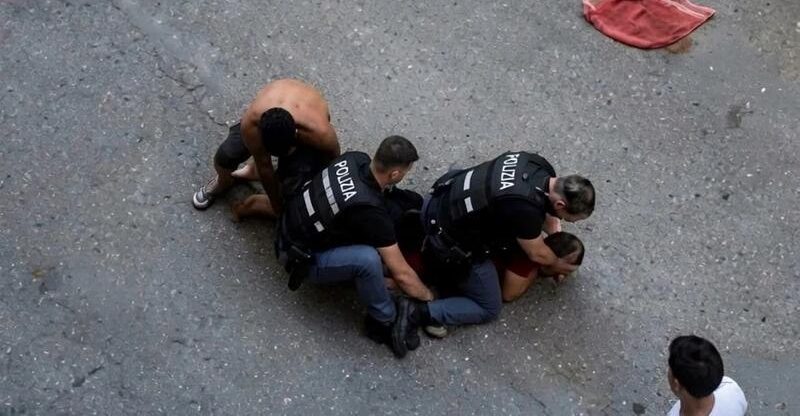
According to the accounts that have emerged so far, the officers, along with Red Cross medical personnel, arrived at the scene following a call from some neighbors. Upon arrival, they used pepper spray on Fakir due to his alleged agitated state. What happened shortly afterward—the police’s actions and the victim’s reaction—can be seen in a video recorded from a nearby building by anonymous individuals and widely shared on social media.
The footage shows the two police officers sitting on the man’s back, clearly intending to restrain him, while a third unidentified person —presumably a local resident— holds his legs down. For several minutes, Fakir writhes and screams for help. To keep him still, one of the officers strikes him in the side. At one point, Fakir loses consciousness, while one of the officers remains on top of him. Afterward, his ankles are tied with a zip tie. Only then—once the man had ceased to offer any resistance—did medical personnel intervene. Despite attempts at resuscitation, Fakir died.
According to various media reports citing family members, Fakir suffered from asthma, a condition that causes attacks making it difficult to breathe, triggered, among other things, by “emotional factors.”
The Reactions: Mobilized Anger and Institutional Justifications
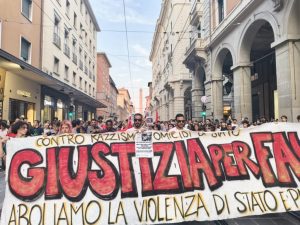
After news of Fakir’s death at the hands of the police broke, various groups in Bologna immediately called for a protest march. About three hundred people answered the call and marched through the streets of the capital of Emilia-Romagna demanding “Justice for Abderrahim.”
For its part, the grassroots union SI Cobas, to which Fakir belonged, called for a 24-hour regional strike in the private sector beginning at 10 p.m. In a brief statement, the union shared the news and announced the strike: “Comrades, the video shows the brutality of the Italian police against a worker in Bologna. Just as in the United States, the police, without mercy, have killed Abderrahim Fakir, a former member of our union. […] We call on all comrades in workplaces outside Bologna to participate, so that the condemnation of our comrade’s murder reaches as wide an audience as possible.”
Fakir’s body has been turned over to the courts for forensic investigations that should clarify the causes of his death. According to a statement from the Bologna Questura (the government’s police agency), the officers “intervened at the request of some residents, who had reported the presence of an enraged individual.” This morning, major newspapers reported the news, relying heavily on this exculpatory language and using nearly identical headlines: “A man dies during a police intervention.”
When asked by the media, Fakir’s sister responded: “I demand justice. If someone is agitated, you have to calm them down, not kill them in broad daylight.”
It remains unclear exactly what happened in the minutes leading up to the video shared on social media. In this regard, the police department itself has stated that “footage from the officers’ body cameras recorded the operation and will be made available to judicial authorities.” However, given the usual dynamics in such cases, it is unlikely that this footage will ever be released.
Statements from political parties have been as expected. The mayor of Bologna from the Democratic Party, Matteo Lepore, has refrained from making any accusations, calling on the citizens of Bologna to gather in Neptune Square “to stand in solidarity with the Pilastro neighborhood community during such a painful time.” Other members of Italy’s main opposition party have called for clarification of the circumstances surrounding the death. Meanwhile, Galeazzo Bignami, a member of parliament for Brothers of Italy—the majority party in the coalition government—stated that the officers’ intervention “was carried out professionally.”
The officers involved are putting the new “legal shield” to the test
The Bologna Prosecutor’s Office has opened a judicial investigation to “clarify the causes of Fakir’s death.” In the press release, the judicial institution also stated that it “[will] take into consideration the full sequence of events (which is more extensive than the video that has been circulated on social media, though it was recorded by this office), as well as the actions of both the officers and the medical personnel.”
This case marks the first application of the so-called “criminal shield,” a new provision under which officers are not formally charged as “defendants,” but rather classified as “individuals to whom criminal acts committed in the presence of a justifying cause are attributed.” Under the new law, examples of justifications could include “self-defense” or “performance of duty.” This adds a preliminary “verification” phase to the judicial process—applicable only to certain protected categories—which provides special protection against potential criminal liability.
The provision is just one of the legal changes that make up the sweeping “security” reform being carried out by the government led by Giorgia Meloni. The increasingly repressive policies of the post-fascist coalition aim, with little regard for scruples, to subdue any form of political and cultural opposition organized from below—while, unsurprisingly, favoring and supporting state institutions that hold the legal monopoly on the use of force.
