Emiliano Teran-Mantovani
(Venezuelan Observatory on Political Ecology)
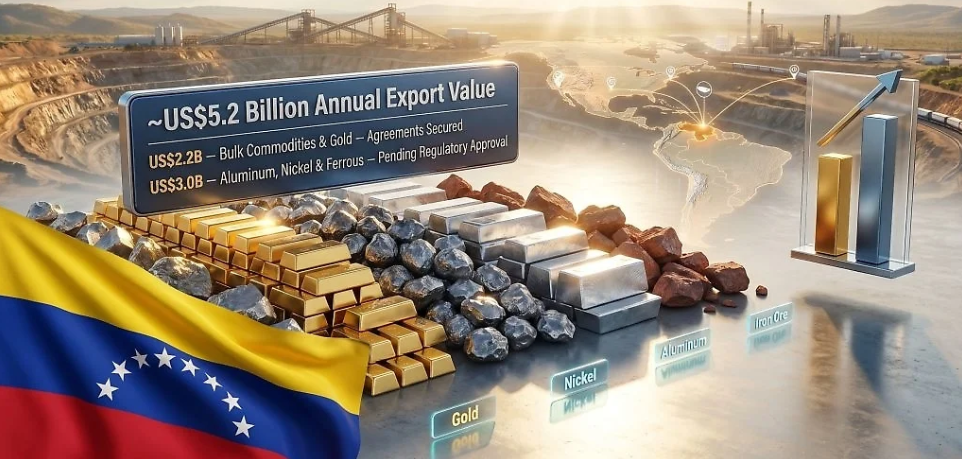
(Reference image from Resumen Latinoamericano, generated by AI)
(Castellano) (Euskara)
Following the U.S. military intervention, certain mining-related operations are charting the course of a Trump administration strategy to consolidate the flow of minerals from Venezuela to the U.S. little-known companies, a new mining law, military operations, and the persistence of illegal mining. Where are we headed?
In mid-September, Delcy Rodríguez’s interim government finalized an agreement with Heeney Capital, granting the company the rights to operate the Chocó Mine and export the gold extracted from it[1]. This is a productive open-pit mine located in the municipality of El Callao (Bolívar state), part of the Chocó Mining Industrial Park III—which also houses a major gold processing plant of the same name—and Area 4 of the Orinoco Mining Arc (AMO). It is important to note that the presence of various criminal groups in El Callao—which have a decisive impact on mining activity[2]—has been reported for years, and the municipality is the most violent in Venezuela[3].
The agreement in question was signed specifically with the Venezuelan Mining Corporation in Houston, Texas (U.S.), during the G20 Energy Conference. Although few details are available, the agreement announced 30-year operating rights—a provision now included in the amendments to the new Mining Law of 2026—and an initial investment of US$1 billion.
What do we know about Heeney Capital?
This is not a mining company, but rather an investment firm based in New York[4], apparently founded in 2021. There is not much information available about it, but it appears to be involved in mining investments in other countries, such as Trinidad and Tobago, the Congo, Peru, and Guinea, among others[5]. It appears they focus on acquiring stakes in mines that are already in production but are “underutilized.” Their goal, therefore, would be to take these ventures from small to large scale—to grow them and increase their market value.
Heeney partnered with Mercuria Energy Group (based in Geneva), a globally significant commodities trader, which—through an “offtake” agreement (or a prior commitment to purchase resources)—would be responsible for ensuring the placement of Venezuela’s highly controversial gold on the markets.
But here we must once again emphasize what we have stated elsewhere[6]: U.S. intervention and interests in Venezuela are not just about oil; nor are they even just about oil and gold. Since last April, agreements have been announced between Heeney, Mercuria, and Venezuela for the exploitation and marketing of aluminum, nickel, and iron ore[7].
The U.S. remains highly dependent on aluminum imports, particularly in manufacturing sectors. Bloomberg has reported that Heeney seeks to gain operational control of the state-owned company Venalum[8]. On Monday, October 12, the first shipment since 2018—consisting of approximately 15,000 metric tons of primary aluminum—was sent from Venezuela to the U.S. The aluminum was produced by Venalum under the agreement with Heeney and Mercuria[9]. The U.S. Geological Survey’s 2025 list, which updates the classification of critical minerals, includes aluminum and nickel[10].
Iron, meanwhile, is key to the U.S. steel industry; Venezuelan iron, in particular, has high levels of purity, making it cheaper to process, and its geographic proximity also makes it more advantageous[11].
Mercuria is attempting to position itself in several Venezuelan natural resource supply chains simultaneously. Heeney is also exploring agreements involving coal and aims to establish a metals trading company.
The Context of U.S. Intervention in Venezuela and the Trump Administration’s Goal of Consolidating the Flow of Minerals to the U.S.
Clearly, the evolution of the new mining agreements in Venezuela cannot be understood outside the framework of U.S. intervention and the situation of U.S. control that the Venezuelan state has been undergoing since January 3, 2026.
These agreements and operations are clearly being directed from Washington, driven more by strategic, military, and national security interests than by purely commercial ones. The role played by the powerful commodity trading transnational corporation, Trafigura, in the shipment of oil and gold following Maduro’s removal has been key, and was directed by Donald Trump[12]. The U.S. chargé d’affaires, John Barrett, was present at the signing ceremony last April for the memorandum of understanding between Venezuela, Heeney, and Mercuria, and the event began with thanks to Trump for his leadership in “securing everything related to critical minerals at this time”[13].
Since the start of Trump’s second term, the U.S. has set itself the goal of aggressively intensifying its geopolitical competition with China. This is an existential goal for the country. To achieve this, it must subjugate Venezuela, Latin America, and the Caribbean—especially given the setbacks it is currently facing in the Middle East. This involves the installation and consolidation of subordinate governments, along with the simultaneous establishment of highly favorable extractivist frameworks, to secure energy (fossil fuels), critical and strategic minerals, and the expansion of supply chains controlled by this power. The so-called “Donroe Doctrine” and the “Pax Silica” initiative clearly spell out these objectives.
The Trump administration is attempting to establish guarantees and incentives to encourage new investments in sectors of interest to it in Venezuela. To this end, it is dismantling the national and sovereign frameworks through which the Venezuelan state managed its natural resources, revenues, and taxes, creating new channels for the rapid and inexpensive appropriation of minerals. The goal, according to Trump, is to achieve “total access” to these resources—and to achieve it quickly. The new Mining Law (April 2026) was sponsored and promoted by the U.S. Department of the Interior—headed by Doug Burgum[14]—and subsequently overseen by the U.S. Embassy[15]. The law formally establishes these safeguards and incentives for foreign capital: it expands its powers and stakes (see, for example, the new Article 5), formalizes patterns of plunder that have been in place for years and continue under this framework, in addition to granting discretion in setting royalty rates and taxes, special advantages, and numerous tax exemptions (on the latter, see Articles 91, 93, and 97 of the law). These extractivist measures have been carried out under the utmost secrecy, opacity, and arbitrariness, and in violation of various constitutional rights—just as has been done with the oil industry.
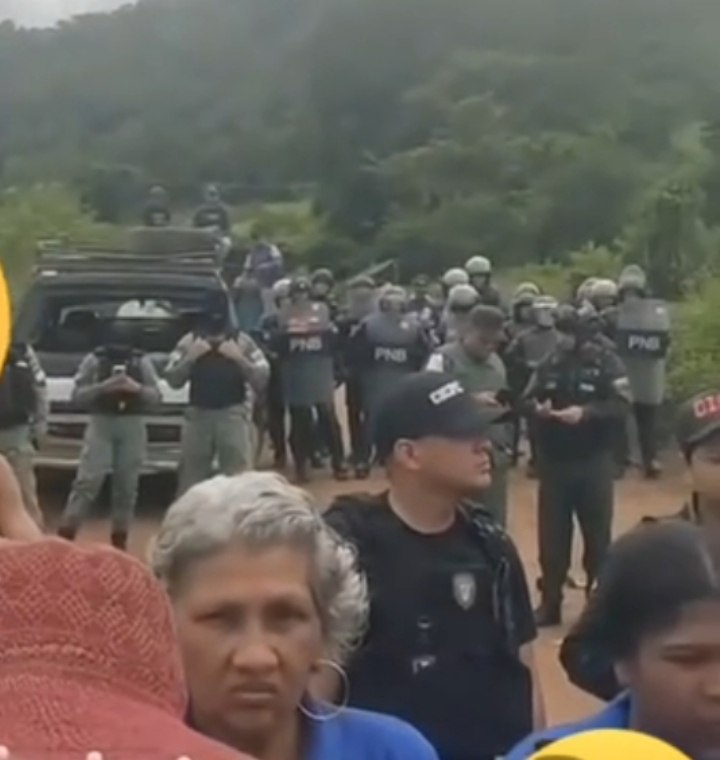
In fact, in June, a “joint” military operation between Venezuela and the U.S. (by land and air) was carried out in the mining areas of Km 88 and Las Claritas (Sifontes municipality, Bolívar), the area with the highest concentration of gold in the country (Area 4 of the AMO) and where the two main mines that have been part of the country’s history of formal/industrial mining are located: Las Cristinas and Brisas. These areas have also been dominated for years by various criminal groups. The operation involved precision airstrikes by the Southern Command at the location where alias “Niño Guerrero,” leader of the Tren de Aragua—accused of controlling part of the mining industry alongside other “pranes”—was located; these criminal leaders fled in the face of the attack[16]. These are selective actions aimed at “clearing” the mining terrain, always with the goal of creating a favorable environment for investors.
Why are certain little-known companies spearheading the new agreements?
There are still no major mining companies involved. There weren’t any even from the start of the AMO, due to Venezuela’s economic collapse, legal instability, the presence of criminal groups, and international sanctions. But the new landscape of U.S. control has yet to attract them. What we are seeing, in some cases, are smaller, independent companies. The long-controversial Gold Reserve is back in the spotlight; it currently operates solely to recover assets and pursue claims against Venezuela.[17] Augusta Capital has emerged as a partner; with few mining assets, it is best known for its ties to industry veteran Richard Warke, who has developed and sold mining companies for multimillion-dollar sums.[18]
In addition to Heeney Capital, we should highlight North American Blue Energy Partners (NABEP) in the hydrocarbons sector—a company founded as recently as 2024 with which the U.S. government signed the “Grand Oil Agreement” that Trump announced in late August with the Rodríguez administration.
Why, then, do these types of companies prevail? Perhaps we could highlight three main reasons.
First, because the largest corporations avoid taking risks in the face of an illegitimate government, with Venezuela’s political situation still undefined, an institutional structure that remains fragile, and, above all, the widespread presence of criminal groups in mining areas. Second, as we have seen, companies like Heeney view complex contexts such as Venezuela’s as a business opportunity, just as entrepreneurs like Warke do. Third, because these companies are establishing ties, deals, and a certain degree of protection from the Trump administration. One of Heeney’s co-founders, Sean Pi, has met with high-ranking officials and figures close to the Trump administration and testified before the U.S. Congress on the strategic importance of the development development of supply chains[19], in line with the current administration’s objectives. A similar situation is reported regarding NABEP CEO Alejandro Betancourt, who had already established ties with Trump’s aides during his first term and became the primary intermediary between Trump and the Venezuelan government[20].
Finally, the question arises: What became of Mibiturven, a joint venture formed by Minerven and Marilyns Proje Yatirim (Turkey) that operated in Chocó and, according to various investigations, had ties to Alex Saab? Has its definitive removal been confirmed?
Unresolved Issues and Persistent Corruption: The Extraordinary Prevalence of Illegal/Criminal Origins of Venezuelan Gold
The fact that U.S. refiners refuse to process Venezuelan gold, and that the transnational corporation Trafigura admits that the gold it purchased from Venezuela is still in storage [21]—despite having acquired it from the most industrialized areas of the Orinoco Mining Arc under Minerven’s management—reaffirms what has been pointed out ad nauseam: that Venezuelan gold is almost entirely of illicit/criminal origin.
Does that matter to the Trump administration? It seems it does, but at the same time, it seems it doesn’t. The Trump administration—specifically the Treasury Department—had sanctioned Minerven prior to the intervention for operating in an area rife with irregular groups involved in gold mining, and for the environmental impacts on the Amazon. But that was suddenly forgotten: in late March, with OFAC’s GL54 and GL55 licenses, authorizations for mining activities in Venezuela—as well as for investments and services—were expanded, without addressing the serious problem of criminal mining that is entrenched in the Amazonian territories. Ultimately, the flow of “dirty gold” continues.
The New York Times noted that the deposits Heeney/Mercuria would have to rely on are even more informal than those supplying Trafigura, and thus carry greater risks of corruption and environmental impact. The prestigious U.S. newspaper also reported that contractors for these mines—who provide services and machinery—paid protection money to local criminal groups[22].
All of this reveals the brutal hypocrisy surrounding U.S. intervention in Venezuela—presented as a fight against organized crime and drug trafficking, and in support of democracy and freedoms in Venezuela. What is actually revealed is a new facet of “crony capitalism” and the ever-blurred and confusing boundaries between what is legal and what is illegal.
Military operations such as the one that took place at Kilometer 88/Las Claritas can, in reality, barely bring about localized changes, given the practical impossibility of eliminating all the criminal structures spread throughout the Amazon region. They can only displace them. The punitive approach has yielded few results (for how many years has the Amazon region been militarized?) and offers little help in addressing a multidimensional and complex problem like illegal mining. It is not enough to simply crack down—which, moreover, has a severe impact on families, women, and children—but rather to tackle the structural causes of this expansion.
Alternatives, Sovereignty, and Democracy
In any case, it must be emphasized that legal mining is by no means a solution or a salvation from illegal mining. There is abundant evidence from numerous parts of the world of the terrible impacts that industrial mining has had on communities and ecosystems. We must identify socioeconomic alternatives for a bioregion as delicate as the Amazon—alternatives that go beyond mining—for the sake of Venezuela’s sustainability. But to tell the truth, to even aim for such a goal, among our first steps must be to restore the country’s sovereignty and democracy and to achieve a political alternative that envisions Venezuela from a holistic perspective, focused on restoring the sustainability of life.
[1] https://rnv.gob.ve/suscriben-acuerdo-cvm-heeney-capital-mineria/
[2] https://drive.google.com/file/d/1o-A2aocfwlSHaXBGmuEUUCK1KRKqmmly/view
[3] https://cronica.uno/tres-municipios-de-bolivar-figuran-como-los-mas-violentos-del-pais/
[4] https://www.heeneycapital.com/
[5] See, for example, Peru: https://gestion.pe/economia/empresas/mineria-panoro-recibe-pagos-por-la-venta-de-proyectos-antillas-y-cochasayhuas-noticia/. Trinidad and Tobago: https://www.prnewswire.com/news-releases/heeney-capital-welcomes-launch-of-us250-million-pinnacle-steel-and-vanadium-redevelopment-project-in-trinidad-and-tobago-302849863.html
[6] See: https://www.bbc.com/mundo/articles/cp822mqz0geo; and https://www.elsaltodiario.com/venezuela/todo-lo-deberias-saber-petroleo-venezuela-no-eres-accionista-repsol
[7] https://mercuria.com/mercuria-and-heeney-capital-secure-strategic-offtake-agreements-in-venezuela-as-part-of-u-s-backed-energy-and-mining-initiative/
[8] https://www.bloomberglinea.com/negocios/esta-pequena-firma-de-wall-street-apuesta-hasta-us1000-millones-por-la-mineria-de-venezuela/
[9] https://www.bloomberglinea.com/latinoamerica/venezuela/tras-8-anos-de-ausencia-el-aluminio-venezolano-volvio-a-eeuu-a-donde-llego-de-cuanto-fue-y-mas-detalles/
[10] https://www.usgs.gov/programs/mineral-resources-program/science/about-2025-list-critical-minerals
[11] https://www.orinoco-iron.com/vpc/html/company.htm
[12] https://www.nytimes.com/es/2026/09/28/espanol/america-latina/trump-oro-venezuela-corrupcion.html
[13] https://www.instagram.com/reels/DX1eyfMCqxk/
[14] https://www.eltiempo.com/mundo/venezuela/delcy-rodriguez-agradecio-a-donald-trump-tras-firmar-la-nueva-ley-de-minas-en-venezuela-buena-disposicion-para-la-cooperacion-con-estados-unidos-3548588
[15] https://www.diariolibre.com/mundo/america-latina/2026/05/22/john-barrett-impulsa-la-mineria-en-venezuela-con-nueva-ley/3543297
[16] https://armando.info/con-la-muerte-del-nino-guerrero-todo-cambio-para-seguir-igual-en-las-minas/
[17] https://goldreserve.bm/company
[18] https://www.bloomberglinea.com/latinoamerica/venezuela/firma-estadounidense-busca-revivir-proyecto-aurifero-en-venezuela-con-inversion-de-us200-millones/
[19] https://docs.house.gov/meetings/II/II06/20260224/118947/HHRG-119-II06-Wstate-PiS-20260224.pdf
[20] https://elpais.com/expres/2026-09-03/quien-es-alejandro-betancourt-el-elegido-de-trump-para-explotar-el-petroleo-de-venezuela.html
[21] https://www.occrp.org/es/notacio/trafigura-compro-oro-venezolano-en-un-acuerdo-historico-con-eeuu-en-marzo-todavia-esta-en-un-deposito
[22] https://www.nytimes.com/es/2026/09/28/espanol/america-latina/trump-oro-venezuela-corrupcion.html
