Photos: Radio Temblor
(Castellano) (Euskara)
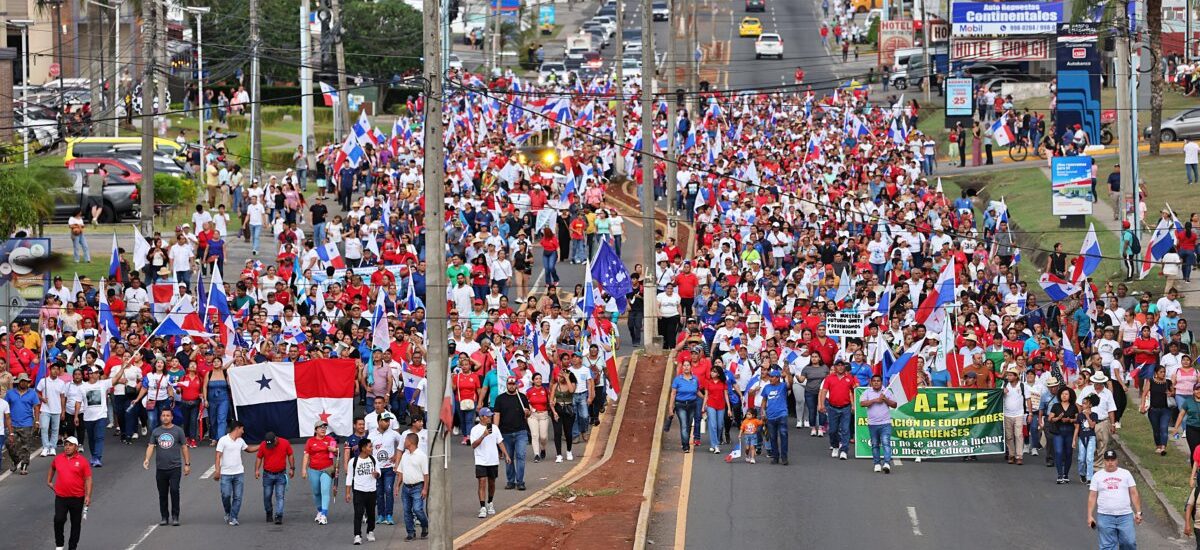
More than 15 days have passed since the indefinite national strike called by different unions of teachers, university students, workers, environmentalists, and peasant and indigenous communities in Panama, whose demands to the government are:
- repeal of Law 462 of the Social Security Fund
- the elimination of the memorandum signed between Panama and the United States
- the non-reopening of the mine
- and the fight for environmental defense against the reservoir on the Río Indio.
This Panamanian scene has also seen the violation of human rights due to dozens of protesters being repressed, detained, and judicially pursued as part of the criminalization of social protest. Hate speech has also been maintained in the media and social networks paid for by the government, the business elite, and the mining companies.
On the other hand, the government disregards the social movement, labeling it communist, leftist, to delegitimize the struggle they are carrying out for social justice and against corruption. In addition, they threaten teachers with deducting their salaries and dismissing them.
Social protest has intensified. But despite this, discontent is growing and more social sectors are joining, even from remote rural areas. Here we share the program of Radio Temblor, which featured the participation of Briseida Barrantes Serrano, sociologist, university professor, Master in Gender and Development, President of the College of Sociology and Social Sciences of Panama, and the educator Luis Arturo Sánchez, General Secretary of the Association of Veragüenses Educators (AEVE).

Olmedo Carrasquilla Aguila (presenter) (Radio Temblor Internacional): More than 15 days of indefinite strike in Panama have passed. On this occasion, we are going to share a radiograph of the mobilizations and citizen demands. More than 15 days have passed since the indefinite national strike called by different teachers’ unions, workers, university students, environmentalists, peasant communities as citizens, whose demands to the government are the repeal of Law 462 of the Social Security Fund, the elimination of the memorandum signed between Panama and the United States, the non-reopening of the mine and the fight for environmental defense against the reservoirs on Río Indio.
This Panamanian scene has also seen the violation of human rights because dozens of protesters have been repressed, detained and even judicially pursued, that is, there is a criminalization of social protest. Hate speech has also been maintained in some mass media, as well as in social networks paid for by the government, the business elite and mining companies.
We are going to share some radiographs in the Panamanian isthmus with the sociologist Brigzeida Barrante Serrano from the University of Panama. Briseida Barrantes Serrano (Sociologist from the University of Panama:
The current reality is showing that the profits of Panamanian heritage are protected by a pro-business, pro-North American, pro-surrender regime, a lack of human solidarity and a lack of love for Panamanian sovereignty. Their interest is focused on privatizing public services in various forms, eliminating or wanting to eliminate the achievements of the majority sectors that have fought all their lives in this country to improve the living conditions for all people in the country.
At this moment, one of the triggers, because there are several, that has mobilized all the popular sectors of the country, the unions, the teachers, the students, is precisely an arbitrary act committed in the National Assembly of Deputies that only 48 deputies, on March 13 of this year, in the third debate, supported and approved bill 163 of 2024 that modified the Social Security Fund Law against the feeling of the great majorities of the Panamanian people who were there, brought well-substantiated proposals, written and delivered, right?
Both trade union organizations and the University of Panama, as well as independent professionals and hundreds of Panamanians who contributed and showed their opposition when it was still a project and did not take a single point or comma from those proposals. On the contrary, the needs to maintain the solidarity system, the no to the increase in the retirement age and to achieve decent retirements for current and future generations were sustained time and again, it was evident that the Social Security Fund was not bankrupt, nor is it, however, the interest of generating more profits for the financial system and the banks with the funds of the Social Security Fund prevailed and created privatizing mechanisms through the so-called individual accounts, leaving out the original character for which Social Security was created, which is solidarity.
Of course, before the failure of having then quickly approved Law 462 of March 18 of this year in the Official Gazette, which is now modifying, adding and repealing Law 51 of 2005, which reforms the organic law of the Social Security Fund and dictates other provisions. That is the fundamental cause against which the thousands of workers of all the unions in the country and the people in general have sat and have been mobilizing, demanding its repeal due to the nefarious implications for the current generation as well as for the future generation.
I wanted to add that the other trigger that comes from 2023, although it is much earlier still, added to this, is the failure to comply with the ruling of the Supreme Court of Justice of November 28, 2023. Let us remember that when this government came to power, the idea of opening to close the mine was sold, as the panacea of a decision that contemplated the programmed abandonment of the Donoso mine, minimizing the environmental impact of the surrounding sites and their population.
Rather, on the contrary, then the transnational First Quantum Minerals plays at creating a kind of mining colonial enclave and its subsidiary in the country, which is Minera Panamá, S.A., seems to be in a permanent advertising campaign, since everyone can see it as it openly tours fairs, shopping centers and other public spaces, as if nothing had happened here, as if there was no mandate from the highest judicial authority, that is, the mining company is there. So I don’t know what they are waiting for so that it is no longer in Panama, because we cannot allow that. So that is there, that is maintained: they are not complying with the law.
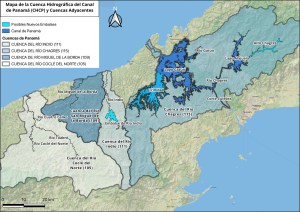
But as if that weren’t enough, and this also has to do with the environmental issue and the right of people to live with dignity, there is the issue of the peasant communities that live in the region of the Río Indio watershed, who have been firmly denouncing for some time the violation of their community rights for wanting to remove them from their lands. They are fighting against the Río Indio reservoir project promoted by the ACP, but they are also offering alternatives so that it can be done elsewhere, where it does not harm people and they are not affected, flooded by the reservoir they want to build, and removed from their lands that they have worked and where they have lived all their lives.
So there is another front, there is another problem there. There is the issue of the mine, there is the issue of the Río Indio reservoir, and to make matters worse, we have here a context that exacerbates and violates the dignity of our nation, that is, the issue of sovereignty through the memorandum of understanding signed by the Panamanian government with the North American government, and also the joint declaration of this government with the United States government, with its representatives, evidently. So they forget the historical trajectory that this country has of fighting to be sovereign, that we do not want to be another colonial enclave and that we have the right to have relations with all the countries of the world, so we are sovereign and sovereign to decide the reins of our country.
In this sense, with all these situations in which we find ourselves at this moment, it is very important to point out that the Panamanian social movement is a movement of struggle, it has unions, associations, that is, it is made up of many characteristics of struggle, right? And that we must support it and continue the struggle to achieve the final objectives and in that sense, at this moment, hopefully we could even manage to concretize a congress for sovereignty that allows us to take out, study the conclusions that we have to have to really build a truly democratic, sovereign, independent Panama and that we can have a dignified life in this country.
Presenter: The assumption of President José Raúl Mulino in May 2024 did not substantially represent a change in Panamanian society, but rather the continuation of the imperious forms of absolute and pro-neoliberal governments post-North American invasion of ’89. Having gone through these sequels, the people are forced to go out and protest against various classic social demands such as poverty, inequality, but above all against corruption expressed in various areas. We are going to share a balance of the Panamanian struggle against the demands presented by Professor Luis Arturo Sánchez, secretary of the Association of Educators of the AEVE, and member of the Panamanian Teaching Movement.
Luis Arturo Sánchez (AEVE):
We started from little to more and what we have seen is that the law is bad, that the law really does not meet the expectations of all Panamanians. What happened in Argentina, what happened in Chile, what happened in other European countries, we are experiencing here right now when they want to take away our social security and where the authorities have wanted to state that the law is beneficial for the people, but it is the opposite because they ignored our proposals when we were on September 16 in the presidency.
Then on October 30, the president came out with a speech that there was going to be sacrifice, that we were going to have, but the sacrifice is to leave us without decent pensions and above all the young people and the new educators who enter the education system because the same law punishes them before 2036. It even leaves it open for the Panamanians to be hit and the age to be increased. There is nothing written that the age will not be increased in that article 139, but we have seen that there are articles that are disastrous such as 168 that creates the pension table, no person is going to endure working until the age of 80-75 years and what they are going to do is retire you before the age and you, by retiring before the age, they are going to apply the pensioning factor that will lead you to live with less than 30% of the replacement rate.
So the government has been lying, we have told the Panamanian people and thanks to the organizations that have opened up and supported us so that we can really see that we must wake up from this, from this law and we have tried to defend the health conditions of Panamanians and pensions. Now the government is aiming for the position of what is the memorandum of understanding that grants to the United States, grants to what the Panamanians have fought so much for and I remember in 1999 on December 31 the Panamanians were happy because even the last gringo had left and this government, this government has made Panama go back almost more than 100 years. Why? Because we return to the military bases and it gives us to understand that the issue of the social security fund was a pretext because what they are looking for is to try to get the United States of America to try to pay off that multimillion-dollar debt it has to pay. So they are submitting the countries of America, the countries of Latin America and the other countries to circumstances that we see are not good and proper to the sovereignty of a country and what we are living in Panama and that is what no country wishes, to see their country full of foreign military bases here.
This brings us more, as we say here in Panama, that they are throwing more wood, more gasoline on the fire because we had the issue of the disastrous law of death and hunger which is a reform they made to the social security fund. They put in the issue of the memorandum of understanding and to top it off we see the president of the republic say that he is going to reopen the mine. In other words, not to take away the land from the peasants of Río Indio to make those reservoirs that we see are against the life of the Panamanian. That is, they want to take everything away from us, they want to take everything away from us.
This protest is taking much more than we expected and we thank everyone because the struggle of the Panamanian people is really accepted. Look, there will be no white smoke here yet because the president has remained radical. He says he is not going to repeal. It is up to us to do what corresponds to us, the struggle in the streets, as we always did from 2022 and 2023. What is dialogue for? If they did not listen to us in the presidency or in the assembly.
We blame the deputies who signed that law, the deputies. So, what is dialogue for? If what they have to do here is the same as they did in 2005. They suspended the effects of law 17 and made law 51. And that is what we have to do here so that this country is at peace.
- Presenter, Olmedo Carrasquilla:
We thank the sociologist Briseida Barrantes Serrano of the University of Panama and Professor Luis Arturo Sánchez, secretary of the Veragüenses Educators Association AEVE, and members of the Panamanian and Popular Teaching Movement. And in this way we come to the end of the evening broadcast of the Latin American Association for Education and Popular Communication ALERE. Your friend and servant Olmedo Carrasquilla Águila of Radio Temblor Internacional bids you farewell. This southern contact is possible thanks to a wide network of correspondents. Popular communicators from the Latin American Association for Education and Popular Communication ALERE in all of Abyeyala. Southern contact.
