Emiliano Teran Mantovani (Venezuelan Observatory of Political Ecology)
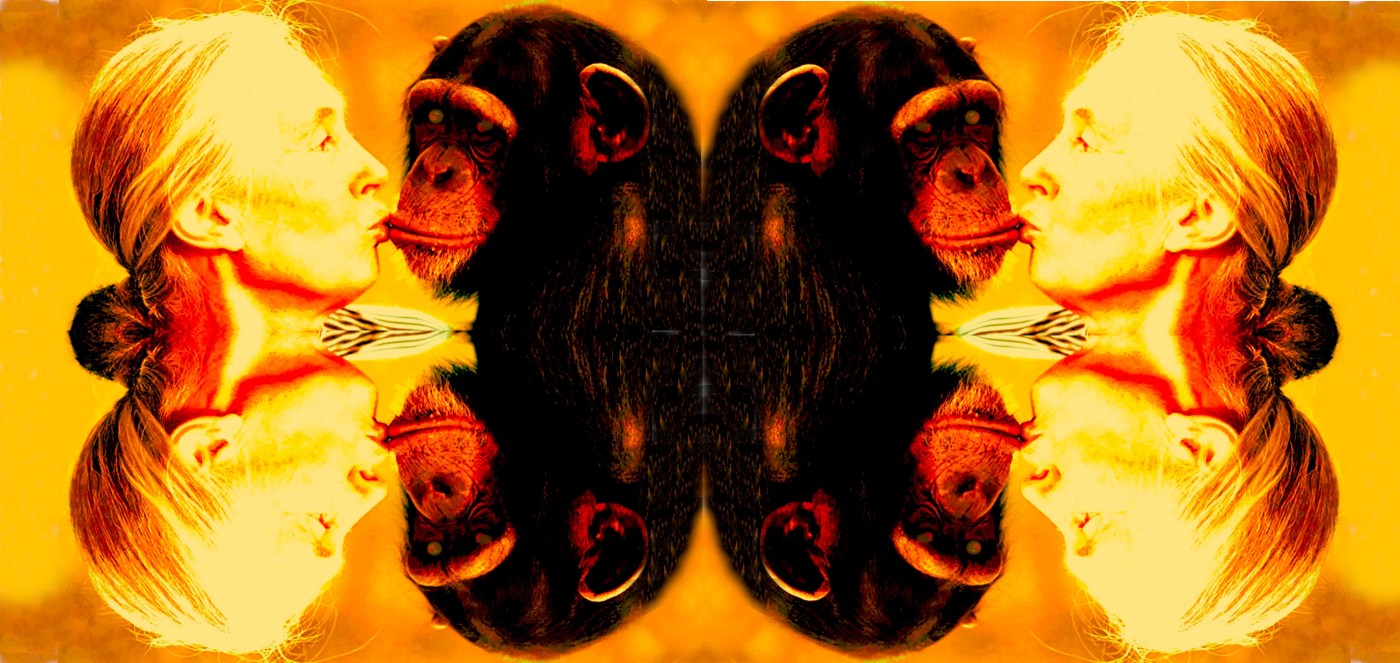
Main image: A Planeta
(Castellano) (Euskara)
A crisis as profound as the one we are experiencing on a planetary scale should lead us to ask fundamental, existential questions about our ways of being and existing on Earth; about how we relate to nature. Government policies are becoming more indolent and acts of ecological destruction are on the rise. But this does not mean that we should reinforce the idea of “humans” as innate predators of nature. In this article, I attempt to demystify this idea and show the pluriverse of knowledge and social expressions that today, despite this context, are developing other ways of being and existing with Nature. They show other facets of humanity. From the memory of the work of the recently deceased ethologist, Jane Goodall, I also reflect on the idea of redefining the human.
Against the backdrop of the global chaos we are experiencing, there is a crisis in the very sustainability of life, at least as we know it. And I am not referring only to human life: in the current planetary crisis, fundamental ecological structures are being shaken, with accelerated loss of biodiversity, massive disappearance of forests, severe processes of pollution and environmental poisoning, and climate disruption that is bringing us closer to more extreme events.
Such a profound crisis should shake us up and, above all, should lead us to ask fundamental, existential questions. Questions about something as essential as our ways of being and existing on Earth; about how we relate to nature, and about our conceptions, worldviews and epistemic paradigms, our ways of knowing.
What is clearly evident is a dominant pattern of objectification of nature, turning the extraordinary richness of the webs and cycles of life into nothing more than a “natural resource”, “raw material” for export, or a marketable landscape. In this pattern, we have become deeply divided from nature and, instead, have set ourselves up as its supposed owners and masters. A predatory way of relating to Life has been established and institutionalised, which has progressively led us to this compromised planetary situation. Today’s government policies starkly reveal this pattern, and even its intensification. The extreme right, which includes Donald Trump, Javier Milei, and the former government of Jair Bolsonaro, has even gone so far as to deny the existence of environmental and climate problems, abolish policies and ministries on the issue, radicalise the exploitation of nature, and perhaps worst of all, convincing their followers that these issues are nonsense and part of a “woke” or “communist” conspiracy to prevent growth and development. Other slightly more moderate right-wing governments have followed a similar pattern, such as Daniel Noboa in Ecuador and Rodrigo Cháves in Costa Rica, who have downplayed environmental issues.
But this is not exclusively a right-wing issue. In fact, in the progressive tradition and among the majority of the left, despite their narrative of popular transformation, and in some cases even their advocacy of “Mother Earth rights” and “eco-socialism”, they have also imposed this predatory and divisive relationship with nature, continuing the plundering of territories through the expansion of extractivism. In recent years, to mention some recent examples, Luis Arce in Bolivia unfortunately promoted the expansion of soybean cultivation with the resulting massive loss of forests; Andrés Manuel López Obrador imposed the Mayan Train, causing major impacts on the rainforest and the fragmentation of ecological corridors; Nicolás Maduro in Venezuela aggressively established the Orinoco Mining Arc in the Amazon, and recently Lula da Silva in Brazil has granted oil concessions at the mouth of the Amazon.
As we can see, there is something underlying this that has nothing to do with ideology. There is a shared aggressive mandate of ecological plundering and colonisation, which is also embedded in the prevailing imaginaries, and at this existential crossroads where we find ourselves as a Planet, it is urgent to question and counteract it if we want to preserve the minimum conditions for life on Earth.
These shared patterns have led some to assume that “humans”, in an abstract sense, are a species that is inherently destructive to nature, the “virus” of the Planet – as was repeatedly heard during the COVID-19 pandemic – “man as wolf to man”, and lately, as a “genocidal species”.
This idea needs to be problematised.
The myth of “humans” as innate predators of nature and ontologies in dispute
The idea that humans as a species are natural and inevitable predators of their ecosystems, presented as a particular political ontology, is not only part of common sense in certain sectors of our societies, but also fits into traditions of Malthusian thought, Garret Hardin’s “tragedy of the commons”, Paul Collier’s “greed” paradigm, among others, as well as the predominant perspectives in Western political theory, with its Hobbesian roots, which are based on the idea of the voracious and predatory nature of “man”.
Furthermore, a generalisation of the species is often established, erasing the notable cultural and worldview distinctions among the different human groups that populate the Planet. The highly suggestive concept of the “Anthropocene”, which points to a new geological era in which “humans” are the main factor generating the drastic changes that the Earth is undergoing, has been the subject of controversy precisely because of this homogenisation of anthropos and, therefore, of those primarily responsible for the serious crisis we are experiencing. Hence, concepts such as Capitalocene, Plantationocene, Phallocene, Occidentalocene, among others, have been proposed as counterpoints.
By universalising this diversity, this tradition is not only deeply deterministic, but also conceals the fact that, rather than a reflection of all that is human, it is the particular expression of the prevailing model of civilisation. This model has been established through the imposition and colonisation of the Planet’s cultural and biological diversity; of subjective homogenisation and a tendency towards individualisation; and which has established a structure of power relations over all this otherness to facilitate the occupation of territories and the massive appropriation of nature, the exploitation of peoples in much of the Planet’s geography; and, in contemporary times, the accumulation of capital, the rise of consumer societies and the urbanisation of much of the world.
-
See also: Anthropocene and human interaction: the need to transcend predatory relationships
Understanding socio-ecological relations from this perspective also has several implications. First, concealing the real causes and perpetrators of the planetary ecological crisis behind the generality of “the human” and a supposed natural condition of being avoids confronting these factors and actors and, therefore, addressing the necessary systemic changes. Second, the category of “predator” can be attributed to the “savage”, who in the colonial worldview are usually racialised subjects, the impoverished classes and the inhabitants of countries in the Global South. From this perspective, it is generally the poor, the peasant, the “Indian” or the “black”, the migrant, the “Latino” or the African who prey, rather than the transnational corporation or state institutions, which “follow technical procedures” and are invested with formality. Third, the universal idea of humans as innate predators actually disregards any capacity for care, conservation and restoration that social groups may have. Fourth, and ultimately, this perspective is currently in line with extinctionist conceptions of humanity – “to save the Planet, we must eliminate its main and only predator” – which in these times of crisis have been gaining dangerous ground.
As a counterpoint to this tradition, I could refer to some critical perspectives, such as Piotr Kropotkin’s mutualistic evolution – which has been opposed to the predominant social Darwinism –, Murray Boockchin’s social ecology, or various views of theories on the commons, all of which conceive and emphasise the inherently cooperative factors that also exist between the different species that make up and enable the reproduction and historical sustainability of ecosystems, including humans. However, I will emphasise Latin American territorial experiences, which offer a wealth of contrasts and possibilities with regard to other relationships with nature, and which show that humans do not have a univocal condition.
I have been fortunate to have travelled extensively throughout Latin America, interacting with communities, academics, and social organisations dedicated to the defence of nature. A recurring theme that I observed in many of these territories refutes this idea of humans as predators. I have seen forests created by communities or environmentalists, such as the Mindo-Nambillo Ecological Reserve in Ecuador. I have met the creators of protected areas, such as the communities of Sarare (Lara state, Venezuela), who turned Cerro La Vieja into a municipal park and are fighting to have it declared a natural monument.
Creators of protected areas, such as the communities of Sarare (Lara State, Venezuela) who turned Cerro La Vieja into a municipal park and are fighting to make it a natural monument. Reproducers and restorers of mangrove forests, such as the experience of Asprocig in the lower Sinú River, in the Colombian Caribbean. Long-standing defenders of rainforests, such as the community members of the Tariquía Flora and Fauna Reserve (Bolivia), who today are also resisting the advance of hydrocarbon exploitation.
I have also met numerous guardians of water, who are fighting against the degradation of this common good, which serves the entire web of life. Defenders of rivers, from the interesting movement for the rights of nature in Ecuador, which among other actions achieved the recognition of the Machángara River (Quito); or the different communities that have joined the Ríos Vivos Movement in Colombia. At sea, there are the fishermen who defend Guanabara Bay in Brazil. There are also water sowers in the state of Mérida or defenders of the la Reina lake in the state of Miranda and the Urao lake in the state of Mérida (all in Venezuela).
I have met many groups that preserve seeds; defenders of spectacled bears in the state of Lara (Venezuela) and in the Andean Chocó (Ecuador); or those who provide homes for hummingbirds and tangara birds.
-
See also: Defenders of the forest, water and spectacled bears reforest in Humocaro Alto (Lara)
These are expressions that can be found throughout Latin America and the Caribbean, and indeed throughout the world. They represent other ontologies, other ecosophies and ways of conceiving and relating to nature, which debunk the myth of an absolutely predatory ontology, not to propose a romantic perspective or another form of determinism, but to clarify the possibilities of other ways of being and existing on Earth, different from the civilisational pattern.These are ontologies in resistance, in dispute, as Arturo Escobar has argued. It is no coincidence that in these times of aggressive advances in extractivism, we are witnessing a very recurrent increase in the criminalisation of environmental activists and indigenous peoples. They are the front line of defence for life on the Planet, and unfortunately, it is in Latin America where most of them are killed. Silencing their voices also means silencing those other worldviews and ways of understanding our relationship with nature.
Redefining humanity with nature: remembering Jane Goodall
From the 1970s to the 1980s, the work that the recently deceased British ethologist Jane Goodall carried out with chimpanzees caused a great international stir. In numerous interviews she gave, the question of whether we were similar to chimpanzees, and to what extent, was asked repeatedly.
Perhaps the insistence of these questions revealed, in a very subtle way, the curiosity of a Westernised world that had become alienated from its own animal nature. A world that, perhaps, deep down in its unconscious, was seeking bridges to its ecological roots; who knows if it was trying to understand its own orphanhood with regard to Mother Nature.
A very provocative and wonderful question raised by Goodall’s work could be this: understanding chimpanzees, not so much to reinterpret our relationship with nature, but to redefine what it means to be human.
Goodall was like a bridge, a little as if she herself had become more chimpanzee, as someone who could inhabit and speak the language of those two “worlds”. And that bridge was, therefore, two-way: chimpanzees are like us, they use tools, they experience adolescence, they hug and kiss, they wage war. We, therefore, are also like them.
That bridge implied a twinning; a twinning that was strange to Westernised humans, but a twinning nonetheless. The recognition of our basic mammalian condition, our animal nature. Twinning to create an inter-species community, as she did. Living together, with care and mutual respect for the environment, knowing that we are part of it.
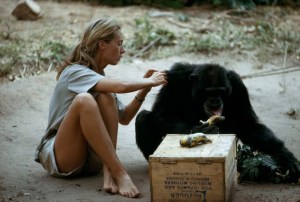
The chimpanzee, at the end of the day, has also been an excuse to re-approach the whole range of species.
What, then, does it mean to redefine what it means to be human? The first thing that comes to mind is the need to overthrow the arrogance of modern Western humans and return to being just another species among many. It is humility that we lack in our relationship with nature, to step out of that position, to stop mistakenly believing that we are its owners and masters. Redefining what it means to be human, in the midst of this planetary crisis, is a profoundly revolutionary idea.
But there is more: Goodall’s relationship with chimpanzees shows us a pedagogy of the animal towards the human. Their ways of relating to nature give us lessons, teachings, answers on how to be.
Their ways of relating to nature teach us lessons and provide answers on how to be and relate to the whole. Goodall went so far as to say that chimpanzees had made her a better mother.Thinking about this pedagogy could go beyond animals: it can also be considered a pedagogy of plants, as indigenous wisdom has shown.There is one last point to highlight.
This connection of kinship and reciprocity always has the potential to become political: by forming a community with chimpanzees, Goodall became aware of the environmental impacts affecting their vital ecosystems and putting them in danger of disappearing. That empathy led her to take a political stance and become an activist.
Her political commitment to chimpanzees extended to everything, not only to other species and the defence of the forest, but to the entire Earth. It is about the consolidation of an environmental ethic. Not surprisingly, in one of her last interviews, she suggested the need to grab a rocket and send Trump, Xi Jinping, Elon Musk, Putin, Netanyahu, etc., off this Planet.
Observatorio de Ecología Política de Venezuela: We are an environmental research and activism organisation with an ecopolitical and ecosocial perspective.
