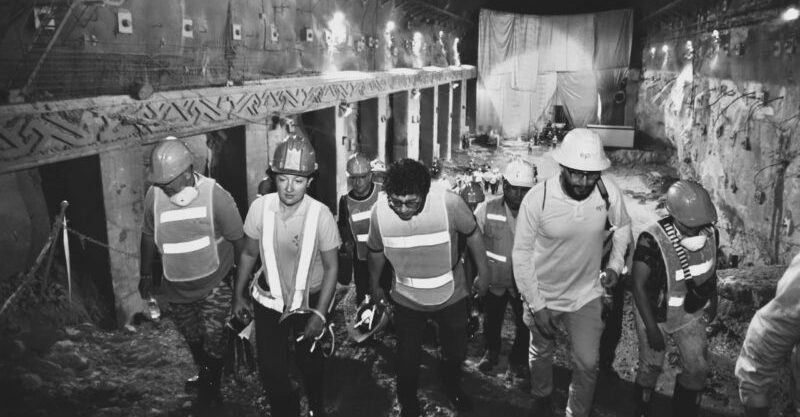
After our tour of the Hidroituango hydroelectric project between 29 July and 1 August, we were able to confirm that the planning of the project continues to have serious difficulties and a lack of transparency. It is necessary to review the pre-feasibility plan, the acceleration plans and other design change decisions related to the early and forced filling of the reservoir, the emergency upstream and downstream caused by the project, the activation of slopes, the changes in the environmental licence and the multiple sanctions by the National Environmental Licensing Authority (ANLA) that have not resolved anything.
It is clear that Empresas Públicas de Medellín (EPM) does not generate concrete and restorative proposals, it limits itself to minimal interventions established in the requirements demanded by the Authorities, many of which have not been complied with and which have resulted in sanctions against EPM. Furthermore, the company pretends to show these interventions as if they were part of a proactive and preventive approach, forgetting that it is a process of correction and mitigation of a series of disasters caused by themselves in complicity with Hidroituango S.A. and that knowledge and repair measures have not yet been implemented.
It is evident that the entire construction is based on experimentation and the works have no precedents in the world, such as the plugging of the diversion tunnels, the bypass, the dam wall, the early and forced filling, among others. Therefore, we are faced with what for the engineers is an «engineering feat» but for the communities is an «unconsulted experimentation that increases the risk» by not having a process of comparison and verification of these methods and structures; we are forced to put our lives and that of the territory at risk, a fact that we reject. Even so, EPM claims to know the project because it is modelling and taking data from its monitoring, as if the monitoring solves the risk, but it ignores the history and culture of those of us who are canyoners and have been in the territory for several generations and know it from our knowledge.
Among other things, we note that areas such as the powerhouse for turbines 5 to 8 and beacon 2 have been completely destroyed since 2018 due to the disaster. We do not understand how EPM claims that, as of March 2024, the project had a construction progress of 92.66%.
On the other hand, we note that sediment management is considered by EPM as an action plan, however, it is not taken into account as a factor of possible instability of the work, the massif, the strength of the dam wall, the useful life of the project or its eventual dismantling, therefore, they do not have a definitive plan for sediment management associated with the removal of materials and clogging of the reservoir. In this sense, the level of sediment is not considered within the risk scenarios, which is burdensome for the communities, in addition to the ineffectiveness of the Early Warning System, which should be an institutional and community system, not just a monitoring or instrumentation system.
We are also offended and concerned that EPM claims that the dam has improved the water quality of the river downstream, ignoring that the project is not a water purification system and that a river is not only made up of water but also of sediments and all the natural hydrogeological movement of a body of water as an ecosystem.
We conclude that there is no certainty that the rock massif is stable and, therefore, it is imperative that a specialised and independent third party carries out the corresponding study on the stability of the rock massif of the Hidroituango project within the framework of the precautionary measure order number two issued by criminal court 75.
We urgently call on the ANLA not to perpetuate its harmful action by inexplicably continuing with a study that it ordered and did not comply with from the beginning.
Rivers for life, not for death!

