-
May–September 2026
Re-Read, 13 Segundo Izpizua, San Sebastián
-
Below, the guided tour of the exhibition
-
Poster (PDF)
(Castellano) (Euskara)
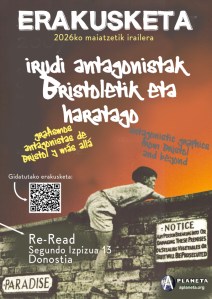
A collection of posters and images from the anti-globalization scene in Bristol and beyond from the late 20th century and early 21st century.
This exhibition of posters and other graphic works draws from a collection curated by A Planeta. The central theme is Bristol, because although many of the pieces were created for events in London or elsewhere, they all stem from the movement that originated in Bristol—and more specifically from Kebele/BASE. Bristol is known for the artist Banksy or for its music (Massive Attack, Smith & Mighty, Tricky, Reprazent, Portishead), but above all for hosting a vibrant political scene that took shape in the late 1990s and early 2000s. The exhibition also captures an interesting blend of music and culture with the most radical politics.
Bristol, in the wild wild West
Bristol has a long history of uprisings. In 1793, a major rebellion broke out over the imposition of a toll on one of the bridges. As a result, the police killed 11 people. Similar conflicts occurred in 1809, 1831, 1932, 1944…
In 1926, Bristol and the southwest of England were the scene of the largest labor mobilization in their history: a nine-day general strike in support of the miners, as would later occur in the 1980s under Thatcher.
Especially after World War II, a new component was added to the situation of economic and social inequality: racism. Until then, racism had justified the oppression of some people by others through slavery, which brought so many benefits to Bristol’s elite. But while that was happening far away in the colonies, many of them were now settling in the metropolis. And we must remember that many of them had fought and died in the war as British soldiers. As a result of this racism, a bus boycott took place in 1963, coinciding with the civil rights movement in the U.S.
Conflicts over racial issues continued, such as in 1980 and 1982 in the St. Pauls neighborhood. Also in 1992, in Hartcliffe.
In the 1990s, the political reality of the United Kingdom was characterized by the implementation of Margaret Thatcher’s neoliberal measures. Among them, the introduction of a new tax, the Poll Tax, sparked a strong backlash.
In 2011, there were riots at a squat on Stokes Croft, the street where Banksy’s massive “Wild Wild West” mural (1999–… and it’s still there!) stands. And again in 2021, during the “Kill the Bill” campaign (a play on the title of Tarantino’s film Kill Bill), the bill that would have given the police more power to make indiscriminate arrests and increased violence.
This is how Bristol has continued to this day: large demonstrations against far-right extremists, in solidarity with refugees, against racism and its ties to the city… As demonstrated in 2020 (in the midst of the pandemic!) with the toppling of the statue of the slave trader Colston; or by stopping the far-right extremists who were threatening a hotel housing asylum seekers in 2024 (Trump’s current ICE operations bring to mind similar images).
And large solidarity demonstrations for Palestine (Bristol also has a museum on the Palestinian genocide!), Lebanon, and Rojava… For Indonesian prisoners… which follow a long history of mobilizations against the wars in Afghanistan, Iraq, etc. In Bristol, moreover, there is the Ministry of Defense and with it, another military industry (Rolls-Royce, Aerospace).
And other activities take place ceaselessly, such as the latest Radical History festival, held in April, or the new anarchist fair, now in May. And the autonomous center BASE (formerly Kebele) has already turned 30!
Antagonistic, anti-globalization… anarchist
This exhibition is antagonistic because it expresses opposition—a series of things we want to change. But over the years, we have also sought to move beyond both that label and that approach: we are not merely against things, but we are proactive and propose alternatives; we want to create them and we build them, even if this sometimes goes unnoticed (even by ourselves) or if the urgency to act often forces us to react rather than act. In essence, we are antagonistic to the capitalist system, although the term “anti-system” has been corrupted and used pejoratively by associating it with violence. To this, in addition to more positive proposals, we could add anti-heteropatriarchal, speciesist, and racist/Eurocentric antagonism.
Or we could have framed it as anarchist or libertarian (snatching the concept away from repugnant figures like Milei). The main reason for not doing so is that none of the activities publicised in these poster (except the Anarchist bookfairs) had been organized as such for many reasons. Despite being organized from that political perspective, most have tended to seek approaches that are as inclusive as possible and in which ideology and personal stances are not as important as the goals themselves.
We considered defining it as “anti-globalization,” which refers to the slogan “another world is possible,” alluding to a world without the oppression of the many by the few. Perhaps that would be more positive? Or “anti-globalization”? But perhaps these concepts better convey the movement against major international financial institutions and their terrorist policies. The fact is, however, that many of the posters included here fall under those categories.
Decades marked by neoliberal policies
In the 1980s, the debt crisis occurred, accompanied by structural adjustment plans—a way to make certain governments pay (only those with the least ability to do so, those most in dire straits) by imposing unbearable conditions on them. The effect of these decisions led to social fracture, the impoverishment of millions of people, and a massive migratory exodus. All of this took place under the direction of entities such as the International Monetary Fund (IMF), the World Bank, the G8, and others. What became clear is that instead of preventing economic, social, and environmental disasters, all they did was exacerbate them and further concentrate the power of the few who held it before.
Although the roots go back a long way, certain dates stand out, such as 1999 with the G8 summit in Cologne (Germany), accompanied by protests organized around the world (including in the Basque Country) using new approaches that were more festive but also more confrontational. The Carnival Against Capital in London stood out, and we’ve included its poster here.
That year, another major protest burst onto the scene, right in the heart of the beast, in Seattle (United States), against the WTO. The results are there for all to see. The fact that someone foresaw it and traveled all the way from Bristol to experience and document it only underscores the high expectations and the force with which the movement had burst onto the scene. Si Mitchell, a punk and journalist for the Big Issue (a magazine for the homeless in the UK), flew all the way there—true to DIY culture—to show what this was all about. Then, as on many other occasions, we showed the video in Kebele and in different places and continued in this way, as they say, creating critical mass.
Then came the 2001 G8 summit in Genoa with drastic results… the one in Biarritz in 2019… And so on until today. Undoubtedly, this journey is important for understanding the direction things have taken and where we’ve been up to now. So much effort, so much imagination, so much courage to confront this monster that today seems more despicable than ever. That is why we believe this exhibition is necessary—not only because it showcases graphic works that may be unfamiliar to us due to their origin, but also because they are historically significant.
The posters and graphics on display:
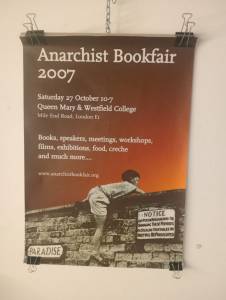 London Anarchist Book Fair 2007 (D. Hunter). The London Anarchist Book Fair began in 1981, making it one of the first of its kind. It has since been replicated around the world, with events also held in Bristol. This is, therefore, the poster for the 26th edition.The posters from the 1990s (1991–99) were created exclusively by the quintessential anarchist illustrator Clifford Harper. These are therefore from a later period, but as you can see, they are by no means lacking in creativity and flair.The Bookfair, in addition to being a place to display publications, was an annual gathering for ideological exchange and discussion of the latest campaigns and resistance movements, featuring numerous workshops, a daycare center, and the usual gig. We participated with a stall for Bristle (a Bristol fanzine) and Kebele (BASE).
- Dutch anti-NATO poster: “NATO Missiles Out – Returned to Sender”
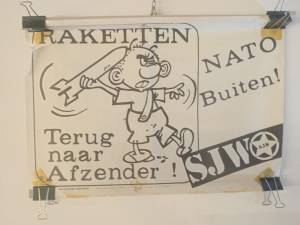
At this moment of widespread questioning of NATO, but also of the value of military coalitions and protection based on militarism, this Dutch poster from the 1980s takes on new relevance. It reminds us, also, that this approach was already rejected here in the Basque Country in 1986 following a major movement parallel to the anti-militarist and anti-conscription movements (Insumisión). Similarly, those protests have now been replicated in the Netherlands in response to NATO’s potential involvement in an attack on Iran. 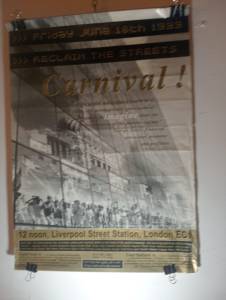 Carnival Against Capital (also known as J18) was an international day of protest held on Friday, June 18, 1999, timed to coincide with the 25th G8 summit in Cologne, Germany. The carnival was inspired by the “Stop the Cit«” protests of the 1980s, “Peoples’ Global Action,” and the “Global Street Party,” which took place at the same time as the 24th G8 Summit in 1998 in Birmingham. The rally’s slogan was “Our resistance is as transnational as capital.” An estimated 5,000 people marched past the London International Financial Futures Exchange. From these experiences emerged Reclaim the Streets, as an initiative for direct action, the reappropriation of space, and social empowerment (see: Anarchist Techno Attacks (CrimethInc.)). Its success led to various actions being replicated and the same formula being used for the protest against the G8 in 1999. At Bristoly Kebele (BASE), we support and organize locally. As the poster shows, protests took place simultaneously around the world, including the Basque Country.
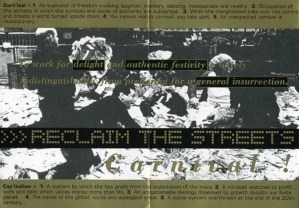 By the way: a correction to the Wikipedia entry on Reclaim the Streets: At least two editions were held in Bristol that are not included. Kebele actively participated in both in various ways (logistics, organization, catering, etc.). The first, in 1997, was a resounding success, blocking traffic with an incredible party at the Broadmead traffic junction. The second was shut down by the police, who took it very seriously so it will not be repeated. But skirmishes spread throughout the city, making the failure relative. In 2020, Extinction Rebellion organized another one that was canceled because of pandemics.
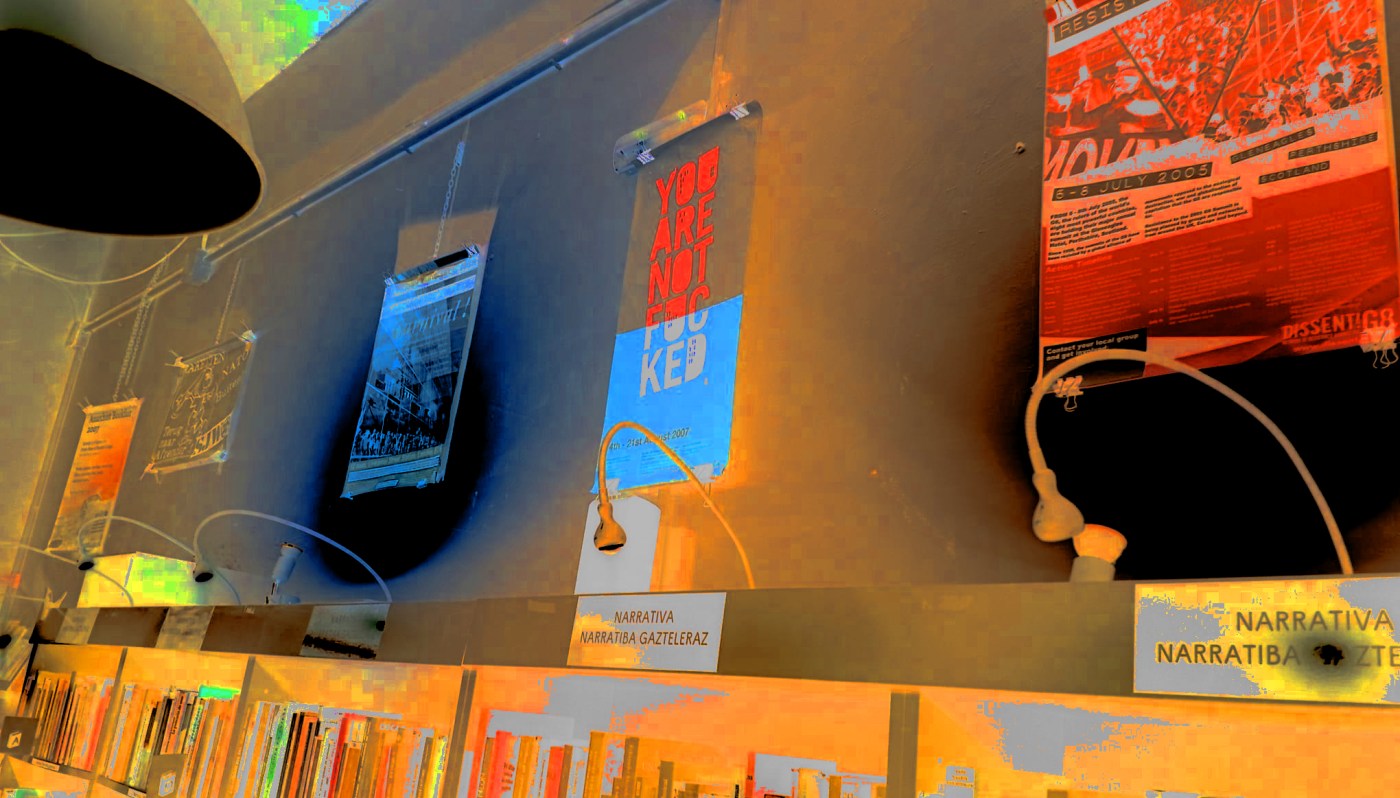
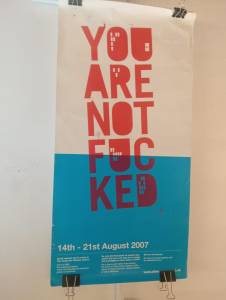 “You Are Not Fucked.” Undoubtedly, one of the new developments in the anti-capitalist movement in recent decades has been the inclusion of climate concerns on the agenda. Due to the scale of the impact associated with the accumulation of greenhouse gases, we were forced to take action. And that has been the trend so far, because in addition to having to introduce new variables into our discourse, we have had to confront pseudo-solutions and capitalist co-optations that do nothing but obscure our goals and discourage the public. In 2007, you had camps to choose from or plan your summer around: the “No Border” camp in solidarity with refugees in September or the climate camp in August.
Another clever poster with a more than ironic touch (English humor?): “You’re not fucked.” Or as the small print adds: “Unless we come together and get ready to act.” The word “fucked” enters the blue space of the poster, in the water, symbolizing the flooding associated with extreme weather events caused by the climate crisis and rising sea levels, which pose a latent threat to many ecosystems, populations, and countries.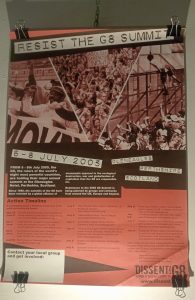 Resist the G8 Summit: Another poster against the 2005 G8 summit in Gleneagles (Scotland), with the subtitle “ABOLISH CAPITALISM NOW!”. The poster announces numerous activities related to these projects, including struggles for land (permaculture), ecology, and campaigns against war, poverty, borders, and globalization, as well as against sexism and homophobia. Among the actions carried out were occupations of the nearby Faslane nuclear submarine base and protests against the Dungavel detention center (near Glasgow), with the main action being the blockades of the G8 Summit itself. The protest was also organized in a decentralized manner, taking place simultaneously in towns and cities around the world.
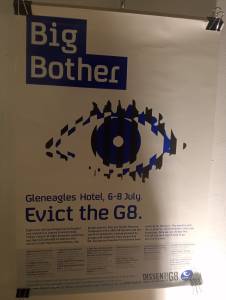 “Big Brother / Evict the G8” poster. One of the largest protests since the formation of the G7, expanded to the G8 with the addition of Russia in 1997 to Canada, France, Germany, Italy, Japan, the United Kingdom, and the United States. In Bristol, and more specifically at Kebele (BASE), meetings were organized—when the meeting’s content wasn’t highly classified, as we had indications that Kebele (Base) would be the first place kept under surveillance—by activists who were due to travel to try to paralyze the summit or evict (in a clear reference to the squatter movement) those gathered. The advertising campaign revolves around the theme of surveillance. “Big Bother” is a play on the phrase “Big Brother», term coined by George Orwell in his seminal dystopian novel “1984” to refer to the system that monitors and exercises absolute power over citizens. It was later used as the name of the series that has since become known as reality TV shows. The poster’s logo was also that of the program. In the United Kingdom, they began in 2000, and by that year (2005) they had already made a clear impact on the contestants and the population (see Owen Jones’s “Chavs. The Demonization of the Working Class» by Owen Jones—starting on p. 151).
But in addition, from Kebele (BASE) we organized the demonstration that would take over the city center, in what was one of the city’s largest anti-globalization events ever. And then, the meetings and activities continued, as there were numerous people arrested, some accused of vandalism, whom we had to support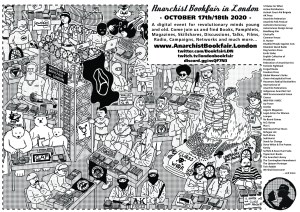 Poster for the 2020 London Anarchist Book Fair, like that entire year, marked by the coronavirus pandemic and restrictions. However, despite directly affecting our movements, it did not mean we were silenced entirely or that we abandoned the struggles. That year’s poster was once again spectacular.
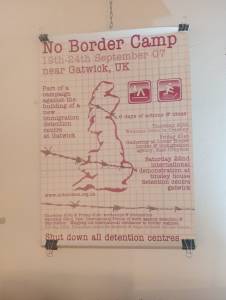 Poster for the “No Border Camp”: The 2000s can be defined as the decade of great hypocrisy, if that can even be considered a novelty. But it does take on a new hue: a self-proclaimed, supposedly left-wing, proletarian party (Labour!) spearheaded Operation Enduring Freedom, a war in Afghanistan in 2001 alongside one of the most reactionary governments, that of Bush in the U.S., and then in 2003 another war against the people of Iraq. As a result of these wars and the supposed establishment of democracy in those countries, thousands of people were forced to flee. But the UK government, led by the progressive Tony Blair, closed its doors to them and deported those who did enter in the most despicable manner – Blair’s Third Way! Campaigns in support of refugees spread, targeting detention centers, the companies set up for that purpose, and deportation flights. One such effort was the 2007 “No Border” Camp, near one of the airports from which deportations were carried out, Gatwick. The goal was to prevent the construction of a new immigration detention center and included six days of actions and debate.
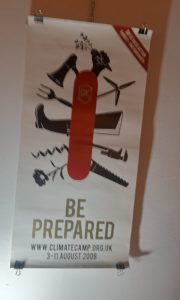 “Be Prepared”: the slogan for the 2008 climate camp poster. This is the motto of the Scouts (notes Pablo), founded by Baden Powell in the United Kingdom (we won’t delve into analyzing this Eurocentric colonialist). Alongside the motto is an equally evocative graphic: a multi-purpose knife, a clear allusion to the survival ethos promoted by the Scout movement. But in this case, its uses are more rebellious, including loudspeakers for demonstrations, tools sustainable agriculture, or even wreches… for sabotage.
- Engraving on the impact of the embargo against Iraq by Emily Johns. A man sells his own scarce belongings on the street to cope with the hardship.
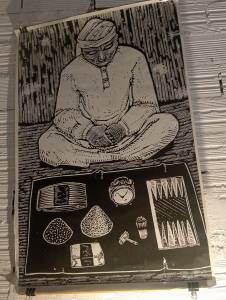 Iraq had already been under an embargo since 1990, following the invasion of Kuwait and the first Gulf War. This embargo remained in place until 2003, having a dramatic effect on the population. Because, like all embargoes, they are imposed with the aim of provoking the population—faced with the hardships to which it is subjected—to rebel against its authorities. However, these authorities have always built a vast power structure against which it is nearly impossible to act. Thus, the population suffers not only the imposed restrictions but also unprecedented repression. In Bristol, activists focused on the campaign against the embargo.
An artist, Emily Johns, began to put her art to work for the campaign. This made it possible to draw attention to the horror caused by the embargo in a more accessible way. The exhibitions of Emily Johns’s prints served to showcase her art while also bringing to light an issue that had received little attention in society. We organized an exhibition in Kebele and another at the Easton Community Center, for which we enlarged some of her woodcuts like the one displayed now.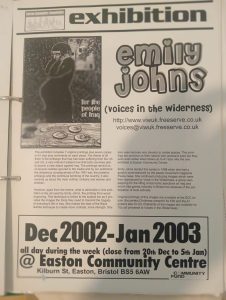
Soon, the capitalist forces led by the U.S. and the United Kingdom (later joined by the Aznar government to facilitate the use of military bases) began pushing the narrative of weapons of mass destruction—that lie they used to justify bombing and mass murder.
Thanks to that earlier campaign against the embargo, in Bristol the condemnation of that massacre, the hypocrisy, and the cowardice of these governments—encouraged by the big oil companies—was very strong. The rallies against the attack on Iraq were daily!!! For several years!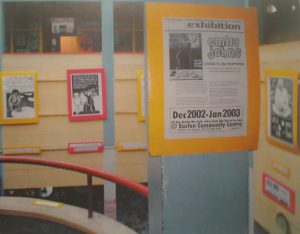 The peak was in 2003, when the nationwide protest was massive. Alongside the protests, there were actions against military installations, acts of sabotage, etc. A resistance that had deep roots (Greenham Common, Ploughshares) and which, in this case, was forced to continue afterward and up to the present day (Palestine, Lebanon, Iran). The same protest (and others) in the same place (and others).
 - Poster for Kebele’s benefit for Satpal Ram and the 5th May Group
March 30, 2001 @ Easton Community Centre, Bristol.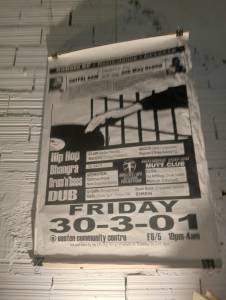
SATPAL RAM & 5th May Group Benefit @easton community centre The day before, the 5th May Group gave a talk at Kebele on March 29, 2001, at 8 p.m. The 5th May Group is a group of Turkish and Kurdish anarchists in exile (mainly in England). On May 6, 1972, three young anarchists (Deniz Gezmi, Hüseyin ðnan, and Yusuf Aslan) were hanged by the Turkish military regime. The group took its name from that day while their comrades were still alive and kicking. Since then, many of their comrades, fearing the same fate, went into exile.
Satpal Ram is a British man accused and convicted of the murder of Clarke Pearce in Birmingham, England, during a racist attack in 1986. Satpal claimed self-defense on the grounds that he was of Bengali origin. on top of that, Pearce refused treatment at the hospital. Neither of these facts was taken into account when sentencing, so we considered the case as a miscarriage of justice due to his racial background. His case was the subject of a song by the Asian Dub Foundation. Satpal Ram was released in June 2002. - «
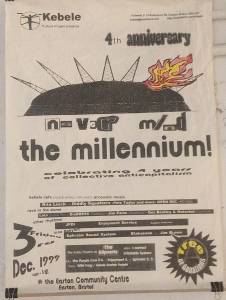 Never Mind the Millenium»: The year 2000 surprised us with a new millennium and new conspiracy and apocalyptic theories. And as always, the usual suspects trying to capitalize on it for their own gain. For that year, they proposed the construction of a giant Ferris wheel as a major celebratory feature—the tallest in Europe—which became the most popular tourist attraction in the United Kingdom, which says a lot about the state of society: the London Eye. The Millennium Dome was also built. It cost 789 million pounds!!! which was funded mostly by the National Lottery. But if we consider that British lottery money is the government’s main way of financing social and cultural projects, this massive investment had terrible results. So, as Kebele (BASE), we celebrated the project’s 4th anniversary by criticizing this waste and reaffirming our commitment to D.I.Y. culture (self-managed and independent, community-based—REAL!). The motif is very explicit: a Millennium Dome in flames and a modified Sex Pistols slogan: Never Mind the Millennium.
 - ANNIVERSARY OF THE ATTICA REBELLION
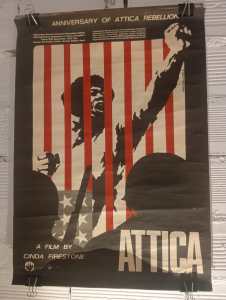
We have been involved in the case of Mumia Abu-Jamal since his death sentence was signed in 1995 and the new attempt to execute him in 1999 was denied. It was signed again, and Abu-Jamal’s request for a retrial was rejected again in 2008 and 2012 (part of that activity included the release of the CD “Free Mumia Abu-Jamal”). During that time, we also mobilized on behalf of the MOVE Movement prisoners, and, as a result, of other African American prisoners.
That was the case with the Attica uprising. The Attica prison riot took place in 1971 at the New York State Prison of that name, when inmates demanded better conditions. As a result, 33 prisoners and 10 prison officials and staff members were killed. The uprising had a strong racial component, as 63% of the inmates were African American or Puerto Rican, while the entire staff was white. The Attica riot has been described as a historic event in the prisoners’ rights movement.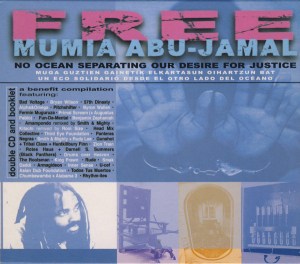
Kebele (Base) has been known for its work supporting prisoners, both in political cases and in the numerous cases of frame-ups (rather than mere mistakes). For years, a support group for prisoners from the Anarchist Black Cross (ABC) has been based in the premises. - “Injustice”
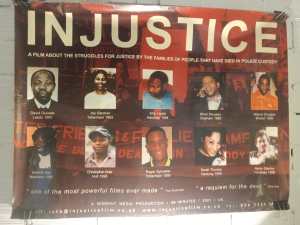 was more than a film; it was a campaign against police and racial injustice in the UK. Government and police censorship meant that its screening was limited to guerrilla-style showings organized by social collectives. The first attempt to screen it in Bristol was at a private club, which received a call from the police trying to dissuade them from showing the film. So we improvised a second venue, the Easton Community Centre, which was ideal in terms of location and community composition to avoid police repression, as the screening later proved.
“INJUSTICE” documents the struggle for justice by the families of people killed in police custody. The censorship of its screening mirrors what the families of the victims went through, as each faced a wall of official secrecy. The filmmakers gathered documents and footage over a five-year period.
The British police have been responsible for hundreds of deaths during detention, with a clear racist bias, and have gone unpunished. We can understand their desire to prevent the screening. But we share the need of the filmmakers, the families, and the communities to screen it and to expose this aspect of the system. 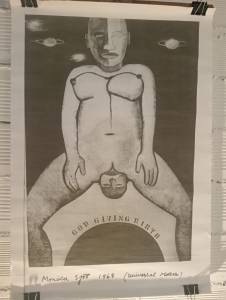 “God Giving Birth” (1968) by Monica Sjöö (1938–2005). This reproduction of the painting was a gift from the artist herself. I loved it because it describes something with which I fully identify: the questioning of the Eurocentric patriarchal system from its very foundation, from its main justification—religion and especially from Christianity.
Sjöö’s painting became even more relevant when she explained to me that it was censored for that very message. When it was first exhibited in 1970, English Christian groups accused her of blasphemy under an existing law in the United Kingdom. The painting depicts a woman of African descent giving birth, using a technique that is also African, and which we can identify as very characteristic of the artist.
Sjöö was Swedish but lived most of her life in Bristol. Due to her anarchist views, she identified with Kebele, and despite the venue’s limited space and simple nature, she was enthusiastic about organizing an exhibition of her work there. Obviously, due to the size of her paintings and their number, it could only be a selection, but her trust was greatly appreciated, and it was an honor to be able to showcase the work of a leading figure within the feminist and pagan movements.
Sjöö was also the co-author, alongside Barbara Mor, of the seminal book on feminist paganism, *The Great Cosmic Mother*. Later, at another time when, for various reasons, Sjöö was in difficulty and we stored all those paintings in our home, under beds, etc. Currently, “God Giving Birth” is housed at the Anna Nordlander Museum in Skellefteå, Sweden, a museum dedicated to works by women.- Zapatista
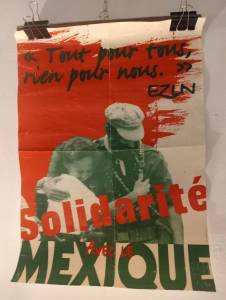
1994: Neoliberalism was inaugurated that year. Or rather, the movement against it: that year, the Zapatistas rose up in Chiapas on the very same day that the North American Free Trade Agreement (NAFTA) between Canada, the United States, and Mexico came into effect. Since then, both the defense of the Zapatista movement and its proposals have been among the guiding principles of the anti-capitalist movement. This is also true in Bristol, where a group was formed that continues to work and champion the Zapatista demands.
As part of these activities, various visits were made to the communities, contributing economically and politically at different levels. Undoubtedly one of the most memorable delegations was the one that included the Easton Cowboys community soccer team, which played several matches against Zapatista teams in 1999. The delegation included Bristol’s most famous figure, Banksy, who painted several murals in the communities.
Over the years, Kebele/BASE has also organized exhibitions, talks, meetings, and fundraising activities. The poster we’ve included, however, is French, because it undoubtedly expresses the broad and international scope of the Zapatista movement. -
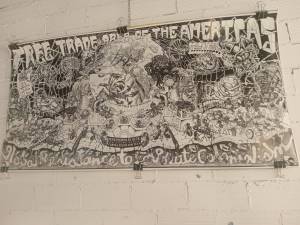
https://beehivecollective.org https://beehivecollective.org/ “FREE TRADE of teh Americas»: As part of that creative struggle against neoliberalism and the North American Free Trade Agreement, the Beehive Design Collective created this large pen-and-ink drawing, “FREE TRADE and the global resistance to corporate colonialism.” They printed 150,000 copies and distributed them around the world as a way to show opposition and raise funds. This one was obtained at Kebele/BASE, the distribution point in Bristol. The Beehive Collective denounces not only globalization, trade, and the extraction of resources and energy, but also biotechnology and climate change—elements intrinsic to capitalist exploitation.
