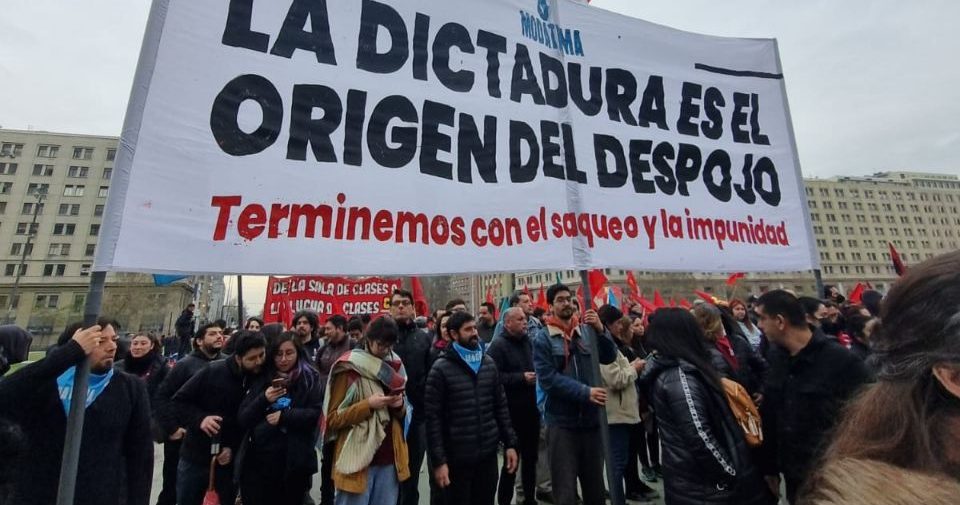
is the Movement for the Defence of Water, Land and the Environment, it is the organised expression to recover the common goods for the people of our country, repairing years of socio-environmental injustices that have made the lives of thousands in this long territory precarious. From this premise, we allow ourselves to share a heartfelt reflection in the context of these #50Years of the Military Coup, which not only abruptly ended a process of social and popular transformation at the cost of death, torture and disappearance, but also in these dark years we can also find the origin of a model of dispossession of water, land and natural common goods, which today have us in the worst climate crisis that our country has ever experienced, with fatal consequences that, if we do not make a deep reflection on its origins, we will not be able to act with determination to change the course of our destiny.
50 years after the military coup
the search for truth and justice
It is 50 years since the military coup that began Pinochet’s bloody dictatorship, which lasted for 17 consecutive years during which systematic and extremely serious human rights violations were committed in our country. Today we remember with feelings of sadness for the atrocities committed, but also with the strength and courage to raise our voices and ensure that the truth is present, just like the thousands of compatriots who fought hard in those dark years of our history.
State violence, which manifested itself in part through the National Security Doctrine initiated by the Regime, led to a military policy which, using the intelligence apparatus, violently transformed the political order, overthrowing a democratically elected popular government and a progressive political project of Popular Unity, embodied in Salvador Allende. At the cost of political violence, murder, torture and all kinds of humiliation, an authoritarian and extreme right-wing political and social order was established and maintained.
During the dictatorship, a bloodthirsty machinery of intelligence, media censorship, political sabotage, espionage and torture was built up, expressed in the National Intelligence Directorate (DINA) and later in the National Intelligence Centre (CNI).These State intelligence apparatuses, which had the power to detain and limit people’s freedom by Decree Law, aimed to annihilate all opponents and exterminate all that was different, under the fictitious threat of Marxist ideology. Thus, the State, through its armed and intelligence forces, focused on the extermination of political leaders of left, centre-left and revolutionary left parties, as well as social and territorial leaders, trade unionists, settlers, peasants, as well as sympathisers or people who simply supported the political project.

Between 1973 and 1990, there were around 40,000 victims of political imprisonment and torture, of whom an estimated 3,225 people were victims of extrajudicial executions (1) and forced disappearances. Regarding forced disappearances, it is estimated that there are 1469 people victims of this violation (2).These figures are not just numbers, they are lives, stories, families, friends, comrades, it is our history stained with the blood of its people.
The guarantee of human rights and the need to make memory present, to make effective reparation to the victims and their families, and to have guarantees of non-repetition is a debt in open conflict in our country, a struggle that we will not cease to wage until truth, justice and guarantees of non-repetition are enforced.
Reparation (3) means constituting specific measures aimed at restoring the victims to the conditions prior to the act, which implies annulling the immediate consequences of the violation as far as possible, and compensating the damages caused. Reparation measures are still pending, situations such as the Valech benefit that presented irregularities, in order to be able to judicially address the culprits of the crimes committed during the dictatorship.
Guarantees of non-repetition (4) are all judicial and non-judicial measures aimed at ensuring that circumstances that have led to human rights violations in the past are not allowed to continue. It is the demonstration that Chile can learn from its history.
In addition, another essential aspect for the relatives of disappeared detainees is to be able to advance the truth (5) about what happened to the victims. According to data from the Retting and Valech reports, 1,102 disappeared persons are registered. In this regard, we welcome the launching of the National Search Plan promoted by the government. We cannot spend 50 more years asking ourselves «Where are they?», but neither can we allow one more minute of silence on the part of the complicit institutions such as the Navy, the FACH ( Fuerza Aérea de Chile) and the Military.
It is necessary to advance in measures of historical reparation, we believe it is necessary to advance in the right to Justice (6). A necessary policy, considering that today people who were accomplices or outright violators of human rights are still at liberty, not only without any conviction or punishment, in impunity, but who hold positions of political authority, for example, Hernán Larraín, former Minister of Justice and Human Rights of Piñera, currently a member of the expert commission of the constitutional convention.

Since the return to «democracy», state violence has not ceased to be present; rather, the mechanisms of repression have been reconfigured in an underhand manner. A clear expression of this is what happened during the social outburst of 2019: 3099 complaints were filed for human rights violations by victims of the state, of different connotations. Today, more than ever, an institutional framework is needed that has the protection and promotion of human rights as a cross-cutting theme in all its work.
The installation of a political-economic project – the model of plunder
During the military dictatorship, a doctrine of state terrorism was applied, which, along with building a machine of murder on our people and limiting political and civil rights, was responsible for building the pillars of a neoliberal and extractivist model. In circumstances of authoritarianism and without the possibility of opposition, a model of plunder was configured that appropriated our natural common goods, water, land and nature, privatised public companies and commodified our social rights, benefiting the power circles of the dictatorship with the wealth of all Chilean women and men.
The pillar of the dictatorship’s re-foundation project, the 1980 constitution, underpins the model of plunder.This process was reinforced with a series of constitutional organic laws, through decrees with the force of law, legal instruments that were dictated by the dictator without passing through a «legislature».A structural reform was set up that modified the developmentalist state character of the Chilean economic model, making a complete turn towards the free market (7).
The national market was oriented towards the export of raw materials mentioned in the global economic processes, a role relegated in the global value chains, which configured extractivism in our country. In this way, these structural reforms favoured the development of certain extractivist economic sectors: mining, agro-industry and forestry, among others.
Among these neoliberal reforms that were implemented to privatise our natural commons, mining is the most acute effect of extractivism.The slogan of «Copper for Chile» was completely erased, in its essence of basing development on state control. The shift was towards giving greater opportunities to private investors, relaxing all installation regulations, low taxes and keeping environmental standards low. In this area we have a series of pillars; the 1974 «foreign investment» DFL 1748, the 1982 «mining concessions law» and the 1983 «mining code», which built the mining model in Chile (8). Our country’s economy depends heavily on this extractive activity, accounting for 13% of GDP (9) in 2022. In the same year, 55.6% of exports correspond to mining, mainly copper.
The effects of this productive sector are varied in terms of equitable economic development. Private miners produce around 70% of Chile’s copper, 30% is state-owned. CODELCO remains one of the largest producers and the only open-pit producer. Although the total deregulation of the state has been abandoned, for example through the mining royalty (2005), it is still quite timid, between 5% and 34% of income.In this sense, the territories where the companies are located do not receive the profits from the mining business.
It is also important to highlight the effects on local communities, who are the ones who suffer the negative effects of mining activity, such as the change in local productive activities, the effects of mining, but it is important to highlight environmental justice, in the context of the «global boiling», the environmental impacts of this productive sector are acute, triggering a series of socio-environmental conflicts, mainly in the north. According to the map of socio-environmental conflicts (2018) of the National Institute of Human Rights, our country is experiencing 34 conflicts related to this issue.
The forestry sector is another economic pillar promoted by the dictatorship that affects our natural commons. It began in 1974 through the DFL Nª701, which focuses on promoting forestry plantations based on subsidies for this forestry activity. In this sense, a 100% subsidy was granted for the planting of pine and eucalyptus trees, and since 1998 the amount of the subsidy has been reduced to 70%. It is estimated that, over the last 40 years, the state has paid US$875 million to forestry companies for plantation and associated administrative costs. On the impacts of the forestry model, it is relevant to highlight that this model benefits a few, mainly the tycoons belonging to the Matte and Angelini family, through CMPC, the Matte Group and Forestal Arauco, which control approximately 70% to 75% of the forestry market. The environmental effects are equally important, with a high impact on native nature. The presence of forestry is associated with the loss of biological diversity, ecosystems, fragmenting the habitat of local native fauna and native forests, soil damage and negative effects on water availability.
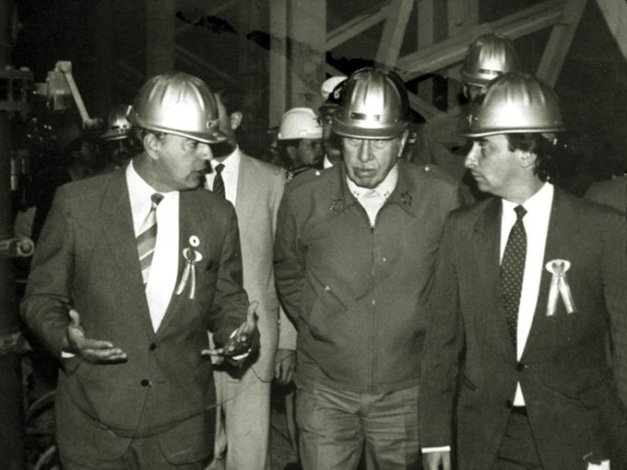
In Chile’s countryside the situation was no different. With a brutal onslaught against the process of Agrarian Reform and the organisation of peasant and indigenous communities from 1967 onwards, state terrorism erased with blood the slogan «the land is for those who work». The bosses’ order quickly resumed its control, and the peasant organisations were massacred and persecuted, their collective lands were returned to the big owners, or distributed among the new «beneficiaries» of the dictatorship, giving light to the installation of a new economic model and land use in the Chilean countryside. The human right to land was also violated during these years.The dictatorship installed an agro-export model based on fruit and forestry products.The agrarian reform was reversed, liberalising this economic sector, targeting capital-intensive investment in the fruit sector. Agro-exports grew from 5% to 30% during this period by 1990, tending to depend on this trade and taking on a peripheral role in the economy (10).
In terms of water, the 1980 constitution itself, as well as the 1981 water code and its reform of 2022, are the legal basis for the privatisation of this natural common good. However, water is probably the basic commodity; understood as a «resource», in economic language, necessary for the development of the rest of the productive sectors. The privatisation of water, its delivery in perpetuity and free of charge to private entrepreneurs, evidently has a dynamising role.
In the constitution in its article 19 numeral 24, it is good to remember the well-known sentence that states: «The rights of private individuals over water, recognised or constituted in accordance with the law, shall grant their holders ownership over them». The ownership of water was enshrined in the constitution, and could be challenged because it was included in the «Magna Carta».
The remaining legal framework is complemented by the 1981 Water Code (DFL N°1.122) which reinforces what is stipulated in the constitution, giving an excessive emphasis on basing water administration on «efficient» use through the free transferability of water rights to the market. Although there is an update with the water code reform of 2022, although it grants greater possibilities of redistribution of water and priorities of use, indicating the human right to water, it still maintains the privatisation of water.
It is necessary to remember that Water Use Rights are regulated in commerce, they are prescriptible, transferable and transmissible, so in practice it works in a way that is incompatible with the condition of national goods of public use, even less with the notion of natural common goods.On the other hand, other norms are designed and implemented that allow greater possibilities for large agricultural entrepreneurs, which accompany the privatisation of water, such as the irrigation law, which, through the National Commission for Irrigation (1983), gives bonuses to the State for the use of water.
Among the effects of the water privatisation model, we can see that the DGA’s public water cadastre, although with limited data, shows that approximately 140,000 water rights are distributed among 70,000 holders throughout the country, of which only 2% have access to more than 80% of the volume granted at the national level. The fact that there are private registers that refute this information is part of the problem we are trying to overcome. This reality coexists with the fact that, according to census data (2017), around 383 thousand homes in our country lack a permanent drinking water connection.

When faced with a complex climatic reality, it is necessary to account for a model that does not take into account the need to protect our nature. In Chile, it has been projected that 76% of the Chilean surface is affected by drought, desertification and soil degradation.
The effects of the military dictatorship persist to this day, in the political model that we live in our daily lives, in our present; when we see in the precarious pensions that our pensioners receive, in the precarious rural communities without water in Petorca, in the forestry installation in Curacautín in territories ancestral to the Mapuche people, in the pollution of mining companies in dormitory towns.
The dispute for a future with justice
The construction of the present and the future is based on our social and historical memory. It is necessary to keep in mind the facts of what happened, to understand the historical process and its effects. For this reason, it is necessary to say that the dictatorship set up a doctrine of fire in which very serious human rights violations were committed in order to establish a neoliberal and extractivist political project, which today is expressed in the model of dispossession and inequalities that we live with.
This historical memory requires a call to action: where we, the social movements, are heading.That is why we say forcefully: the effects of the political order imposed by the dictatorship continue to violate our rights and our natural commons. It is necessary to advance in its transformation towards a model that is ecologically healthy, socially just and economically supportive. This horizon is today in contradiction with the material reality, where the order imposed by the big owners of this country outweighs the security and quality of life of the millions of inhabitants of this beautiful land.
Today our country commemorates these 50 years in a political context that we cannot ignore. Hate speeches that threaten freedoms, fundamental rights and democracy are growing at a dangerous pace. Sectors of the ultra-right cling to the conservatism and neoliberal values that were once imposed on us by coup d’état, validating the democratic rupture that the dictatorship signified.This is a threat to our memory, because they deny the thousands of victims and horrors committed, but also to the future of our democracy. This denialism and/or promotion of the horrors of the past committed by their own sector makes us ask, will they be able to repeat this history? Chile cannot allow this regression.
Fifty years after the coup, social movements maintain that, without the unrestricted defence of human rights, together with reparation, guarantees of non-repetition and the right to justice, there is no present or desirable future for communities. But it is also necessary to argue forcefully that, without a necessary and unavoidable social and political transformation of the foundations imposed by the dictatorship, there is no present and no just future possible. The dispute is still open and we are the ones who are called upon to do battle.
They buried our people, but we rise up as the seeds of their struggle. Following the example of those who fought against the dictatorship, we will not rest until we put an end to looting, impunity and inequality.
References
- Valech Commission. National Commission on Political Prisoners and Torture. 2005.
- Actualización Nómina de víctimas de Desaparición Forzada, calificadas en los Informes de la Comisión Nacional de Verdad y Reconciliación, Corporación Nacional de Reparación y Reconciliación, y Comisión Presidencial Asesora para la calificación de Detenidos Desaparecidos, Ejecutados Políticos y Víctimas de Prisión Política y Tortura. 2022. UNDERSECRETARIAT FOR HUMAN RIGHTS.
