Bianca Feifel Brasil de Fato
Photo: Rafa Stédile / Photos at the end: Tchena Masso
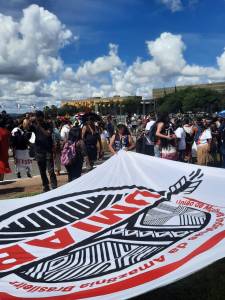
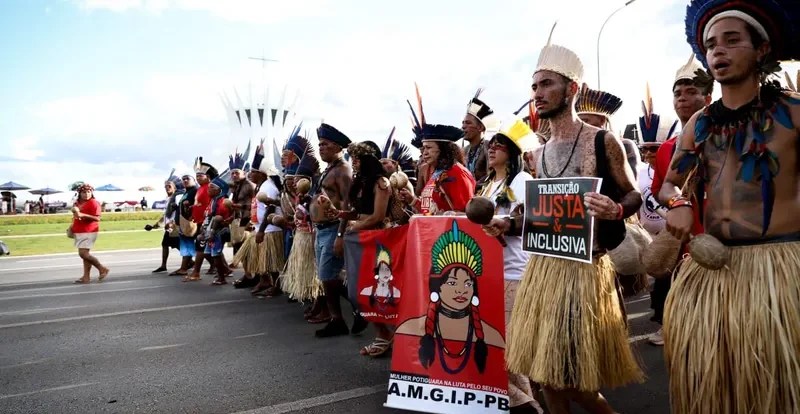
Moved by the motto «Our Framework is Ancestral: We Were Always Here!», thousands of indigenous people marched this Thursday (25) along the Esplanade of the Ministries in defense of the territories and rights of the indigenous peoples of Brazil. ‘Our reference point is ancestral, we have always been here’, they say against the temporal reference point; Lula received the leaders at the Planalto
«There are 524 years of resistance, of struggle of indigenous peoples, and being here is a very symbolic moment to be able to talk about the struggles of the territories, about the demands we have. Mining kills, the lack of visibility of indigenous peoples It also kills. Being here representing various peoples of Brazil is a strong act of saying that we are alive, we continue fighting against big companies and we say no to the Temporary Frame and yes to the lives of indigenous peoples,» DFWakrewa Krenak, indigenous to Minas Gerais, declared to Brasil de Fato.
It is the fifth time that Wakrewa participates in Camp Tierra Libre (ATL), this time accompanied by her three-year-old daughter. «There is no way to be an activist for indigenous peoples, to be indigenous is to be born in the struggle since childhood,» she added.
With cries of «Demarcation now!», participants demanded more structure and budget for the Ministry of Indigenous Peoples (MPI) and greater commitment from other portfolios, especially the Ministry of Justice and Public Security (MJSP), to indigenous rights.

In addition to representatives of more than 200 indigenous peoples from all the country’s biomes, other organizations that also fight for land and territory joined the march in Brasilia: the Movement of Landless Rural Workers (MST), the National Coordinator of Quilombo Articulation (Conaq) and the National Council of Extractive Populations (CNS).
«The fight for land is not only for indigenous peoples,» said Dinamam Tuxá, executive coordinator of the Articulation of Indigenous Peoples of Brazil (Apib). «What we are asking for is the right to access to land and territory, not only for indigenous peoples, but also for other segments of the population that participate in this struggle. This march marks a historic moment in this union of forces which fight for life, which are all the social movements that are fighting and organized in favor of life.»
The participants marched from the Funarte Cultural Complex, where the 20th edition of the ATL is being held, towards the Plaza de los Tres Poderes. President Luiz Inácio Lula da Silva (PT) was expected to come down the ramp to greet the indigenous people, but that was not the case.
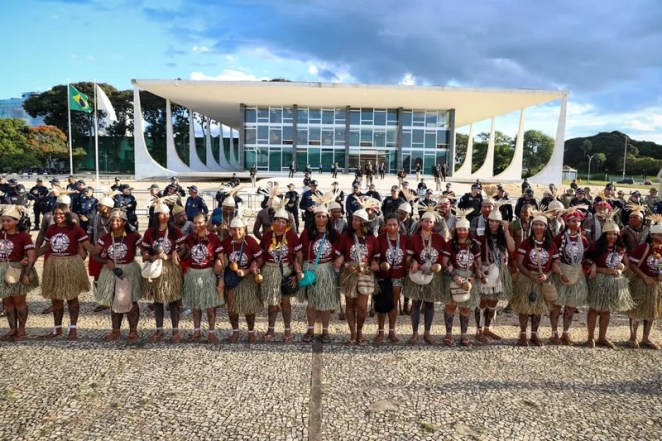
A delegation of 35 indigenous leaders was received by the Chief Executive after the march. The objective was to present the movement’s letter of demand with 25 demands addressed to the government, among them the speeding up of the demarcation of indigenous lands. The meeting was also attended by the head of the General Secretariat of the Presidency of the Republic, Márcio Macêdo, the president of the National Foundation of Indigenous Peoples of Brazil (FUNAI), Joenia Wapichana, and the Minister of Indigenous Peoples, Sônia Guajajara.
«It is very important for us to be here again, united, all the peoples of Brazil,» celebrated Nimon Oroeu, deputy coordinator of the Organization of Indigenous Peoples of Rondônia and Northeast of Mato Grosso (Opriona), who is participating for the third time in the ATL.
«I cannot say that my mission is accomplished, because the fight continues. The fight does not stop. Our main demands are that these governments, these deputies who try to violate our rights, respect us, because we are the true Brazilian people. In fact, Brazil was not discovered, Brazil was invaded,» defended the Uru-Eu-Wau-Wau indigenous people of Rondônia.
Indigenous women suffer the consequences of illegal mining
For Raquel Tupinambá, coordinator of the Indigenous Council of the Tupinambá People of Bajo Tapajós (Citup), the feeling of participating for the fifth time in the ATL is one of struggle and agility in the defense of rights, but also of anguish. According to her, the climate emergency has put great pressure on indigenous territories, forests and rivers.
«The government and society in general still do not understand the importance of preserving life. That is why we are very distressed, because we know that we will be the first people affected. As we already are,» she laments.
The territory where she lives, in the Amazonian Bajo Tapajós, suffers the effects of mining and is threatened by the construction of the Ferrogrão, an agro-industrial mega railway project almost a thousand kilometers long, which aims to link Sinop, in Mato Grosso, with Miritituba, in Pará, passing through Itaituba (PA).
The railway will pass through at least six indigenous lands, where approximately 2,600 people live, as well as 17 conservation units. On the route of the deforested area there are also three isolated indigenous villages, which do not have contact with non-indigenous people. «A project of death,» said Raquel.
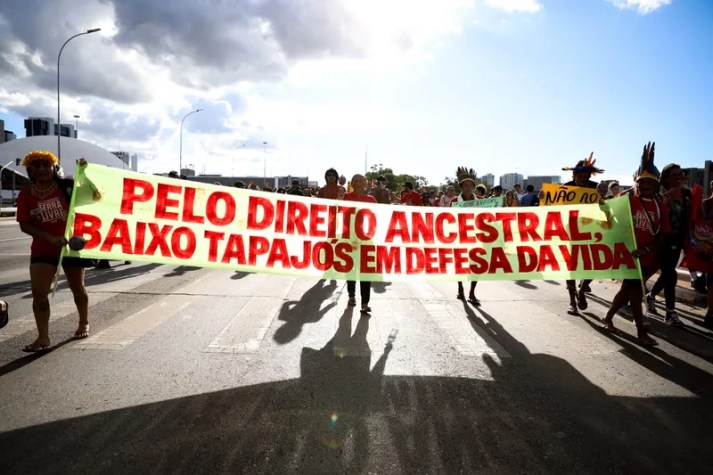
The Citup coordinator also highlighted that indigenous women suffer various impacts from illegal mining. One of them affects one of the most sensitive periods, lactation, through the contamination of breast milk. «Can you imagine, as a mother, knowing that instead of being healthy, you are giving poison to your child?» she asked herself.
Violence and sexual exploitation also persecute indigenous women in mining areas. Mothers often lose their children to the «mining life» and to the diseases that miners bring.
«Women suffer in many ways when it comes to mining. In addition, of course, to the fact that the land, the soil, the river, the forest, our bodies are destroyed and devastated by mining,» added Raquel Tupinambá.
Fotos: Tchena Masso