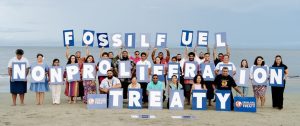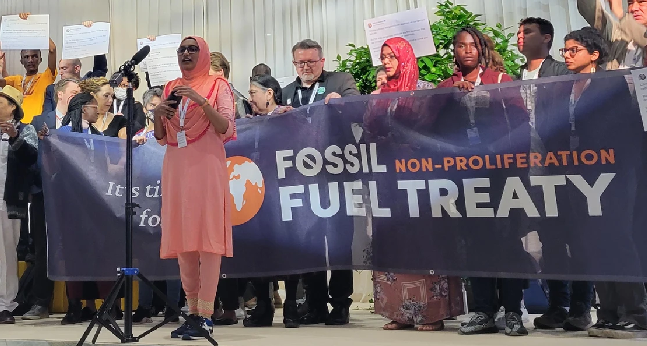
Interview with Andrés Gómez, an activist and current Latin America coordinator for the Fossil Fuel Treaty Initiative.
(Castellano) (Euskara)
Today, April 24, the First Conference on the Transition Away from Fossil Fuels begins in Santa Marta, Colombia. The conference has been convened by the governments of Colombia and the Netherlands, which, along with 16 other countries, have been participating in the Fossil Fuel Treaty Initiative since 2024. The second conference will be held in a year’s time in the Pacific.
The conference will take place alongside other events where civil society will be fully represented: the Fossil-Free Territories Conference and a People’s Summit.
We are all well aware that this conference is taking place at a time of global upheaval, in which energy—and fossil fuels in particular—are at the epicenter. The aggression by the U.S. and Israel against Iran has led to the closure of the Strait of Hormuz and, with it, a crisis of global proportions due to the difficulty of transporting these fossil fuels. But equally, in January, we saw one of those key players (the U.S.) attacking another country, Venezuela, with the aim of securing its own access to those fossil fuels as well. Meanwhile, the war in Ukraine—which also has access to and transit of gas at its core—has now gone over four years.
Now that a theoretical Energy Transition had been agreed upon globally, we realize that we remain just as dependent on fossil fuels. Or even more so, because their availability is clearly on the decline.
In this context, we see that fossil fuels do not merely signify the disaster of pollution caused by their extraction, transport, and combustion, or the resulting disaster of climate change, but they also signify war, death, and destruction. Therefore, at this critical moment for humanity and the Planet, abandoning fossil fuels is more urgent than ever—and so is a conference like this.
We interviewed Andrés Gómez, an activist and current Latin America coordinator for the Fossil Fuel Treaty Initiative.
In November, the latest COP30 (Conference of the Parties) on climate change was held in Brazil. There, this First International Conference on the Transition to Abandon Fossil Fuels was presented. What will this conference contribute to the ongoing climate and environmental efforts?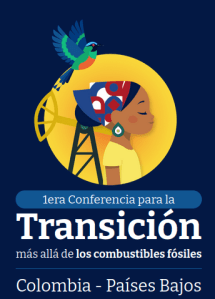
This is a historic conference; it is the first time that countries from different nations—in this case, more than 55 countries that will gather in Santa Marta—are sitting down specifically to discuss fossil fuels. And what the Ministry of the Environment is saying is precisely that countries are coming that are convinced that a planned, just, and equitable phase-out of fossil fuels is necessary. This forum does not aim to replace the COPs—that is clear—but it does connect with what could be more direct, faster paths toward phasing out fossil fuels. The report to be released from the conference, presented by the Netherlands and Colombia, will be part of the upcoming COP—the roadmap, Brazil’s proposal—and we also hope it will chart a clear path toward addressing this gap in international governance that can complement the Paris Agreement, potentially through a treaty on fossil fuels.
One of the most difficult questions to answer when addressing the transition away from fossil fuels is how to phase them out without leaving anyone behind, without harming weaker economies, or how those economies can cease to be dependent on these fuels.
 The solutions being sought here are risky and complicated; we are talking about the fossil fuel economy—oil, coal, and gas—which underpin the entire economic system and clearly involve differences between consumers and producers, as well as distinct economic challenges for each region and country. Clearly, an international instrument—a multilateral framework—is needed to find a way forward. Here we need to address many aspects: we need to discuss how science tells us that we do not need further expansion or new oil and gas projects. We also need to discuss how to achieve a just and equitable transition over time, because we must understand that we cannot simply stop consuming fossil fuels overnight. This requires strategic planning that takes into account historical conditions and the specific circumstances of each country, as well as responsibilities and economic conditions—and this is precisely the framework that can be addressed there. That is why the conference has a framework of 13 key areas covering most, if not all, of the issues surrounding fossil fuels. One of them focuses on the economy and fiscal conditions, another on supply and demand, and another on the gaps in global governance regarding the transition away from fossil fuels.
So, all these issues are being addressed there, with a broad perspective that encompasses not only the 55 countries but also the more than 10 civil society sectors that will be contributing and helping to shape a vision of the pathways that will enable a transition away from fossil fuels.
Communities have said many times at COPs that they already have solutions they are implementing on the ground, but their voices are not being heard. In that sense, given the questions and challenges this process will face, where do you think the greatest complexity lies when seeking solutions?
It seems to me that the most difficult issue to address is the one that ultimately carries the most weight in the process of the United Nations Framework Convention on Climate Change UNFCCC, namely historical responsibilities and differentiated responsibilities. There are countries that, through the exploitation and intensive use of fossil fuels, have achieved economic conditions completely different from those of the Global South; therefore, there should be compensation for this exploitation and this responsibility for the climate crisis so that countries in the South—which have different economic conditions and different access to energy—can develop. That is why we must insist on this path toward a solution through a multilateral instrument such as a fossil fuel treaty, which can effectively address and advance the resolution of these equity issues. This is what civil society is pushing for, and it is also being championed by the Colombian government and the 18 countries advocating for a fossil fuel treaty. It is also important to understand that this transition must incorporate a perspective of energy justice in these regions. In many of these regions, there are communities today that lack access to energy. What kind of transition do we intend to propose to them while countries in the Global North consume 100 or 150 times more energy than the rest? So this is where there is a complex perspective that drives civil society toward equitable solutions and, let’s say, in economic terms, the issue of debt in the Global South—which leaves no room for transition—will be the most difficult topics. I insist: these economic issues have to do with financial justice, debt, and the reform of all these structures, as well as reparations for the countries of the Global South.
“Given that fossil fuel production is so structurally entrenched in global markets, financial systems, and geopolitics, no country can manage this transition on its own.
Coordinated international cooperation, based on equity and justice, is essential to avoid a chaotic phase-out, economic recessions, and new forms of energy inequality.
The demand to abandon fossil fuels is no longer just a whisper that many dare not utter aloud; it is a universal cry for survival: we must move away equitably from the extraction that plots our destruction.
We need a global transition away from fossil fuels that is rapid, just, and well-funded; a transition that strengthens energy sovereignty, stabilizes economies, and supports workers and communities, leaving no one behind.”