(Euskara) (Castellano)
As we have already reported on this site, Trump’s fascist immigration policy during his second term has focused on deportations carried out by ICE. But that does not mean he has given up on his attempt to build a wall along the U.S.-Mexico border. That’s right: this also highlights a reality—one that Trump himself now ignores—namely, that he doesn’t keep his promises. Despite all the money invested and all the effort expended, he failed to deliver on his first-term promise to build a wall, and now he’s failing to do so again. “Thank goodness!” we might say, “at least there’s one inhumane policy he can’t pull off.”
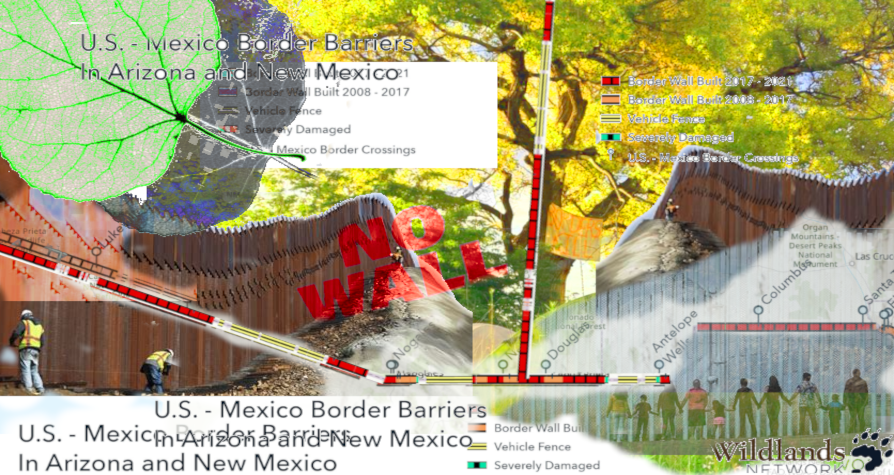
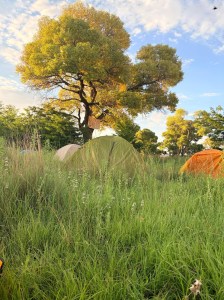
The fact is that along one of those sections that remain unfinished, a beautiful struggle has taken place—beautiful in and of itself, simply because it represents resistance to so much power, bigotry and stupidity—in which the struggles against borders and deportations have converged with the fight for environmental conservation. Yes, part of the reason that hateful wall isn’t moving forward is also because activists are resisting it, as CrimetIhnc. has reported. The resistance in question is taking place in Arizona, an ecosystem home to cottonwood trees (another incomplete section currently in dispute is located in Texas—see below).

In fact, those cottonwood trees and that ecosystem have been successfully protected (hopefully for good) using a technique that has already been widely replicated and that we, too, have covered here on numerous occasions: tree-top occupation or tree sitting. That’s why we also find it very interesting, since we can link it to recent struggles such as Cop City (Atlanta) and Yellow Finch (Virginia) in the U.S., Puszcza Borecka (Poland), Altdorfer Wald, Flensburg, and Hambach (Germany), Stop HS2 in the U.K., La Clusaz (Switzerland), Don Bosco (Italy), and the previous ones in the U.S., the U.K., and so many other places.
This resistance also reminds us of the struggle that took place between Poland and Belarus, which sought to protect the marvelous primeval forest of Białowieża—also threatened by the construction of another border wall and intended to block migration. In that case, it’s also worth noting that the wall was being built in Poland, and that its primary purpose was therefore to block the flow of migrants—specifically in that country (Poland) but more broadly across Europe. Thus, it’s not just Trump who builds hateful walls; the EU does so as well.
Because we are witnessing this now as well with the recent migration crisis in Ceuta, which highlights the role played by borders and states such as Spain, Greece, and Poland—which we mentioned—as well as others that act as buffers, such as Morocco, Turkey, etc., and reveals what borders and nationalism truly mean. How close we are to fascism. What we call a “crisis” refers only to the situation that affects us directly —not the crises experienced by millions of people in Africa, Latin America, or Asia who find themselves trapped, nor the crises that force them to migrate. And there are hundreds of other related crises within this “Fortress Europe,” such as the one we’re experiencing these days in Donostia with the city’s decision to prevent volunteers (Kaleko Afari Solidarioak) from feeding migrants (even though they do so selflessly!).
Finally, this case also brings to light an observation that, though obvious, deserves mention: in all these forests and places, there are no borders. These borders are constructed; they are human-made, imagined, and imposed on our cultures—but above all, on other peoples, in ecosystems that they also damage or destroy. Not only are they unnecessary, but they are also avoidable and undesirable.
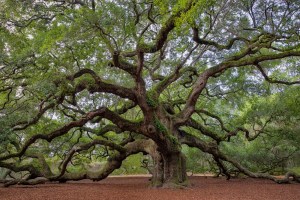
Another point, though less significant, that catches our attention here in Euskal Herria (the Basque Country): the name of the state of Arizona holds meaning in our language as “Aritz Ona” (Good Oak – «Roble Bueno» in Spanish). In fact, it is one of the etymological meanings accepted there as well! In fact, there are many species of oak trees in Arizona (Arizona Oak Tree, Emory Oak, Arizona White Oak, Escarpment Live Oak, Arizona Oak Tree, Gambel Oak, Texas Oak, Desert Scrub Oak, Canyon Live Oak, Palmer Oak). We understand that, of the many Basques who went there (for whom there were no borders or barriers to entry, despite being inhabitted by Native people as the O’odham)—whether as shepherds or pursuing other ways of life—those oak trees reminded them their home oak trees, but, above all, those oaks were significant enough to give the state its name. Just as significant as the cottonwood trees that activists and residents want to preserve.
Even more: another interesting thing of CrimetIhnc.‘s article is that it opens with a Gloria Anzaldua ‘s poem, and that one of the articles we wrote recently at A Planeta —»Trump, the latest link …«— we also started with another writing by another Chicano woman, Cherríe Moraga. In fact, both Anzaldua and Moraga have projects together, like the book «This bridge called my back : writings by radical women of color».
READ THE WHOL ARTÍCLE :
«The Border is an Open Wound – A Tree Sit in Lochiel, Arizona Halts Border Wall Construction».
(CrimetIhnc.)
Sections in Texas and Oklahoma Also Incomplete
But the Arizona section isn’t the only one left for Trump. The wall Trump proposed between the U.S. and Mexico is supposed to stretch 3,144 km, which presents numerous challenges. Of that border, more than 1,000 km have been completed with a “primary” barrier, but just over 2,000 km remain without any barrier at all—and the concept of a “completed” barrier is highly subjective indeed. In addition to the Lochiel section in Arizona, the Big Bend of the Rio Grande in Texas remains without a wall.
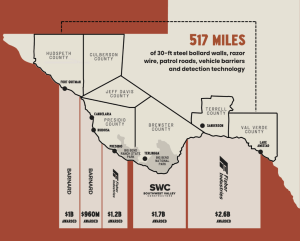
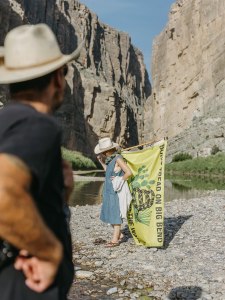
Now, an indigenous group is also filing a lawsuit to halt construction of this section of the border wall on religious grounds (the Religious Freedom Restoration Act), as it will affect their sacred sites and ecosystems essential to their spiritual practices. The affected people are the Lipan Apache.
Furthermore, this massive project will affect the designated natural area of Big Bend National Park, as well as Big Bend Ranch State Park (Texas’s two environmental gems), the Black Gap Wildlife Management Area (WMA), and Seminole Canyon State Park.
In order to carry out this mega-project, the U.S. government has had to suspend 28 federal protection laws. As we already know, it has been one of Trump’s practices to eliminate institutions and workers dedicated to environmental protection.
Big Bend National Park was established in 1940, and to do so, the state exercised its power of eminent domain, which led to the dismantling of entire communities and the demolition of homes, barns, and significant historic sites. Now, eighty years later, we are witnessing how the very rationale for eminent domain—and (in theory) habitat protection—is being ignored again. Once again, families living along the river face the same dilemma: accept a buyout offer from the government or fight it in court.
«No Big Bend Wall (NBBW) is a community coalition focused on public education, transparency in federal decision-making, cultural and environmental resource protection, landowner rights, and due process in response to the proposed wall in Big Bend».
Coincidentally, one of the major environmental disasters of recent years in the Brazilian Amazon was the construction of the Neoenergía (Iberdrola) Belo Monte dam, where indigenous peoples were also significantly affected, particularly the Kayapó people. This dam was also built at the great bend (Big Bend or Volta Grande) of another major river, the Xingu, a tributary of the Amazon.
