‘Skip the lathe
turn a corner
on any cobblestone
on any cobblestone
is the front line’(Kortatu «La línea del frente » (The Front Line))1
(Castellano) (Euskara)
Public transport fares are and have been questioned on numerous occasions. Especially in those mega-metropolises where millions of people are crammed together and where moving long distances is indispensable. These cities are sold to us as an ideal of coexistence, but they are a model of unsustainability, starting with the need for transport itself.
The questioning lies in the nature of transport itself, which is public and therefore already subsidised, but which we continue to pay for. At the same time, guaranteeing that this fare is complied with entails a huge security cost, because, on the one hand, you need agents to supervise it and also a lot of very expensive technology, from monitoring systems, video cameras, to the turnstiles themselves, to the vending machines, etc.
In all of this we have a lot of economic interests, especially from all those security firms, because, like everything in this system, institutions contract these services out to external companies (to all of this are added other aspects associated with surveillance, such as the restriction of rights: intrusion and control, as well as the unwanted incidents that usually occur).
Obviously, all this questioning becomes more radical when public transport fares rise, making them inaccessible to the less well-off (generally those who use them because they do not have access to private transport – and good thing, in a way, that this is the case).

The latest case of a riot instigated by such a case was in New York, and it is the one we bring here and now. We translated into Spanish it for CrimethInc., which once again reports what no one else reports, but also does so from the very protagonists and those affected, which are us, and from the rigth angle, questioning Power and justice. But before New York, the tariffs provoked revolts also in Chile and before that in Brazil. In Chile their impact was tremendous, as they were the ones that triggered the great revolt of 2019.
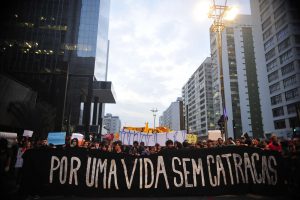
In Brazil, a movement, the Movimento Passe Livre, was formed after the massive movilisations in Bahia in 2003. This was followed in Florianópolis in 2004, and in the following years in almost all Brazilian cities, the most relevant being those of 2011 in São Paulo, which lasted three months. These demands were also the beginning of the 2013 riots, one of the largest in Brazil’s history.
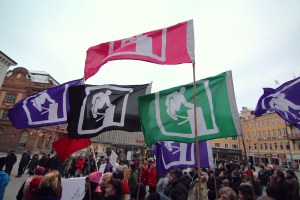
In turn, the Brazilian movement was inspired by the Swedish one. As is well known, Scandinavian countries are climate conscious, as Greta can testify, and enjoy good public policies and services. But obviously, this is not achieved without previous popular demands, and without resistance. The Planka movement demands free public transport. It advocates direct action and mobilisation, as well as awareness raising and communication of its goals and campaign. In areas such as Norberg, the Västmanland Zero Fare Zone has already been established.
In Sweden, this message has caught on and is supported by other organisations such as the National Mayflower Association, which proposes it as a way to ‘reduce inequality for children and young people in Sweden’. Other organisations like Återställ Våtmarker (Reclaim the Wetlands) opened the turnstiles last January ‘against rising ticket prices and in favour of climate-friendly transport’.
We wanted to take the opportunity to give it a local dimension as well. Undoubtedly, the subsidy that we have been enjoying lately in the Basque Community for public transport is to be praised, because it promotes this type of transport instead of private transport (also subsidied in many ways), which has many environmental, climate and social impacts associated with it (better if thy truly subsidised public transport and not squandered on elitist and wasteful projects, if they invested in real public transport). However, despite the reduction in fares, and despite the fact that there would be very little rip-off if someone did not pay, the previous surveillance system has not been abolished.
This reminds me of a case two years ago at the local train station when a security officer arrested a young Moroccan man for allegedly jumping the turnstile without paying. He had in fact paid for it, as he proved when his card was checked. But apparently there was another young man who passed by him, or who took advantage of the opening in the turnstile to get through. In any case, it wasn’t him, but he was held, and the police were called. Three cars and about 6 officers turned up for the youngster. They proceeded to treat him like a criminal: they made him identify himself in the middle of the street, under the gaze of passers-by, when, let’s remember, these are sectors that are already highly stigmatised.
A friend and I who witnessed the hit-and-run, and alarmed by the disproportionate and vexatious treatment, stayed behind to be able to assist the young man if needed. My friend was fined €500 for refusing to leave the scene, charged with obstruction of police work, when she did not obstruct anything. Is all that necessary? All that money wasted, in theory, to ensure that someone pays his low fare?
Not to mention the humiliation of the young person, the witness, the time lost, the resources, the stress caused, the financial fine, etc.; or the violated freedoms, such as freedom of movement, the presumption of innocence, freedom of expression or the freedom to supervise the police and other bodies when we understand that they exceed their duties.
All we want is to be able to move ‘freely’; we want public money to be invested reasonably and to cover the needs of all citizens, and thus, incidentally, to contribute to alleviating major local and global problems such as ecological and climatic ones.
_________________________________________
Notes
1 Kortatu’s song «La línea del frente» asapted for the matter: «Sálta una valla/dobla una esquina/en cualquier adoquín/está la primera línea»
_________________________________________
Last week, a series of demonstrations took place in New York City after police attacked a person they accused of dodging the fare on the subway. The police opened fire, shooting the suspect, a police officer, and multiple other people who happened to be in the station. This shows the real cost of police enforcing subway fare. We received the following report from a mass fare evasion action in Manhattan on the evening of September 18.
It’s senseless to have police randomly shooting people to enforce a $2.90 fare. The subways should be free, as they chiefly serve to put working-class people at the disposal of capitalist profiteers in the first place. The resources to make this possible exist—they are simply held hostage by the ruling class, to whom the lives of ordinary people have no worth.
It was a demonstration very much like the one described below that set off the Chilean uprising of 2019, triggering copycat actions in the United States. Struggles against the cost of public transit and the murderous police that enforce it continue around the world.

“Live Free, Ride Free, Fuck NYPD”
On Sunday, September 15, New York City police officers shot live rounds at random into the L train at the Sutter Avenue station at the border of Brownsville and East New York, Brooklyn. They were pursuing a Black man who had allegedly skipped the $2.90 fare by walking in through an exit door. They shot him and two unfortunate bystanders—one in the arm, one in the head. They also shot one of their own, a police officer, who continues to be the chief focus of concern throughout all of the official statements from the city government.

An autonomous call to meet at Union Square for a mass fare evasion began circulating on September 17 via an online post and printed flier emblazoned with the mantra “Live Free, Ride Free, Fuck the NYPD” and cartoons depicting people jumping turnstiles. There appeared to be no organizations involved, no manifestos, no roles assigned.

At 7 pm, 250 or more people gathered on the 14th Street steps, assessed the situation, and shared a plan among small crews. They considered several different stations as options, in view of the large number of police staged at entrances and the general layout of the platforms.
As one participant reported,
7:30. I was sick with fear and desire. I had traced the perimeter of the crowd gathered at Union Square. There were around two hundred and fifty people, most wearing masks or kaffiyehs. The turnout was good if you consider how little time had passed between the shooting and the demonstration—great if you add the fact that this was simply one of many marches called that week, and indeed, that day. While many of the other protests had been called by established organizations with thousands of followers on social media and resources to share with their participants, this humble march had no central organizing body. There was a flier, yes, but the common thread sewing together this brave collectivity was the desire to act—to do something, whatever possible, to push back against police violence on the subway.
Without clear leaders or planned speeches, the group milled about waiting for someone to take initiative. 14th Street had police vans branching out for blocks outside of Union Square. Talking among themselves, a few affinity groups decided that a march towards West 4th Street might thin police numbers—a plan that hinged on the idea that it would take the police longer to mobilize than the already anxious demonstrators. The plan to march was passed around the crowd and, by 7:45, we were stepping off the square and into the street. These first few blocks would prove to be decisive.
When the crowd stepped off at Union Square, one vocal white-shirted officer, alone but emboldened by the sizable police presence, threatened to arrest anyone who dared step into the street. Defiance was met with immediate police attempts to snatch and grab; this pushed the march to continue on the sidewalk.
It’s worth noting that the cops were bravest at the beginning and the end of the night. Though this was by no means catastrophic, the white shirts had an outsize effect on an otherwise energetic crowd. More physical resistance in the front could have dealt with the situation, emboldening the crowd rather than amplifying fear.

The crowd marched quickly down Broadway, continuing to scuffle with white shirts, though the latter were fewer and further between. A participant tagged up the Wells Fargo. It turned out that many people had come prepared to throw down, though the march may have been too rushed for this, leading to missed opportunities. The mutual aggression between the world’s largest metropolitan police force and people who had been in the streets all year protesting the genocide in Gaza lent an appropriate tension to the short night.

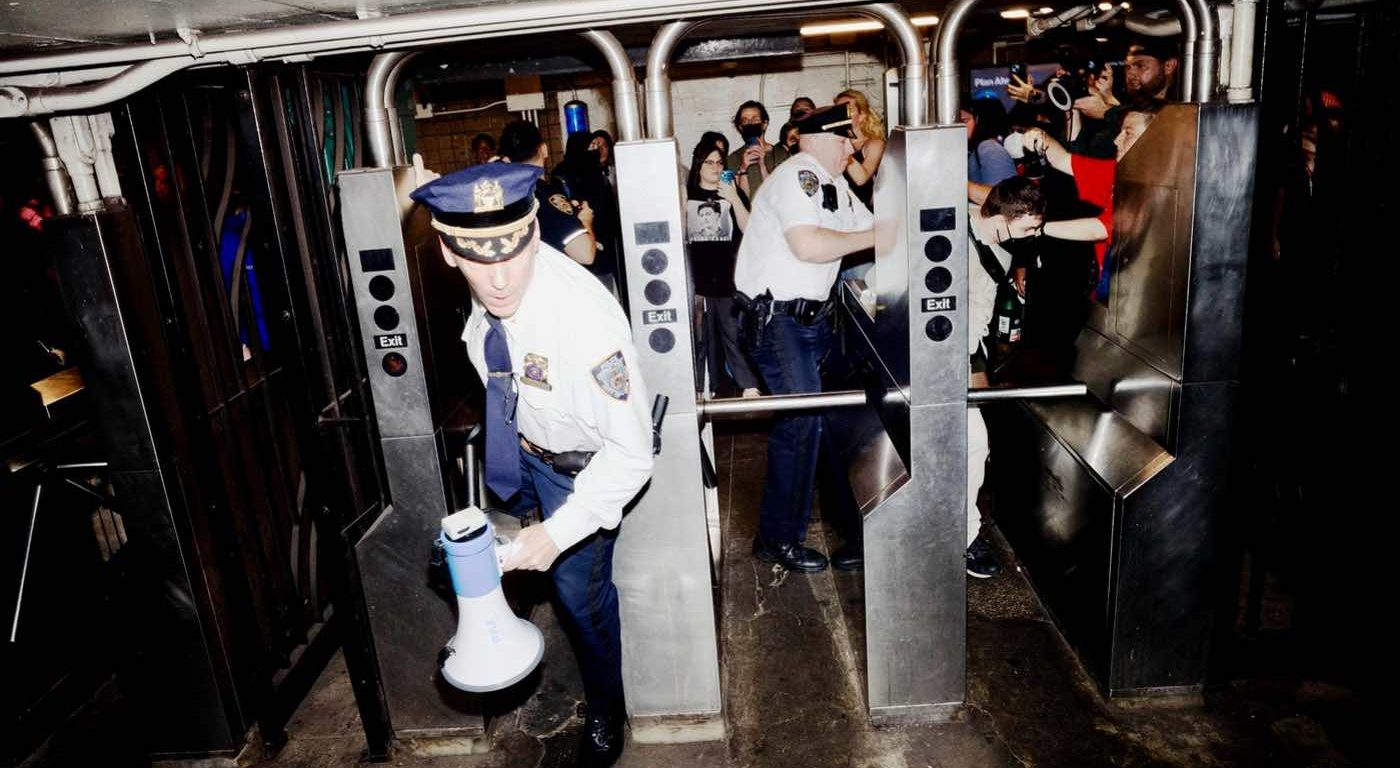
The march took a right on 8th, then a left on University, continued through the park to 4th, then went up 6th to the subway entrance at 8th and 6th Avenue. The front of the march outmaneuvered the police at the under-guarded entrance, with 100 or more people jumping the turnstiles, despite police attempts to carry out snatches and efforts to de-arrest the targets. For a short time, a whirlwind passed through the station, leaving smashed screens, painted cameras, and spray-paint tags on the platform.

Fliers were passed out to commuters, explaining the intentions behind the act and posing the question *What comes next? Some had come to do more than this, some had no idea what was going on, and many people in the second half of the march were blocked from entering the subway together. Various standoffs ensued, with protesters shouting down cops, but most people had successfully dispersed on foot or via train car by 9 pm.

The autonomous call for this action cut through a tendency to hide behind the red tape of safety, responsibility, or management. Consequently, it brought out a crowd that was brave and ready to take the initiative to achieve a simple goal. This mass public fare evasion sought to strike a balance of confrontation and participation that has rarely been seen this year. Mass fare evasions set the stage for this specifically because the potential for crowd conflict with the police is high. Evading fare in this context, rather than on our daily commute or in a clandestine formation, is not an attempt to evade the police, but rather to prepare for confrontations and carry them out on favorable terrain, at the right time, with the right energy and numbers.

The shooting that the police perpetrated on September 15 is unspeakably disturbing. Both the fact that it could take place at all and the justifications that the NYPD have offered for it imply that the public should be subject to police control by lethal means no matter the circumstances.
In response to such an outrage, we cannot limit our horizons to monetary damage, disruption, or individual instances of direct action. The police and the violence that they constantly perpetrate against communities are not simple policy issues that can be reformed though a carefully arranged activist campaign. Police shootings, Palestinian liberation, the rising cost of public transit: all of these are “single issues” that in fact could only be addressed via mass rebellion. Mass rebellion could change everything, or it could only satisfy single-issue demands, but it is the only method that will work to bring about change in relation to any of these.
Hundreds of people confronting the police, asserting their own agency over historical change—this sort of self-transformation is a necessary precondition for revolution. Only mass insurrectionary action can topple the state. Clandestine asymmetrical action can disorganize the enemy, it can startle them and build morale, it can be used in defensive moments—but this has to culminate in large-scale maneuvers, in winnable confrontations if we want to see long-term change.
It is hard to know when and where this will become possible, and even then, it may not succeed. But we have to try. As a stepping stone towards that horizon, the general feeling should be that fare evasion is the new normal—that it is popular, participatory, uncontrollable, and cannot be stopped.

The experiences of the movement to stop Cop City and the movement in solidarity with Palestinian resistance indicate that clandestine direct action is not sufficient against the police or the military. We need thousands of people creating an unpredictable and ungovernable situation. Small closed groups employing a strategy of secrecy cannot achieve this alone, however determined they may be. But these groups can encourage and join larger crowds in expanding the popular understanding of what is possible. They can develop and spread the capacity to win confrontations with the forces that exist to prevent revolutionary change.
Organized groups that communicate and act in clusters can create a political context in which unruly mass dynamics are possible in the course of attending actions organized by others, but they can also take steps themselves to create opportunities for large crowds to assemble in conditions that lend themselves to autonomous initiative and participatory activity. That was the premise of this action, which is just one of many in an ecosystem of many different protests and other efforts.
The same night, OMNY card readers were smashed and walls were tagged at the Halsey L station, rendering passage free for the day until the MTA could address the damage. This was gratifying and significant, no doubt, but what can be achieved in invite-only hit and run actions will not quantitatively accumulate in a linear way unless we qualitatively challenge the ability of law enforcement to control public space. Doing so requires large crowds. There is a small tension between these two approaches to subversive action; it is the task of aspiring revolutionaries to reconcile these tensions.

