(Euskara) (Castellano)
On March 19 and 20, 2026, in Limoges, two individuals were summoned to appear in court following a several-month-long investigation—initiated as an antiterrorism proceeding—and a nearly five-year-long legal process, to answer charges of “damage to property by means dangerous to persons” and “criminal association.”
The incriminating acts were acts of sabotage, on the one hand, against vehicles belonging to the Linky electricity company and, on the other, against 5G relay antennas, carried out in February 2020 and January 2021. The defendants faced up to 20 years in prison and hundreds of thousands of euros in fines. The support committee and the defendants turned this trial into a platform against digital technology, bringing together several hundred people.
On Friday, April 3, 2026, the Limoges court handed down its verdict on the case from June 15, 2020, allowing the prosecution 10 days to appeal. Since no appeal was filed, the verdict is considered final.
The two defendants have been sentenced to 3 and 4 years of probation. They have also been prohibited from leaving the country for 3 years and from having contact with one another during that same period. The ruling on civil damages has been postponed until September 2.
The support committee for the accused believes that these sentences reflect the justice system’s consideration of two essential elements:
- first, the harshness of a nearly five-year judicial review prior to the trial, which constituted a true “punishment before sentencing” for the defendants.
- secondly, the urgent need for a public debate on the central issue raised by this trial: the questioning of the imposed digital wave, which has been shaping our societies for several decades and is a source of colossal damage to the environment and human life.
Strong Support
Since the arrest in 2021, the support committee has evolved from defending the defendants to criticizing the imposed technologies. It has been very active in recent months, organizing around fifteen solidarity actions in various cities and towns, from the Eastern Pyrenees to Amiens and from Bordeaux to Grenoble. The organization was based on two networks: groups critical of imposed technologies (Écran Total, Stop Micro, Stop 5G…) and revolutionary groups. Depending on the location, a wide variety of groups were able to join these activities: OCL, FA, CNT, the Student Union, Amnesty International, anti-repression committees, anti-militarist groups (CRAAM), or grassroots environmentalists…
The format of these events ranged from a simple meeting-debate with a dozen people to events that drew more than 200, depending on the capacity of the local organizing groups. Several solidarity canteens were set up, film screenings were held, and a wide variety of musical entertainment events took place, which, among other things, brought many people together.
All of this helped raise awareness of the issue, raise funds to help finance the defense, and inform and discuss the technologies imposed as well as the means used for repression. This boosted the morale of the accused and encouraged the mobilization from March 18 to 21.
Mobilization During the Trial
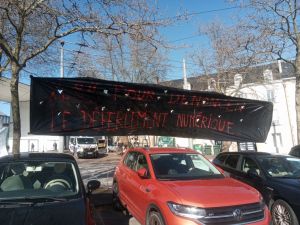
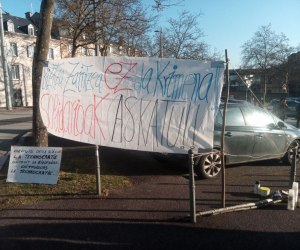
Around 200 people traveled to Limoges, but the courtroom, which had limited capacity and was largely occupied by police officers, prevented most of them from attending the trial. The local organization took charge of hosting those who had traveled from far away, holding a rally with banners and small booths in front of the courthouse, organizing various meetings and discussions, and coordinating two solidarity meal sites that allowed everyone gathered to regain their strength.
Opening of the Trial
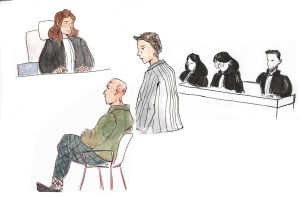
Following an initial presentation of the defendants to the judge, the presiding judge summarized the facts based on the police and judicial investigation.
The Witnesses
Defense attorneys Chloé Chalot and Henri Braun called eight witnesses to speak about the context of the case.
Victor Cachard, author of «History of Sabotage», explained how sabotage had historically emerged as an alternative to violent action against people, aiming to be more effective than “sitting idly by”. Sabotage is a fundamental practice situated between violence and nonviolence. This practice has been used in the context of labor struggles since the late 19th century. The lawyers for Enedis, Bouygues, and Orange (the prosecution) objected to this presentation, equating material destruction with violence.
Celia Izoard, a philosopher and journalist, is the author of several works on digital technology (the latest of which is titled “The Mining Fever of the 21st Century”) and translator of the latest edition of George Orwell’s “1984”. In her speech, she denounced the harmful effects on the Planet of the rollout of 5G, mining—along with the crimes and wars it entails—and the lies surrounding the mandatory installation of the Linky meter.
Jean Michel Hupé, a neuroscience researcher for 25 years, later turned to sociology and co-founded the Toulouse Workshop on Political Ecology (ATECÓPOLO). He highlighted all the harmful effects of AI, 5G, and electromagnetic waves. He advocated for the necessity of civil disobedience, including sabotage, which was challenged by the presiding judge and the prosecutor, who argued that it was wrong to invoke the “state of necessity” to justify acts of sabotage. His remarks were strongly contested by the lawyers for Enedis and Bouygues.
Nicolas Bérard, a journalist at L’Âge de faire and author of works on Linky, 5G, and digital technology, explained the harmful effects of these digital devices on sleep, sedentary lifestyles, isolation, and the mental health of young people. The presiding judge confirmed her knowledge of a program on young women’s mental health. Nicolas Bérard lamented the lack of consideration for citizen mobilizations.
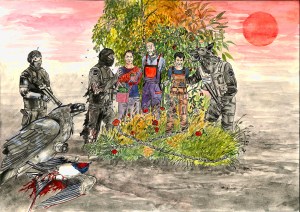
Karima Mersad, a professor and researcher in neurobiology and cognitive psychology in Paris, noted that in her scientific research she had discovered several disturbing symptoms (headaches, sleep disorders, etc.) caused by electromagnetic waves. She testified about the difficulties experienced by people who are electro-hypersensitive.
Mateo Amiech, editor of “Lenteur” publications, author of “Can We Oppose the Computerization of Our Lives?” and a regular contributor to the online magazine “Terrestres,” also criticized an app offered in the Occitanie region that requires the use of a smartphone and geolocation to access transportation discounts. He then cited the “digital ID wallet,” which promises to consolidate all cards into a single app, thereby enabling the automatic deprivation of rights and the complete erosion of civil liberties. Finally, he provided examples of rights violations based on digital communications, messages, and data collected through connected devices…
Sandrine Larizza, an employee at France Travail in the compensation services for job seekers, testified about the dehumanization of relationships with users due to the digitization of services and the development of AI. She noted that according to the Human Rights Defender, one in two people has difficulty accessing digital services.
Romain Couillet, a university professor and internationally recognized specialist in applied mathematics for digital telecommunications processing, highlighted the harmful effects of digital development on humans and the Planet. He himself decided to halt his research to devote himself to reflecting on the various levels of digital rejection. He is also an activist with Stop Micro in Grenoble. Romain Couillet concluded his remarks, his voice trembling with emotion, by evoking the resistance fighters of yesterday—treated as terrorists—who today lie in the Pantheon, and drew a parallel with these whistleblowers on trial for having tried to halt the mad rush toward general destruction, hoping that there will be a future so that in 50 years we can rehabilitate them as what they are, in his words: “heroes!”
At that moment, emotion filled the entire courtroom; some handkerchiefs emerged from pockets. Even the presiding judge seemed moved. The prosecutor, for her part, called for order in response to what was being said: we are within the confines of a courtroom, and the words of this last witness, which amount to the justification and promotion of sabotage, are subject to prosecution.
The court listened intently during these presentations, concerned, perhaps aware of the truth of these observations. The presiding judge seemed kind toward the accused and the large audience in the courtroom.
Cross-examination of the defendant
One of the defendants and his lawyer challenged the evidentiary value of the DNA. Enedis’s lawyer cited an excerpt from the social investigation, in which the investigator reported that the defendant said he “takes responsibility for his actions.” The presiding judge clarified that since the investigation had been conducted without a lawyer present, she could not take it into account. Among the documents used to incriminate him is a pamphlet in Spanish that includes the term “Las bombas” in the title. The defendant, with a mischievous air, then invited the interpreter to explain to the court what this term means in Spanish: it is a treatise on boilers and plumbing equipment. This was not the defendant’s only joke, who did not hesitate on several occasions to address the lawyers for the civil parties to point out the criminal nature of the companies they work for.
The other defendant made a very courageous and moving opening statement, contradicting the portrait that investigators had painted of her. She is not a terrorist, but simply a person deeply connected to nature, devastated by the current destruction of the Planet, and who wanted to raise the alarm. When the presiding judge questioned whether others had been endangered, she clarified that the homemade devices used were not explosives and that no one was nearby. Enedis’s lawyer explained that there was an employee at the site who could have been a victim and was left traumatized. The defendant’s lawyer pointed out that the employee did not testify and that there is no document to substantiate this alleged trauma.
Lawyers for the civil parties
There were three civil parties: Enedis, Orange, and Bouygues. Enedis’s lawyer was the most aggressive in his closing argument, as he had been in his questioning. He emphasized the defendant’s violence, her “anti-everything” ideology, and her far-left leanings… He called the defense experts “pseudo-scientists and politicians.” As compensation, she mentioned a total sum of around 400,000 euros, admitting that the calculation and supporting documents were not yet ready, which surprised the judges.
Orange’s lawyer did not speak during the trial and presented a rather brief and dull closing argument. According to her, the state of necessity cannot be invoked, and the violent nature of these acts must be taken into account. She wants the defendants to be found guilty and ordered to pay €1,000 for damage to image and reputation, plus over €76,000 for property damage. She also requests €2,000 in legal representation costs.
Bouygues’ lawyer used almost the same arguments as his colleague from Enedis, though with slightly less harsh language in his remarks. Acknowledging the impossibility of quantifying the property damage, Bouygues is seeking a symbolic one euro. For emotional distress, he is claiming €5,000, and another €5,000 for legal representation costs.
Prosecution’s Argument
Overall, the prosecutor carried out her role without displaying excessive aggression or severity, making it clear from the outset that she would not involve herself in the political sphere and would stick to the facts. She proposed finding the two defendants guilty of conspiracy as well as criminal association. She justified the requested sentences based on the social cost of the actions and the fact that she was not certain the defendants had changed substantially. She sought 4 and 5 years in prison for the accused. Given that the prison sentences imposed could have reached 20 years and that the prosecution is typically very harsh in such cases, this indictment can be considered relatively moderate.
Visibility and Hopes
The regional media (newspapers, television, and radio) mobilized heavily, producing preliminary reminders of the case and then daily reports, which gave space to the support committee’s statements. Media outlets such as Reporterre, L’Âge de faire, Radio Zinzine, and l’Empaillé. were present.
There were expressions of gratitude, warm hugs, tears in our eyes, smiles, and a great collective spirit of encouragement. We will remember this trial for this rather wild exchange of emotions, for the shared awareness that something powerful was happening—something we will remember for a long time and that has made us want to stay together to truly build something great.
We felt deeply united, nourished by all this collective energy, and despite our exhaustion, it was hard to go home. Of course, we promised to meet again for other powerful, joyful, festive, or difficult moments. The bonds are there, essential, enduring, keeping us warm and strengthening us to face this dystopian world.
It is always difficult to assess the future outcome of a verdict, but the support committee had reason to expect a fairly positive result. The presiding judge was very attentive to the arguments presented by the witnesses and defense attorneys. The charges were not excessive, and the lawyers for the civil parties were discredited by their own excesses.
Meanwhile, we hope that one day the real criminals will take the stand, or face the people’s court and their victims…
Epilogue
The President: Well, the arguments are over. Do the defendants have anything to add?
One of the defendants: I would like to say one last thing. There has been much talk of holding a political trial. But for me, this is not a political trial. Whoever the perpetrators were, it was not an act of sabotage, but an act of love. So that children can live in a livable world. My children. (He points with his nose at the lawyers for the civil parties): your children. (He turns toward the courtroom): your children.
The session is adjourned.
Based on an article in Courant Alternatif magazine.