(Main illustration: Txamantxoia / A Planeta)
(Castellano) (Basque)
Today I’m reading the Chicana feminist and LGBTQ activist Cherríe Moraga (from her 2007 book *The Last Generation*):
“and the United States’ blatant refusal to commit to protecting the environment at the Earth Summit in Brazil”1.
I find this enlightening and, for that reason, deeply sad and tragic. Because that Summit Moraga refers to took place in… 1992!!! (A fateful and significant date as well, 1992).
Yes, it was 34 years ago. It was the first summit addressing the planet’s environmental crisis; the precursor to all the COPs—Conferences of the Parties—or climate change summits. We’d have to go back 20 years to the first attempt in Sweden in 1972.
It was at this very 1992 Earth Summit in Rio that the United Nations Framework Convention on Climate Change (UNFCCC) and the Kyoto Protocol were created. Both are the main international frameworks for combating the climate crisis, which was ALREADY THEN (1992) predicted to be disastrous. These are the treaties and organizations from which Trump has now withdrawn.2

George H. W. Bush: The Beginning of Denialism
As Moraga points out, even back then the United States refused to contribute, and that has been the pattern (with some exceptions, though always timid, always insufficient to rectify previous missteps). At the time, at the Earth Summit, Bush Sr. was seen “as an obstacle to the global environment”3.
Even then, in 1992—34 years ago—the focus was on signing a treaty to limit carbon dioxide emissions. But even then, George Bush, representing the U.S., opposed setting timelines to reduce them, and signing a treaty to protect flora and fauna. Meanwhile, other leaders, such as German Chancellor Helmut Kohl, committed to accelerating the reduction of their carbon dioxide emissions by 25% to 30% by the year 2005, and British Prime Minister John Major called for an increase in the World Bank’s environmental aid fund from $1.3 billion to $3.3 billion, while the European Community also pledged $4 billion to meet the summit’s goals.
Displaying a haughtiness that would seem all too familiar to us today, George Bush addressed the other 172 world leaders in Rio in 1992, saying: “America’s record on environmental protection is second to none, so I did not come here to apologize.”4 Bush faced criticism from poor countries demanding that the U.S. contribute more funds to finance environmental protection programs. As we can see, things haven’t changed much.

This summit was held after the 1990 Gulf War (prior to the Iraq War). In that conflict, the U.S. and allied forces fought against Iraq over its invasion of Kuwait. But as is evident from the White House directives at the time, the real interest was—just as it is now with Venezuela—to regain access to oil through a “friendly” government (Kuwait): “U.S. interests in the Persian Gulf are vital to the national security. These interests include access to oil and the security and stability of key friendly states in the region.”5 That year, there was an oil crisis.
Ironically, before being elected president, George H. W. Bush had distinguished himself through policies addressing acid rain and acknowledged climate change, which at that time had been warned about by American scientists, including those at NASA. During his 1988 election campaign, he announced, «In my first year in office, I will convene a global conference on the environment at the White House.”6 During that campaign, he reiterated, “»Those who think we are powerless to do anything about the greenhouse effect forget about the ‘White House effect,’”
But as soon as Bush took office, he began working on policies that ran against this. We might think that this is what all politicians do once they come to power, or that he then found his proposals clashed with real interests and with those who truly held power in the U.S. But whatever the case, that is when the U.S. government’s climate denial began. Bush did not convene a global conference on the environment; rather, as we know, he undermine the climate proposals at the conference that was organized.
What can we say about his son? Like Trump today and everyone else before him, George W. Bush’s (2001–2009) election campaign was also funded primarily by the oil giant Enron, but also by the coal industry, which contributed more than $250,000. By 2003, with Bush in power, coal was once again dominating the U.S. energy system.

Like his father, George W. Bush had close ties to the oil industry: one of his business ventures was the founding of the oil exploration company Arbusto in 1977. Bush appointed Dick Cheney, a former executive at the oil company Halliburton, as vice president. Cheney was also appointed chairman of the National Energy Policy Development Group (NEPDG). The chief of staff of the Bush administration’s Council on Environmental Quality was Philip A. Cooney, a former lobbyist for the American Petroleum Institute (API). He abused his power by altering reports on climate change prepared by experts, including those from the Environmental Protection Agency (EPA).
Undoubtedly, the central aspect of the Bush (Jr.) administration regarding fossil fuel dependence was the Iraq War, which was seen as a war to control that country’s oil resources. Once the country was occupied, those resources were offered through bidding processes to international oil companies. While all major companies were involved, the U.S.-based Exxon secured the most lucrative contract. Above all, however, the U.S. benefits from Iraqi oil through the Development Fund for Iraq (DFI), which channels all profits from Iraqi oil toward the reconstruction of Iraq and Kuwait. This fund is held at the Federal Reserve Bank of New York. In 2021, payment for Kuwait’s reconstruction was completed, but the financial mechanism has remained in place, and Iraqi money continues to flow into the Federal Reserve fund.
The Clinton Foundation also received funding from three oil giants (Chevron, ConocoPhillips, and Exxon) estimated at between $2.5 and $3 million.7 Ironically, this foundation works on issues related to climate, health, and poverty.

The long road to Trump
The fact that the U.S. government has refused to commit to protecting the environment for so many decades stings, because that’s a long time. But it stings even more that the world’s greatest power (we can now debate to what extent, or in what sense) has consistently, for so many years, been (actively) opposing international proposals and needs. From a position of economic, political, and military power, we must remember. The democracy they preach and demand of other governments is not reflected on the international stage (nor on the national or local levels, for that matter). Because while the U.S. is currently the world’s second-largest emitter, historically it has been the world’s largest emitter.
And while this has been a constant—with some exceptions—it has been even more obvious and glaring under Republican administrations, and even more so now under Donald Trump. Before being elected, Trump had already declared himself a climate change denier. Then, as president, he boycotted all the summits without even participating. We must bear in mind that if the United States is the economic, political, and military power that it is, it is also thanks to the production, trade, and consumption of tons of fossil fuels—both within its own territory and in many others. This has always been evident, from the coup in Iran (1953) to the wars in Iraq (1990, 2003–11), the invasion of Libya (2011), and up to the present day (2026) with the operation in Venezuela, the war in Iran, and others.
Therefore, we must be clear that Trump is everything he is and symbolizes everything he symbolizes, but he is neither an isolated case nor something that arises out of nowhere: he is intrinsic to the essence, politics, and history of the United States. He has certain characteristics and certain eccentricities, but he remains faithful to that politics and that history. Not surprisingly, he now presents himself as the successor to or reviver of the Monroe Doctrine (now the “Donroe Doctrine,” adapted to his name), which dates back as far as 1823! Trump is merely a continuation of U.S. capitalist expansionism.
What’s more, as has come to light in recent days, Trump is also someone who has benefited greatly from those policies. It’s incredible that a person with so many economic interests in the country (being one of the wealthiest) is allowed to “govern.” It has now come to light that Trump has earned approximately $3 billion in profits since returning to the presidency, mainly through investments in cryptocurrencies and international real estate transactions.
During his first term, Trump invested in fracking while he was the one deciding whether or not to promote that policy—which is simply inconceivable. Now Trump has revived plans for fossil fuel extraction off the coast of Alaska, which—in addition to its climate impacts—poses a major threat to one of the planet’s most sensitive and best-preserved ecosystems, home to the Gwich’in Indigenous people.
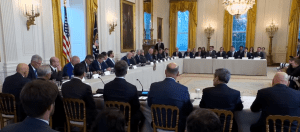
But even before his election, Trump represented the interests of major climate polluters: he himself solicited $1 billion from that industry for his campaign, and—like Bush before him—secured $450 million in funding from the oil and gas industry. In exchange, he offered them tax breaks and regulatory leniency, as well as streamlined mergers and acquisitions. Trump, therefore, owes his success to them. His policies will benefit their interests. Undoubtedly, the invasion of Venezuela and the takeover and division of the Venezuelan oil industry are the clearest examples of favoritism toward this sector. This was also reflected in the composition of his cabinet, which included up to 40 people linked to the fossil fuel sector (oil, gas, or coal).8
Trump has made a habit during this term of undermining international institutions, policies, and even agreements. As we’ve said, it’s not as if the U.S. and its previous leaders had ever been known for respecting international consensus, but now their utter contempt is even more blatant with their withdrawal from these very organizations (we could also question the purpose or results of many of them, though it’s clear that we won’t agree with Trump’s conclusions—nor were those his reasons). In January, Trump ordered the U.S. to withdraw from 31 UN-affiliated organizations9 and 35 non-affiliated international organizations.
But we must also include in this declaration of intent the elimination of institutions within the U.S. government’s own organizational structure, such as the State Department’s Office of Global Climate Change, which is responsible for negotiations on climate change between countries. We all know that this decision is not driven by cost-cutting, because while investment in officials responsible for deporting people (ICE) has skyrocketed (in June, he allocated an additional $38 billion to ICE, not counting the other billions dedicated to his entire immigration policy10).
On February 12, 2026, Trump overturned the scientific conclusion11 that climate change endangers human health and the environment (known as the “risk statement”). That was the premise underpinning the climate policies of the Environmental Protection Agency (EPA), which for nearly 17 years had introduced regulations limiting greenhouse gas emissions (CO₂, methane, and other pollutants). As a result, it eliminated the need for climate action by the federal government: $27 billion earmarked by the EPA for climate grants and clean energy will be redirected to other objectives. On the climate front, this decision is expected to increase those emissions in the U.S. by 10% over the next 30 years.
This paradigm shift—this climate denialism on the part of Trump and his allies—is based on the crude notion that humans emit CO₂ and plants absorb that CO₂, without acknowledging that it is the extraordinarily high levels of this gas (caused by industrialization and the burning of vast quantities of fossil fuels) that are harmful and disrupt natural processes.
The Rio Summit: A Precursor to So Many Others
The 1992 Earth Summit in Rio was followed in 2012 by the Rio+20 summit. Interestingly—and perhaps we’ve forgotten—Barack Obama himself, along with the presidents of major powers such as Germany and the United Kingdom, did not attend this conference, citing an economic crisis affecting their countries. Obviously, their absence was also interpreted at the time as a lack of commitment to sustainability and to finding global solutions to the ecological crisis.
Now, in 2025, a climate summit (COP) has once again been held in Brazil, in Belém. Since that 1992 Rio Summit, 30 COPs have been held, with results that have been more than disappointing. But now, at this 30th COP, the U.S.—under Trump—even refused to attend!!! Without the most powerful country, the one responsible for the highest emissions, refusing to accept any solutions or restrictions, the COP itself was meaningless. That is the tragic situation 34 years later.

Of all the COPs, the 2015 Paris COP was one of the most important, with commitments reached by all countries. But the first thing Trump did upon taking office for the first time in 2017 was to withdraw from those commitments. On this second occasion, he has done the same, withdrawing the nearly $11 billion annually that the Biden administration had previously agreed to provide for climate financing.
This November, COP31 will be held in Turkey, and once again, there are not high expectations for positive results, precisely because of the attitude of the U.S. and Trump.
Tons of Emissions from Trump’s Wars
But we must also note that Trump has been known for his trigger-happy nature, and, in addition to supporting Netanyahu In its destruction of Gaza and Lebanon, during these two years in office, it has carried out an attack on Venezuela and a war against Iran, which prompted this government to retaliate by also attacking Israel, Bahrain, Qatar, the United Arab Emirates, and Kuwait, with the resulting environmental and climate impacts.
Scientist and science communicator Fernando Valladares reported that 50 million metric tons of CO2 were emitted during the first three days of the war in Iran. We already highlighted this in “The reCRUDEscence”. But there is also all the energy and fuel wasted in those attacks, in the deployment of those vehicles and weapons, and in all the preparatory activities (maneuvers, training), as well as in the production of all that weaponry, technology, and vehicles. For example, a bombing from an F-35 Lightning II aircraft consumes between 5,600 and 6,500 liters of kerosene in one and a half to two hours, resulting in emissions of between 14 and 17 tons of carbon dioxide (the same amount emitted by a conventional passenger car over its entire lifespan!).
The Initiative for Accounting for Greenhouse Gases in War (Climate Focus) has calculated that Russia’s invasion of Ukraine generated emissions of 311 million metric tons of greenhouse gas equivalents over five years, while the war in Gaza generated 32 metric tons over two years.
We also point out: “The U.S. Department of Defense is the country’s largest energy consumer and the world’s largest institutional consumer of oil;12 It is therefore the largest institutional emitter of greenhouse gases: Its carbon footprint alone exceeds that of some 140 countries.”
In addition to the war, another activity has escalated under the Trump administration without regard for its climate impacts: the deportation of immigrants. These deportations, along with all the logistics they require (the movement of agents and officials), have led to excessive use of flights (often military ones). The fact is that deporting 11 million people results in significant emissions and costs a great deal of money. According to Alexandra Villarreal in The Guardian, “Air operations by U.S. Immigration and Customs Enforcement (ICE) emitted some 335,876 metric tons of CO₂ into the atmosphere in 2025, representing an 88% increase over the previous year.” As we know, these operations have increased exponentially since early 2026. But if someone denies climate change and is completely obsessed with deporting people, these emissions are the last thing they’ll consider preventing.
And that brings us to this situation
All of this also coincides with the hottest June on record, featuring an unprecedented heat wave across Europe during the last 10 days of the month—not only because of the temperatures (over 40°), but also because of its extent and latitude: Poland, the United Kingdom, Denmark, Switzerland… We can focus on the human toll (more than 1,300 deaths in Europe; according to other estimates, around 2,000), but we know the impact is much greater and will only grow.
These phenomena will affect agriculture and, consequently, our food security. But above all, they will impact ecosystems and, with them, nature’s ability to cope with so many adversities and with temperatures and phenomena that are increasing exponentially. As a general effect of this heat, we have also seen the spread of wildfires, many of which have surpassed the scale of any previous disaster.

Another effect of Trump’s denialism is that it sets a precedent for many others—especially the followers of his policies—to adopt the same formula: pollute without paying, heat up the Planet without paying… or even get paid for it. Such cases are everywhere. In Spain’s case, once again, the right wing—led by the PP and Vox—is avoiding climate policies and investment, adding this to their budget cuts and privatization efforts. As we have seen, the regions they govern have been characterized by following Trump’s lead and eliminating prevention services and budgets, as was sadly experienced during the Valencian DANA or now with the wildfires (including that very same region!).
This is not limited to the U.S., either; as we know, in many respects the ties to the European Union have been close, and similarly, the EU is also characterized by imperialist policies (a long history of imperialism by its member states and, subsequently, as a unified entity) as well as a disregard for the environment.
Likewise, we refer to the U.S. in terms of its government and elites, because the rest of society benefits in many ways or to varying degrees, but generally speaking—as in other places—it is forced to accept a series of policies, decisions, and abuses. Within that broader society, there are those who suffer the greatest exclusion found in any country, those who face persecution, and also those who fight and resist so much authoritarianism and injustice in their own country—as these years of Trump in power have also shown us through that resistance to ICE and deportations.

“Although I cannot claim to possess their wisdom, I see my task as that of the ancient Mesoamerican scribes: to speak to these cataclysmic times, to expose the ‘dream’ of individualism, profit, and consumption.”13
(Cherríe Moraga. “The Last Generation,” 2007)
NOTES
1Cherríe Moraga. The Last Generation. Las Femineras. Horas y Horas Publishing. 2007. p. 30)
3https://www.nytimes.com/1992/06/05/world/the-earth-summit-white-house-snubs-us-envoy-s-plea-to-sign-rio-treaty.html
4https://www.nytimes.com/1992/06/13/world/the-earth-summit-president-in-rio-defends-his-stand-on-environment.html
9https://www.whitehouse.gov/presidential-actions/2026/01/withdrawing-the-united-states-from-international-organizations-conventions-and-treaties-that-are-contrary-to-the-interests-of-the-united-states/
11Trump thinks he has so much power that, without being an expert or even having a college degree, he can question and overturn a scientific conclusion!!
13Cherríe Moraga. The Last Generation. Las Femineras. Horas y Horas Publishing. 2007. p. 30
