MINING BRUTALISM IS GLOBAL
Martintxo Mantxo
(Castellano) (Euskara)
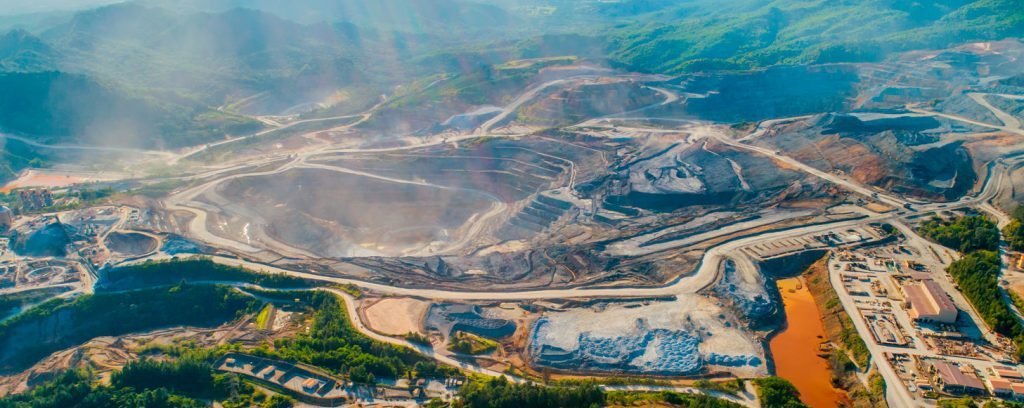
Main picture: Barrick Gold’s Pueblo Viejo open-pit mine (Dominican Republic).
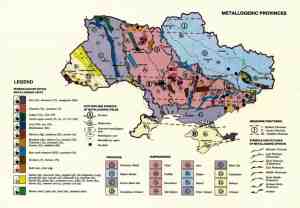
No doubt Trump’s imposition on Zelenskyy of a contract for Ukraine’s rare earths was understood as blackmail, as taking advantage of their situation to carry out a blatant robbery, as yet another episode of US imperialism, but without any dissimulation.
The other side of this contract is that it obviously assumes the rights to extract and therefore, being entirely at their mercy, to extract without any obstacle. No environmental regulations, no environmental impacts, no social impacts, nothing at all. Which, added to the alleged abundance of these minerals in Ukraine, means a lot of destruction, a lot of holes, a lot of immense craters, hectares and hectares of swept ecosystems, of desolate landscapes. Coincidence… desolate landscapes that will be added to the hectares and hectares of landscapes desolated by the war. But we know that this is no coincidence. This means what current mining, open-pit mining entails: millions of tons of tailings, discarded treated ore, millions of litres of polluted water, etc. (More on open-pit mining in Abya Yala here).
But as we say, it is not only Ukraine. This scenario is terrible for a planet that is already experiencing an unprecedented proliferation of mining and destruction. Moreover, open-pit mining continues to gobble up the planet. It continues to engulf ecosystems, water and communities all over the world. It continues unstoppable. While affected communities, affected countries rebel and try to stand up to it.
 Open-pit mining as the most brutal and obvious form of the effects of extractivism, of its brutalism as defined by the Cameroonian thinker Achille Mbembe and replicated by Amador Fernández Savater: ‘The world has become a gigantic open-pit mine. The function of contemporary powers, says Mbembe, is to ‘make extraction possible’’.
We will cite the most relevant cases that have come to our attention: Panama, El Salvador, Honduras, Argentina, Dominican Republic… Although in them we can perceive our greater knowledge due to historical and linguistic connections. Because, as we say, as Mbembe explains, this is a global scourge and many other places also suffer from its hell (Africa, Asia, Oceania).
The case of the Republic of Congo and the disasters caused by coltan mining is well known. Recently, our colleagues at ODG published an exhaustive report on the rare earth mining offensive and the disaster caused also in Madagascar, which we echoed. (By the way, Zorionak (congratulations) to ODG for its 25th anniversary. May you continue for many more years investigating and denouncing so many abuses).
Nor is Europe excluded from the equation. In Europe too, the European Commission has just granted strategic character to 47 extractive projects in different European territories. This means that here too, as Sustrai Erakuntza, EH Bizirik and the corresponding local platforms have been denouncing, the threat is looming, and specifically in the heart of Basque territory, as there are two projects that they have been trying to carry out for a long time, such as the Muga potash project (Zangoza area, also affecting the province of Zaragoza) and the MAGNA magnesite project between Baztan and Esteribar.
These minerals, like rare earths, are considered strategic for the energy and digital transition and also for the arms industry, which they now want to boost again.
Because let’s remember that many of these rare earths are essential for the new technological industry, but also for the alleged energy transition that has been unanimously agreed upon and that involves, among other things, the replacement of fossil cars with electric cars, windmills and solar panels – let’s not fool ourselves: although they do not require fossil fuels, they do require many minerals that have to be extracted and processed. Cars, in turn, require millions of batteries, with millions of tonnes of minerals. But as we can see, it is a false energy transition, which remains on the surface, and which, once again, only changes superficial factors to continue with the same capitalist parameters: extractivism – consumerism – enrichment of a minority.
Neoliberalism certainly prevails, but now, with these tycoons in power (Trump, Musk, Milei, etc.) the state is even more in function and control of the companies (especially their own), and with fewer scruples when it comes to screwing, drilling, destroying, polluting, killing, repressing.
Panama: 22 days of the indefinite strike
Panama is currently experiencing one of the most intense moments of popular struggle in its history and on the Planet, with a strike that began on April 23rd with no end date (which we documented here). It was initiated by teachers against the social security reform, which seeks to privatise pensions. But it was soon also supported by the construction union, Suntracs, and by all the people who are on the streets.
But this is not the only claim against the government of José Raúl Mulino. The decision to reform social security coincides with Donald Trump taking power in the USA, and among many outlandish proposals of an international nature (Greenland, Canada, Palestine, etc.) it included regaining control of the Panama Canal. This was in return for the signing of a memorandum between the two governments. The people are now also demanding that this memorandum be removed.
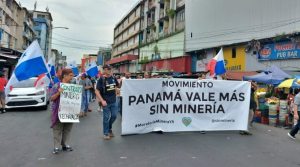
But they are also demanding the suspension of two projects of great environmental and social impact: the Donoso mine and the Indio river dam (related to water supply for the Panama Canal). Therefore, the mobilisations could not be more anti-neoliberal.
In the case of the Donoso mine, it is not a new project, but the reopening of a copper mine that has been operating since 1968 (copper, in decline, an indispensable mineral for the energy sector and also for the alleged transition). Due to the innumerable and enormous impacts caused by this type of mining, on 3 November 2023, the Panamanian National Assembly passed Law 407 or the Mining Moratorium Law. This law ‘prohibits the granting of concessions for the exploration, extraction, transport and benefit of metallic mining exploitation throughout the national territory’. It thus followed the steps taken in El Salvador in 2017 to ban metallic mining in their country.
It should be noted that both decisions (Panama’s and El Salvador’s) do not correspond to fashions, nor to simple cultural or geographic harmony, but rather to the major impacts produced by this type of mining, which, as we have seen, obeys an international pattern, acting with impunity against the environment and communities, as well as against legislation and against those who dare to question it.
Therefore, as the Panamanian people are currently protesting, the problem is not only the reopening of the Donoso mine, but also that this decision would mean the elimination of the Moratorium on metal mining.
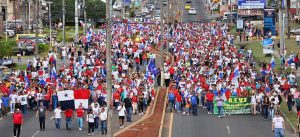
The Donoso mine belonged to the Canadian mining transnational First Quantum Minerals, which in addition to making huge profits ($2959 million in 2022), exported all the copper out of Latin America. Then, again, we see how international interests prevail. In a country like Panama where colonialism has existed almost perpetually, its people, as demonstrated again now, have a long tradition of courageously reacting to capitulation and subjugation.
But as happens in these cases, mobilisations, especially when they are forceful and prolonged, are met with repression. From day one, the government has de-legitimised strikers and demonstrators, and the media have criminalised them. The government suspended teachers’ salaries for April and will do the same in May. On 13 May, arbitrary and violent arrests of teachers, workers, students and community leaders took place all over Panama.
But one day passes, another passes and the strike is still going on. With its consequent results in economy too: the transnational banana company Chiquita suspended its fruit production, unable to transport it. The strike continues.
El Salvador: the return of metal mining
As we said, El Salvador was the first country in the world to ban metal mining by law in 2017. But the mining lobby continued to insist on its repeal, which happened in December last year, 2024. This happened despite the fact that the majority of the population (61%) is against it. Not to mention those directly affected and living in the affected areas.

For this change of direction it was essential that someone like Nayib Bukele was in power. As we already know, Bukele aligns himself with Trump and, above all, with the big transnationals, despite the fact that in his past he was on the left and in the FMLN.
Within this campaign to get rid of the law against metal mining, we can situate the repression against the organisations and communities that have most strongly opposed mining, which, obviously, are also those who suffer most directly from it.
In the case of El Salvador, it is the communities of Santa Marta in Cabañas, and it is activists from organisations such as ADES who are targeted by the government to demobilise and intimidate the population. Five leaders of this organisation suffered almost two years of pre-trial detention, which ended when their case was dismissed on 18 October 2024. Their case, however, was taken up again on 22 November, but they have not yet been tried.

In addition to the continuous postponements of its hearing (5 already!), a new one was added, for 26 May. But once again it has come to light that this one has also been postponed to 3 June. Undoubtedly, this delaying strategy has nothing more than the aim of making the most of an already ongoing operation of extraordinary repression, and to have the greatest and worst possible effect on the leaders and the mobilised society.
Meanwhile, extractivism in general stalks communities all over the country. About 20 poor and peasant communities are threatened with dispossession of their land. Especially violent has been the repression of the sit-in of the Cooperativa El Bosque, whose eviction is scheduled for 22 May. On May 12 and 13 community leader Jose Angel Perez, and environmental lawyer, Alejandro Henriquez were arrested. We demand their release.
Honduras: the sales continues
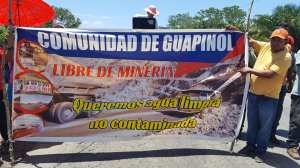
The government that replaced the ill-fated Juan Orlando Hernández promised a different situation. But under Xiomara Castro, extractivism has also intensified. As we know, Honduras is another country that has surrendered to mining, with 35,000 km2 of concessions for projects (a territory larger than the surface area of El Salvador). For them are many of those energy projects like the one that caused the death of Berta Caćeres, and those are the projects that, for example, in Guapinol kill activists, imprison them and force their activists and communities to leave their territory.

This May 14, the collective Guapinol Exige Justicia (Guapinol Demands Justice) together with many other organisations (including A Plane) demanded justice for one of the last leaders to be assassinated, Juan López, eight months ago. The demand holds the Honduran state accountable for the lack of results in the alleged investigation, as well as previous investigations into the threats he received and its interference in denying Juan López protection measures. Juan López was murdered because he was a leader of the Municipal Committee for the Defence of Common and Public Goods of Tocoa, which is opposing the Los Pinares mine, an iron pellet processing plant and the thermoelectric project that supplies it with energy, in the Carlos Escaleras National Park.
Now, once again, the Honduran government is playing a part in selling the country. On 12 May, the government approved Legislative Decree PDIII-0000-2025 #CN – Environmental Licensing Law. If until now companies had many advantages to promote their projects, now with this new law they will have it even easier, because this law will allow them to obtain environmental licenses quickly, without in-depth studies. Among other incongruities, this law will allow licences to be approved automatically if the government does not respond within 60 days. Another issue in its favour is that the control of these projects will fall to private consultants paid by the companies themselves, instead of the state supervising them.
Undoubtedly, this new law is another turn of the screw against the environment, against Honduran territory and its sovereignty, and against the communities affected by these projects, which have fewer and fewer rights and fewer ways to be considered. As we said, what is incredible is that these measures come from governments in which communities and environmentalists had placed their trust.
Argentina and the threat of uranium mining
Undoubtedly another country that is currently characterised by a pro-extractivist government is Argentina under Javier Milei. It is well known that Milei has no qualms about initiating projects, whatever their impact, if the benefits to the entrepreneur are substantial. Such is the case with nuclear energy, and therefore uranium mining, which has long been on hold in Argentina, but is now being proposed again. Together with Brazil and Mexico, Argentina is also one of the three Latin American countries that produce energy in this way. One of Argentina’s ambitions is to be self-sufficient.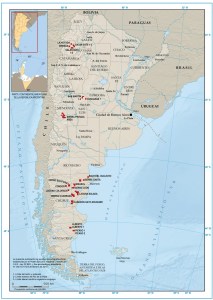
Nuclear energy has been booming internationally since it was massively scrapped. Recently, the Nuclear Energy Agency (NEA) and the International Atomic Energy Agency (IAEA) published a report, the Red Book, in which they urgently call for new uranium supplies. But in addition to energy, as the EU journalist Juan Manuel Izzo rightly points out, there is also a boom in the arms industry and, above all, in the recovery of nuclear weapons. Although both nuclear industries (energy and weapons) have always been closely linked, we are now seeing that this arms build-up is also having an impact on the demand for uranium.
Given this proposal, Argentina, due to its uranium deposits, has a new business opportunity. Sharks such as Eduardo Eurnekián, the Corporación América tycoon, who acquired the Ivana uranium mining project in the province of Río Negro, have been quick to jump on board.

We understand that this project would have been sold because of the impossibility of exploiting it. But Eurnekián’s chances are different, because it is not in vain that he is one of the financiers of Milei’s electoral campaign, and Milei, in turn, was the economic director of Corporación América. So, if it is not clear with Trump, they come to power after having done big business and in order to be able to continue doing more, and to leave the way well paved for more future business.
If open-pit mining poses such drastic threats and impacts, what about uranium mining, which in its mineral state also contaminates radioactively. This is why opposition to this project and to uranium mining in general has been quick to emerge.
Argentina, being crossed by the Andean mountain range, like all other countries (Chile, Peru, Bolivia, etc.), suffers particularly from the brutality of open-pit mining. The Andes are home to some of the largest mineral deposits on the planet. But they are not only ecosystems and populated territory, but also the place from which the country, and therefore all its ecosystems, are supplied with water. For this reason, the struggle against mining and in defence of water and life is deeply rooted. So much so that, despite Milei’s intensification of repression, there is no sign of it abating. In Catamarca, the Asamblea PUCARA has just launched a new information space to counteract the advance of mining in that province and to strengthen the initiatives of struggle in defence of water and life. Because the resistance continues.
More imperialist extractivism in the Dominican Republic
In the Dominican Republic, another Canadian company, Barrick Mining Corporation, extracts gold in the same way, in an open pit. Last May 6th they held their Annual General Meeting – virtually. But again, the affected communities in the Comité Nuevo Renacer reminded them that they are still waiting for them to act accordingly.
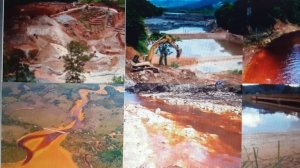
450 families live downstream of Barrick Gold’s Pueblo Viejo mine, close to the tailings storage facility (mining waste resulting from the separation of mineral micro-particles (in this case gold) from the rock using water and highly toxic chemicals). This year (2025) it has emerged that the company intends to increase the height of the tailings impoundment from 135.5 metres to 152 metres. In 2023 it was storing 100.1 Mm3 of tailings.
This situation is reminiscent of disasters such as those experienced in Brazil, in Brumadinho or Mariana, which the affected communities also want to avoid at all costs. For years, the Committee has been demanding the relocation of the affected communities, as well as a halt to the expansion of the open-pit mine, measures that have been ignored by the mining company.
