Martintxo Mantxo (A Planeta)
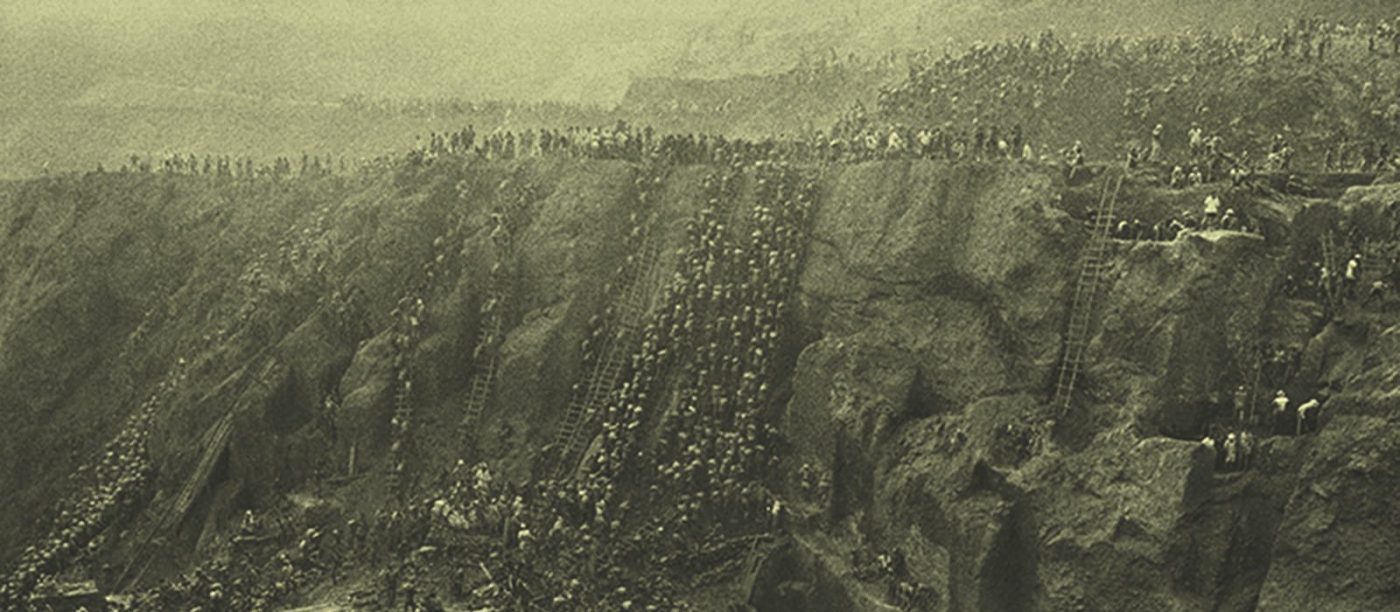
Main pic: Sebastião Salgado
(Euskara) (Castellano)
A few days after writing «Not just Ukraine, not just rare earths,» an article about different problems with open-pit mining (open-pit mining is in itself a problem) on May 17, 2025, we already had new cases to add. It’s the problem of dealing with such a broad topic at a time when the extractive offensive is at its peak.
Regarding one of the central cases in the article and the activity of A Planeta, that of the 5 defenders of Santa Marta, we learned the news that the judge in charge of the case was dismissed due to a conflict of interest: he was a member of the National Guard. Let us remember that they were accused of a crime committed by the guerrillas in the civil war in 1989.
A few days later, it was also published that metallic mining in El Salvador was adding another element to extract, thorium, whose use as a nuclear fuel is in the experimental phase.
A week after writing it, the famous photographer Sebastião Salgado died in Brazil. A month later, a friend from that country, an anti-mining activist who came to Euskal Herria in the first place because of that, asked me for help distributing a report.
A few weeks later writing the article, a corruption scandal splashed the Spanish government with clear links to the government of Navarre. In this case of corruption led by Santos Cerdán for paying commissions in exchange for infrastructure allocations. The case of one of the projects proposed in Nafarroa, that of Mina Muga, is included. Tere was another mining project announced assed to this one, the Megado Minerals company’s one, the Iberian Copper project.
The extractivist map extends through Euskal Herria (Basque Country)

As we say, a few weeks after publishing the article, the corruption case of the socialist deputy and one of the right-hand men of President Pedro Sánchez, the Navarrese Santos Cerdán, became known. Cerdán was accused of collecting commissions in exchange for infrastructure allocations, the reason why he resigned from his position and introduced the PSOE and the Sánchez government into their biggest crisis.
In addition to this case being investigated by the UCO, as Sustrai has denounced, Cerdán has been involved in Mina Muga, another mining project proposed in Nafarroa, where his party, PSOE, also governs; and in which he was also an MP. This project for underground extraction of potash would be located in the border area of Nafarroa with Zaragoza, near Zangoza. The greatest impacts are the disproportionate use of water and energy, associated with the separation of potash from common salt and water.
Now, once again, the Sustrai foundation has just denounced this project, which, as we say, is one more in this great extractivist and energy offensive that the Navarrese territory, citizens and ecosystems are facing. Because Sustrai was one of the articulators of that demand against the Muga Mine exploitation project promoted by Geoalcali and which managed to stop it. However, the institutions and their politicians were not up to the task, and despite the impacts and opposition, they decided to continue with their support. Now, as we say, other interests and other consequences of these positions and decisions are known.
The suspicions are confirmed because the project was unsustainable and much more so, that it was qualified as a strategic project, and because it also lacked all the mandatory requirements for a project of this nature. Its Environmental Impact Declaration (DIA) lacked evaluations of fundamental aspects such as geological risks or the safety of workers, an aspect that was noted by the court itself (TSJN) that stopped the project.
These aspects, already important in themselves, are even more so because the planned exploitation is located next to the Yesa dam, which, in addition to posing risks, these are further increased by the well-known conditions it suffers from and because it is an area with a risk of earthquakes. Nor was the process accompanied by a transparent or democratic process, as these documents were not accessible to citizens or organizations.
As Sustrai expresses: «The bottom line is always the same: the territory and its resources are just another commodity, coveted by those who seek private, direct or indirect benefit, under the cover of a legal and administrative structure that protects it.» A fact that, unfortunately and as we see once again in this article, is replicated globally.
A few days later, we also learned of a new mining project that was added to that of Muga, that of Megado Minerals, the Iberian Copper project. This one covers an arc from Navarre to Aragon, 200 kilometers from west to east, with a permit area of 956 km2. Currently, there are 12 permit applications in progress to secure key exploration areas. Megado Minerals operates in North America in the US and Canada.
As we said in the previous installment, it’s not just Ukraine, nor is it just in other continents, here too the extractivist offensive is unleashed, and here too the Energy Transition entails more extractivism. As we said: copper is indispensable in our system, but also in this supposed Transition. Or more, because in many cases it implies replacing many installations and infrastructures.

Mines and more mines in Minas Gerais
Sebastião Salgado passed away on May 23. One of his many celebrated photographic reports was precisely the one he made in the open gold mine of Serra Pelada, state of Pará. That report left us speechless about the inhuman conditions of the thousands working in that mine, in a true slave regime. Those conditions may be extraordinary, but at a labor level we have also learned that the mines exploit the workers.
In any article about mining, a country like Brazil, which due to its size but also due to the weight of its economic matrix of mining, has to appear. We mentioned Brumadinho and Mariana, in the context of the Barrick Gold mine in Pueblo Viejo (Dominican Republic) where communities live next to the tailings ponds and share their opposition to the increase in the height of the ponds so that what happened in Brazil does not happen. 
Obviously, those cases deserved more attention. Now we receive the request of a friend, Ronaldo Candin, to spread information referring to those two cases because both are also related to a new project near his city. Candin was a member of MACACA (Artistic, Cultural and Environmental Movement of Caeté), which, among other things, managed to stop mining projects in Serra da Piedade, in his city Caeté. Caeté is in Minas Gerais, near the capital, Belo Horizonte, on the way to Barão de Cocais. That was also the reason why I met him, his activism, which led him to leave Brazil and reside in Euskal Herria (Basque Country). Now Candim has also just published a book, which does not have mining as its background, but extractivism, with the paper and forestry industry.
The collapse of the Fundão mine tailings dam of Samarco (of the company Vale (do Rio Doce) along with BHP) in Mariana occurred in 2015. It caused the deaths of 19 people. The same company, Vale, caused the deaths of another 272 people in 2019 in Brumadinho.
Now Earthworks is publishing a report (which Candin asks us to spread) in which they denounce how Vale, far from changing its ways, continues to pose serious threats. On the one hand, many of Vale’s tailings dams are still in very poor condition and there have been cases such as the Gongo Soco mine in Barão de Cocais, Ouro Preto and Itabira which were evacuated in 2020 and 2021 respectively.

On the other hand, these disasters (crimes for those who experienced them) have not been satisfactorily resolved by Vale. On the other hand, Vale also continues to propose mining projects that imply the same or worse impacts, and the same threats, such as those of Apolo and Serra Serpentina. Vale’s Apolo project would extract 14 million tons of iron per year. It is located between the same Caeté and Santa Barbara, on the margins of the Serra do Gandarela National Park. Vale has no credibility to say that it will not affect this natural reserve. MACACA has defined it as «The Gernika of Water.»

The Serra da Serpentina project was presented in 2022, only three years after the Brumadinho disaster. This project would violate the rights of 51 traditional communities, the majority of them quilombolas (Afro-descendants), but also an Indigenous Territory of the Pataxó people. This people was very affected by the crime of Brumadinho. It would also affect 11 municipalities. The mine project in the Serpentina mountain range includes a mineral pipeline to transport the mineral that uses large amounts of water: 720 million liters of water per month. It will be supplied from the Santo Antonio River, a tributary of the Doce River. As a tributary of the river affected by the Mariana crime, the Santo Antonio River is essential for its recovery. But it will also add more impacts to this river (a Rio-AngloAmerica mine already operates in the same area) and to the Doce River and all the populations and communities along its path. 
According to Vale itself, it will affect the landscape in an area of approximately 5,300 hectares, the excavation area will be approximately 45 km long and would extend for about 29.7 km along the Serpentina mountain range. Waste deposits will occupy 2,347 hectares, with waste calculated as 40 dams like the one that broke in Brumadinho, with 1,600 million cubic meters of tailings and waste.
Another coincidence: Sebastião Salgado was from the Doce River valley. And when he was taking photos in Serra Pelada, the rumor spread among the workers that he could be a spy sent by Companhia Vale do Rio Doce to claim the mine, and they almost lynched him.
The slavery photographed by Salgado has less perceptible forms. Now, in Apolo and Serra Serpentina projects, Vale is denounced for “poor working conditions and modern slavery”. Vale is included in a government list of “slave labor” and it is well known that precariousness and subcontracting are used to reduce labor rights: of the 19 people killed in Mariana, 14 were workers, 13 of them subcontracted. Of the 272 people killed at Brumadinho, 250 were workers and 160 were subcontracted workers.
Ecological apartheid in South Africa?
Despite having taken Israel to the International Court of Justice for genocide, South Africa has been denounced for being its main coal supplier, after Russia. These imports have increased during the Gaza war, by 17% more, compared to January 2024. Coal is one of South Africa’s main exports to Israel, representing about $28 million.
On June 13, 2025, the Global Network of Alternatives (TGA) launched the Declaration on Radical Democracy, Autonomy, and Self-Determination. The declaration was the result of the global convergence held last February in Port Edward (South Africa), which was organized, among others, by the Amadiba Crisis Committee (ACC). The Declaration denounces, among other things, the extractivism faced by communities and ecosystems.
ACC is a South African movement from the Eastern Cape region that opposed a titanium mine. But to these threats have been added others such as the N2 highway project. This project is also rejected by the communities because it affects the water crisis in Khanyayo, as it will cross over wetlands and springs.
As ACC states, «The community’s livelihoods must be protected, in the N2 project and in all development. If not, then the projects are not for ordinary people, and development is false.» Now they also denounce the collaboration of their leader with the companies that promote the project, and even death threats from him against ACC’s spokespersons and by extension to its militants.
Canadian mining versus Ecuador
Canadian mining is one of the most widespread in the world (they control 40% of the sector worldwide) and has the worst impacts. Also in their country, in indigenous territories. That is why during the G7 summit from June 15 to 17 in Kananaskis (Alberta) the first nations stood up against the extractivist offensive.
One of the countries in which they operate is Ecuador, which was the country in which mining had been least developed in the Andean zone and in Latin America in general, while its Amazon region was totally concessioned to oil companies.
Coincidence (or not…) mining also developed in Ecuador under the government of a presumed progressive government, that of Rafael Correa (2007-17). He implemented 2 reforms with the aim of promoting mining, one in 2008 and another in 2013. These policies were characterized by the same ailments as the other extractivist activities in the country: a high rate of environmental impacts, little respect for local communities, especially indigenous ones, labor rights, etc.
In this context, foreign companies with Chinese, Canadian and other capital entered the country. This extractivism and these impacts will now increase with a new FTA (Free Trade Agreement) between Canada and Euador that was signed in February. This May they committed to accelerate it. Meanwhile, Canada already leads foreign direct investment in Ecuador, due to its mining extractions.
Canadian companies exploit seven different deposits throughout the country: Naves, Nabón, Warintza, Fierro Urco, Palo Quemado/Las Pampas, Espindola and Kimsakocha. To these is added the new Loma Larga project of Dundee Precious Metals, but in this case it would be an underground gold mine.

Last February, a Local Tribunal of the Rights of Nature was held in Ecuador. Despite all the extractivist activity developed in Ecuador and all the impacts associated with it, this tribunal focused on mining activity. The tribunal concluded «that all mining in the country is illegal and destroys human and Nature’s rights.» It also underscored the responsibility in this devastation of Canadian companies, and of the Ecuadorian State for its omission.
Following its work of denouncing violations of indigenous rights and abuses by Canadian mining companies in its territory, Ricochet magazine assigned its reporter Brandi Morin to investigate the disasters caused by Canadian companies in Ecuador. There she covered the impacts of the Warintza copper extraction project of the company Solaris Resources that affects the Shuar people, and that of Atico Mining in Las Pampas, reflected in 7 different articles. A Planeta translated one of them.
Apaches, s and abuses against women
This May we also learned that the courts rejected the petition of the Apache communities in Arizona to preserve the Oak Flat plateau, considered sacred by them and other peoples, threatened by a copper extraction project Resolution Copper Mine (of Rio Tinto and BHP (the same one that operates in Mariana along with Vale)). Oak Flat is also located in the Tonto National Forest.
In this case also, it is confirmed that in the case of indigenous peoples, mining companies replicate the same modes in the Global South as in the north, with women always being the worst off. An Australian report concluded that 74% of women in mining suffer sexual harassment. And an Integrated Report of Vale S.A. itself from 2022, stated that its risk assessment implies «the sexual exploitation of children and adolescents» in its Brazilian projects.
In the case of Oak Flat, Ricochet has also covered the impact on the community where the presence of the mining company has led to an increase in sexual violence, because they concentrate men who live outside their environments and families. This May the hearing for the disappearance and death of 14-year-old Emily Pike was also held.This case adds up to disappearance of many Native young women.
Milei’s chainsaw and his bulldozer
In Argentina, Milei differentiated his policies with respect to his opponents, proposing a total extractivism – that is, even worse than what was already being carried out in Argentina, which already promoted some items in a totally intensive and destructive way: mining, agribusiness and others. To implement these policies, a regulatory change was initially required, which in turn began with the introduction of the Omnibus Law and the Decree of Necessity and Urgency (DNU) approved in December 2024. The DNU involved the repeal or modification of laws that prevented the development of extractive activities in certain places, such as the Land Law, the Mining Law. And the Omnibus Law did the same with the Forest Laws, the Glacier Law and the Fire Management Law.
The amendment to the Glacier Law took place on June 9th to allow for mega-mining and hydrocarbon exploitation in protected areas. The measure is written to serve large mining companies that previously saw their projects annulled, such as the Canadian company Barrick Gold.
Argentina has more than 16,000 glaciers, making it one of the countries with the largest freshwater reserves. These glaciers are water reservoirs that supply hundreds of ecosystems and on which life depends, including human life and its activities and economy.
Chile and the Lithium Fever
 This Friday, the Chilean documentary «La Fiebre del Litio (The Lithium Fever: Shadows of the Energy Transition)» is being presented in my neighborhood, Egia (Donostia). It is a very important initiative because, on the one hand, we must know what this Energy Transition that they are selling us with the substitution of the energy model for renewables and fossil vehicles for electric ones truly entails, and, on the other hand, because we must know what is happening in other places and how it affects other people and communities.
Because if it has that price, that transition is not valid. Nothing better than for our associations and in our neighborhoods to make those realities known and to discuss the model. In this regard, we have already questioned this transition because of the excessive use of lithium and other elements in A Planeta, and the extraction it entails and its impacts.
In the Chilean case, it’s the same impacts that other mining operations already have in their territory, because, let’s remember, Chile has great experience in this, being the world’s leading copper producer. It is the second-largest lithium producer, since in that triangle that Chile forms together with Argentina and Bolivia, 60% of the world’s reserves are concentrated.
These are very arid areas that lack water. But this extractivism requires 2 million liters of water to produce only one ton of lithium. This exacerbated use of water causes an environmental and human crisis without precedent in already very fragile ecosystems. Again, the defense of water and life must be above any supposed transition, or at least be the center of it.
The current revolution in Nicaragua is against mining
Just to understand the planetary dimension of the problem of open-pit mining: today, the graphic artist Carlos Barberena presented his engraving ‘Nuestra Revolución‘ (Our Revolution). In the case of Nicaragua, now under the Sandinista government, the revolution to which Barberena alludes is the defense of water against the hoarding and pollution of mining companies. Just like in Guatemala, just like in El Salvador, just like in Honduras, Mexico… just like in any country.
Barberena adds the data: «Between 2014 and 2021, 274 mining concessions were granted (in Nicaragua) for a total of 988,325 hectares. In addition, 120 concessions representing 1,927,842 hectares are in the process of being requested.»
Barberena created this engraving in solidarity with the defenders of water in Nicaragua, and you can get artisanal poster-sized copies at Just Seeds.

