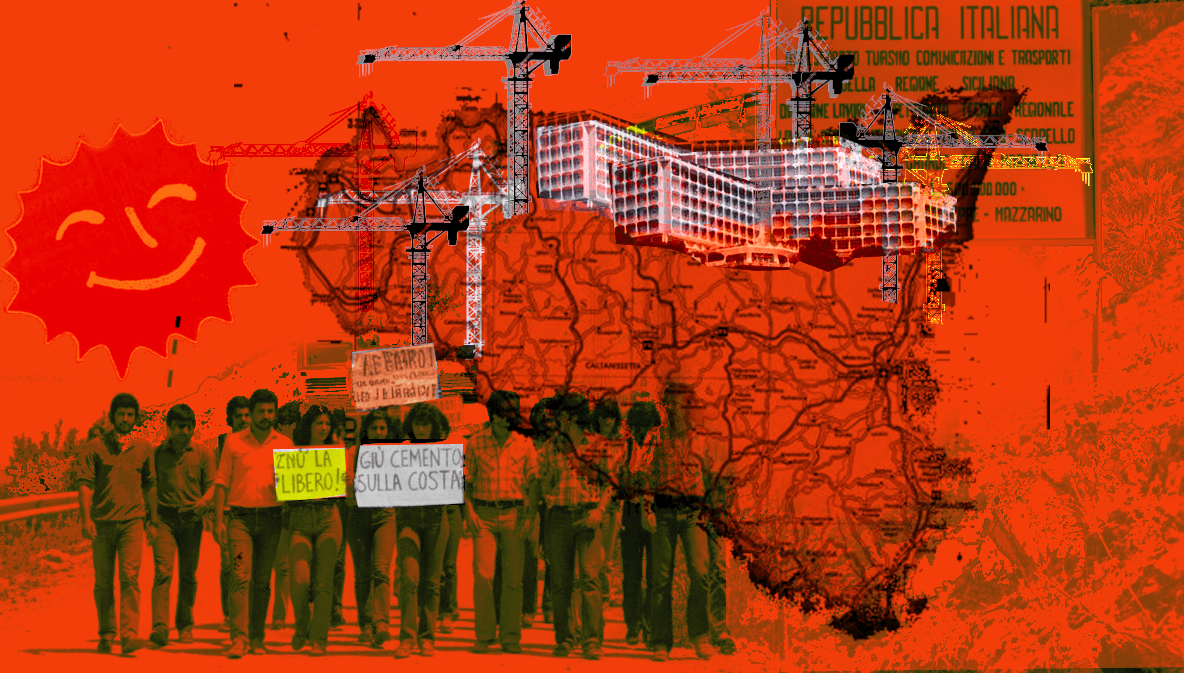
Illustration: A Planeta
(Castellano) (Euskara) (Italiano)
6 June: end-of-year party at Aitor Ikastola, a state school in the Egia neighbourhood (Donostia). End-of-year parties are eagerly anticipated events. For the boys and girls, because they mark the end of the school year, bringing an end to the final stress of completing coursework, exams and results, and heralding the prospect of a summer of leisure. For the teachers, much of the same. For us parents, it’s a time to get together, to celebrate with our children and their teachers another stage of their journey. To see our sons and daughters enjoying themselves in what has been their home for the whole academic year. And above all, it’s a chance for us parents to get together too – as we don’t usually cross paths – and to greet one another and exchange words, opinions and anecdotes about our children in a relaxed atmosphere.
That day I met up (among others!!) with Txema and Nicola Molinaro. I knew Nicola had been to Sicily because her son had been absent from my classes that week. But I found it a bit odd too, because he’s from the other end of Italy, from Friuli. It was then that he told me they’d gone to relive a holiday with his parents (the grandparents) in the late 1970s, during which they’d visited an area that had just been saved from a road-building project, thus preserving its unrivalled beauty: the Zingaro.
Just the day before, I’d read an article in a 1977 ufology magazine about the greys* cracking down on an anti-nuclear demonstration. The article ends on a spectacular note, with the author transcribing a comment by one of the demonstration’s organisers, recalling another Sicilian struggle against yet another (as we used to call them back then) useless, unwanted and imposed project.
‘“Oh dear!” said the geologist. “Like the Sicilian fishermen, who, when they saw that a chemical factory was polluting their sea with rubbish and killing their fish, took some dynamite and blew it up. The political parties protested on behalf of the workers who would be left unemployed, and the fishermen told them that they were workers too. And the factory was never rebuilt.”’
(“Nuclear? No, thanks” (Nueva Dimensión no. 90, 1977))
I mentioned the coincidence to Nicola and Txema, and all that it implied, because until then I hadn’t discussed these issues with them. But that’s how the opportunity arose, too.
Earlier that morning, I’d bumped into another father. I don’t know how the subject came up, but during a lesson his daughter told me that her father had been cleaning up shit on the beaches. I asked her if it was chapapote (oil sludge), but of course, the little girl didn’t know that term. I asked if it was in Galicia, but she couldn’t tell me that either. I was left wondering, especially as it’s been a long time since the Prestige disaster (22 years!) and the girl is only 9. But the party also provided an opportunity: ‘Yes,’ he replied, ‘because I’m from Vigo!’ And that’s when we also began to discuss the matter and, above all, to strike up another friendship.
(The Coordinator of Greenpeace Galicia described the oil spill clean-up carried out by volunteers as ‘probably the greatest act of collective love in defence of nature’)
Police baton charges against anti-nuclear protesters and ufology
 On 5 June 2026, I came across some science fiction magazines and books from the latest collection in the shop. It’s not a genre that particularly excites me (as it does to another old friend and environmental activist): the world as it is is complicated enough without us inventing another one! But sometimes similes and metaphors are an interesting way of analysing situations. There were a few titles by Bradbury and Le Guin that I wouldn’t mind reading, if only for the ideas they explore (social alternatives, dystopia/utopia) and so on.
I wasn’t familiar with the magazines, *Nueva Dimensión*. A magazine that must have existed in the 1970s, dedicated to ufology and science fiction literature, and which must have had a long run, as this is issue number 90.
On the cover of one of them, I recognise the image, which is the same as that on the book *The Female Eunuch*, one of Germaine Greer’s seminal works on 1970s feminism¹. It is a drawing of a garment, with feminine attributes adapted to it, hanging from a rail. As if those attributes that identify a woman could be taken off and put on (a metaphor for what Simone de Beauvoir said: that the figure of women is created through history, culture and traditions). Or as if it were the costume used by one of those aliens who have invaded us to disguise themselves as humans? The image is somewhat surreal, reminiscent of Magritte, but it is by John Holmes. And that was enough to make me take a look at the contents.
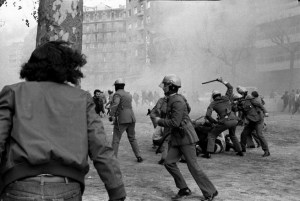
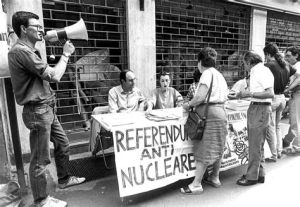
To my surprise, the first article—more specifically, the editorial in that issue—wasn’t a story about aliens but a report on an anti-nuclear demonstration, so I read it from start to finish (the title was quite explicit, as was the accompanying illustration, which is none other than the anti-nuclear sun symbol, accompanied by the text in Catalan: ‘Nuclear? No, gràcies”). Unfortunately, it doesn’t include any photos. Although the black-and-white photos of grey riot police are all very similar (see below).
The anti-nuclear movement was one of the major movements of that era and, in a way, laid the foundations for today’s environmentalism. Although there are still campaigns and references to that struggle (particularly in areas where nuclear power stations operate), it no longer carries the same weight as it once did, nor is it as prominent in the media. But what interests me most is the angle that a UFO magazine might take on the anti-nuclear struggle. Yes, as I say, when it comes to nuclear energy and many other things, we are not so far removed from surrealism or science fiction.
This particular article is a gem, as it recounts the experience of an anti-nuclear demonstration in Barcelona, set in the years following the Franco regime, when the repressive apparatus and many of its practices were still very much in force. The article describes the police charge against those attendants.
Another coincidence: those very same repressive forces were responsible for the killing of Gladys del Estal, an anti-nuclear activist from San Sebastián, at another demonstration in Tudela. The demonstration described in the article took place in 1977, whilst Gladys was murdered in 1979 (3 June). On that day, 6 June 2026, coinciding with the school’s annual festival, a tribute to mark her death was held in our neighbourhood (Egia, San Sebastián), where Gladys had once lived. The 47th! Her case and her struggle are still very much in our minds!
This is how the article ‘Nuclear? No, thank you’ (Nueva Dimensión no. 90) ends:
‘“Oh dear!” said the geologist. “The story of the Sicilian fishermen, who, when they saw that a chemical factory was polluting their sea with rubbish and killing their fish, took some dynamite and blew it up. The political parties protested on behalf of the workers who would be left unemployed, and the fishermen told them that they were workers too. And the factory was never rebuilt.”’
As I said, the coincidence was that just one day after reading it, Nicola shared with me this other account of an environmental struggle in Sicily from the same period – and also a successful one – the Zingaro.
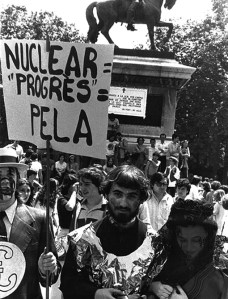
It isn’t the same project, but the Nueva Dimensión article ‘Nuclear? No, thank you’ ends on a triumphant note by also evoking an environmental struggle in Sicily. It isn’t against a road, but against a chemical plant. Yet both date from the same period and both were halted.
How often do we hear news of struggles in Italy? And in the space of two days I’ve learnt of two struggles from the 1970s, both in Sicily, which I didn’t know about! And both were successful!!
Here we have a lot in common with Italy because we shared objectives and approaches with the struggle against the High-Speed Train (TAV) in the north, in Val di Susa. I tell Nicola about the struggle over Bosco Park in Bologna, and everything relevant to the effects of the climate crisis in the Emilia-Romagna region, although as we know it is a global, planetary issue.
I know about these struggles through the people at Wu Ming, and of course, when I mention this to Nicola, it opens up another connection through the admiration we both have for this collective because of their literary and political work (apparently he even knows some of them!). And I know of other struggles through comrades: the one at the Porto Marghera chemical complex in Venice, or, more recently, those concerning the wind farms in Sardìgna. But that isn’t Italy… nor is Sicily.
Now I’ll be sharing all this with them too.
The struggle for the Zingaro Nature Reserve
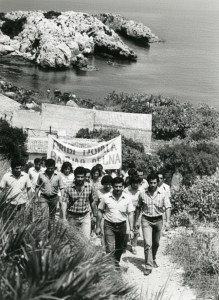
The march and the environmental victory Nicola was referring to was the so-called Marcia dello Zingaro of 1981, which secured Natural Reserve status for this coastal area in western Sicily between Trapani and San Vito Lo Capo (province of Trapani). This reserve covers 7 km of unspoilt coastline, including coves, cliffs and ecosystems, which were under threat from construction projects and the intensive exploitation of the land.
As Nicola explained to us, 40 years on, he wanted his children – now old enough to appreciate it – to be able to experience this protected area just as he had back then. That’s why he’s taking them there now, before the high season begins. According to him, the marine life in the area is incredible.
The march itself was merely the culmination of a previous citizens’ initiative, which at the time coincided with other environmental campaigns – campaigns we can now regard as the origins of a movement. The march set off from Scopello and covered 10 km. During it, as in the marches we organise here too, the organisers provided information at various points along the route about biodiversity and the threats it faces. This march and the campaign behind it were the catalyst that led institutions to subsequently formalise the protection of the Reserve, and this is celebrated and taken into account whenever the area is promoted.

This case reminds us of the current struggles against urban development in areas such as Maricá (Brazil) – threatened by the Spanish company Cetya – or Coyul (Oaxaca, Mexico)³ or even Gaza, where Trump announced his plan to develop the coastline for tourism, and so many others, because tourism is undoubtedly an industry with a major environmental impact. Tourism goes hand in hand with infrastructure projects that also pose a major threat, and the struggles against motorways take us back to struggles here (Leizaran, SuperSur) and others elsewhere, such as the current one in Punilla (Córdoba, Argentina), or the struggles already mentioned here against the high-speed rail (TAV) and in Italy, or against the Mayan Train and the Interoceanic Corridor of the Isthmus of Tehuantepec (CIIT) in Mexico.
[And here are some further coincidences: just as we are writing this, activists opposing the CIIT are on tour in the Basque Country, whilst a caravan is travelling across Europe. Furthermore, on 19 June, the OIT (International Organisation of Women Workers) declared that the Argentine state fell to comply with regulations during the construction of the Punilla Motorway. And on 22 June, following a year-and-a-half-long legal process, we knew of the acquittal of the 21 community defenders who had been criminalised for their work in defence of the Coyul territory was upheld!]
Yet despite that victory for the local population against the plundering of a territory so coveted by the tourism and construction industries, threats and negative impacts have been a constant feature of Sicily. Since then, local people as well as environmental groups, have been opposing numerous developments along the coast, many of which are illegal. Thus, they are currently running the ‘Abbattiamolo’ (‘Let’s tear it down!’) campaign, referring to the illegal constructions on the coast (for example, in the Valley of the Temples Park, in Maddalusa, Agrigento).
The historical context
The article ‘Nuclear? No, thank you’ (Nueva Dimensión No. 90) to which we referred dates from 1977, which, as we have said, and as it aptly illustrates, coincided with a period of anti-nuclear opposition and intense political activity, as it was the time immediately following the death of the dictator Francisco Franco (1975) and a period of openness regarding civil rights, but above all one of great ferment following so many years of oppression. It also coincided with a period of political ferment at an international level following the French May, guerrilla movements and decolonisation processes, and the 1973 energy crisis.
During those years in Spain, demonstrations of a feminist, nationalist, pro-prisoner, anti-repression and environmentalist nature were multiplying. That same year saw the first march for LGBT rights also in Barcelona. Furthermore, the article coincides in date (June 1977) with the first democratic elections in Spain. As the article aptly reflects, despite the supposed openness and establishment of democracy, the state continued to suppress popular demands in the same way: through repression, with truncheons!

That same year, 1977, the Anti-Nuclear Committee of Catalonia (CANC) was formed in Barcelona. We do not know whether the demonstration of the article was organised by the CANC, although it was responsible for other mass demonstrations in 1979 and 1980.
Various nuclear power stations had already been commissioned in Catalonia. The Vandellós plant was started 10 years earlier (1967) and came on stream in 1972 (by 1989 that reactor had already been decommissioned, whilst the one currently in operation was commissioned in 1988). A third reactor was proposed but was scrapped due to the nuclear moratorium decreed in 1984. As for Ascó – the plant that was the target of this demonstration – construction began in 1974 but it did not start operating until 1984 (the second reactor in 1986).
That same year, 1977, another demonstration was organised in the municipality of Xove (Galicia), where the construction of another nuclear power station was planned. This coastal area of Regodela is also considered to be ‘of incomparable natural beauty’ and was likewise preserved through public action. Like the Zingaro.
In the Basque Country, meanwhile, as a result of the popular movement, the planned power stations at Ea-Ispaster, Deba and Tutera were not built, whilst the one at Lemoiz, although already completed, never came into operation (the 1984 nuclear moratorium came into force before it was finished). A month after the article in question was published, in July 1977, 150,000 people demonstrated in Bilbao against the nuclear proposals. The anti-nuclear movement was very active, but ETA also carried out several bomb attacks on the Lemoiz power station and on the offices of the electricity company building it, Iberduero (now Iberdrola), killing two people responsible for the project. The Basque environmental movement emerged as a result of those mass popular protests.
The nuclear moratorium decreed in 1984 is undoubtedly the anti-nuclear movement’s most significant achievement. However, despite this moratorium, the six power stations that had already been built remained operational in Spain. Consequently, given the date on which they were built, they are all extremely old and have exceeded their useful life. However, of these, only Garoña has been closed (2013). Of the others, two are the Catalonian plants at Ascó and Vandellós, which, like the rest (Almaraz, Cofrents, Trillo), have had their operating lives extended to recoup the investment made in their construction. The Cofrents plant turned 40 in 2023. Its licence was due to expire in 2021, but the government extended it until 2030. Now, it would be Almaraz’s turn to close in 2027, but plans are already being made to extend its licence.
40 years without nuclear power in Italy
But the environmental achievements we have mentioned are not Italy’s only ones. Perhaps the most significant is the ban on nuclear power secured in 1987. Among the milestones in the history of nuclear power are the accidents at Three Mile Island (USA, 1979), Chernobyl (Ukraine, 1986) and Fukushima (Japan, 2011). Nuclear power stations were already in operation in Italy, but following the Three Mile Island accident, 20,000 people took to the streets in Rome. The protests were repeated after Chernobyl, but the consequences of that disaster were so terrible that a referendum (a democratic tool) was also proposed to phase out nuclear power. This was held in 1987 and resulted in a vote against the continued use of this form of energy. Consequently, three power stations already in operation had to be shut down, and the completion of another under construction was halted.
Now, in 2025, Giorgia Meloni’s government has enacted a law to revoke that ban and promote nuclear energy in Italy. The proposal also includes another one for waste, an essential ingredient in this equation. And this proposal, once again, is characterised by Italian centralism, which regards the periphery and the islands (Sardinia in particular) as the ideal place to hide this highly dangerous and polluting waste.
40 years since the nuclear phase-out in Italy.
40 years of protecting the Zingaro in Sicily.
We look back on struggles and achievements, because they are part of our history.
They are part of our inspitation. Because we are still fighting.
NOTES
* Grises: because of the grey colour of their uniformes. National Police which came from Francoist times wih all its connotations.
1In his book, Geer argues that the ‘traditional’ capitalist nuclear family sexually represses women, turning them into eunuchs.
2It should be added that this was one of the first years of such mobilisations, as this is the year considered by Ecologistas en Acción to mark the origins of the anti-nuclear movement. See: ‘The anti-nuclear movement in Spain 1977–1990’
http://www.ecologistasenaccion.org/16239/el-movimiento-antinuclear-en-espana-1977-1990
3Incidentally: on 22 June, following proceedings lasting a year and a half, the acquittal of the 21 community defenders who had been criminalised for their work in defence of the Coyul territory was upheld.
