Some considerations after the disaster in Valencia these days and its reaction
(Português) (Castellano) (Euskara)
- Read more about the DANA disaster here, by Antonio Aretxabala
(Updated 22 November 2024)
The ‘hydrological revolution’: to paraphrase Carlos Mazón and how he referred to the meteorological phenomenon of the DANA (Depresión Aislada en Niveles Altos) of 29 October. What the DANA did provoke was a social revolution in the days that followed, with the participation of thousands of volunteers who came from all over and with a tremendous collective effort to re-establish living conditions in the devastated villages. Likewise, on 14 November, a large demonstration took place in Valencia, with the participation of more than 150,000 people and which is considered to be the largest in the history of Valencia. This demonstration was the expression, two weeks later, of a people affected, tired and, above all, let down by their political class and institutions.
From the serenity that we can enjoy living this disaster from afar, but also as impressed as many others by its magnitude, I would like to collect here a series of reflections on the disaster caused by the DANA (Isolated High Level Depression IHLD, in Spanish) in l’Horta de València1. Most of them have already been heard, others are reflections that lead to others, and all of them correspond to a critical attitude towards Power and a system based on greed and disrespectful towards Nature and people. Because, in a way, and as we are seeing at many levels, this disaster is the confirmation of many of these previous approaches and reflections.
Recognition of the climate crisis as a factor
One of the confirmations with this tragedy is its connection to the climate emergency. This was raised by the presenter Pedro Piqueras, but also yesterday on the Basque regional channel EiTB, in which its presenter, Arnaitz Fernández, echoed the analyses of the World Weather Attribution. This institution highlights the connection of the excessive nature of this climatic event with global warming: ‘the intensity of the rain that day according to the World Weather Attribution was 12% higher due to climate change’, explained Fernández2.
He continued: ‘This event was twice as likely as in the pre-industrial era, also due to anthropogenic climate change. It is therefore to be expected that the frequency of such events will increase, so we have to be prepared, because far from lowering global temperatures, we are actually increasing them”. We could add that we should prepare ourselves, yes, but above all we must provide the means to ensure that these temperatures do not increase (reducing them seems less feasible), something for which we have spent many decades (since the 1980s or even earlier), many summits (now a new on, the 29th!) and a lot of money without taking it seriously (ATTENTION, Humanity: today we have already exceeded the limit of 1.5 ºC that was set in the Paris Agreement!3).
Likewise, the United Nations has no hesitation in linking the DANA that devastated Valencia to climate change. Its main headline read: ‘Deadly floods in Spain highlight need to reduce greenhouse gas emissions’4. While the WMO (World Meteorological Organization), also part of the UN, stated that the DANA was not an ”isolated phenomenon, but a reflection of a growing global trend towards the intensification of extreme weather events related to climate change’.
That it is being made so bluntly in the media and by such weighty organisations only corroborates what we have been saying for a long time. And that said, before the denialists come back to the table, I would like to say that we have been saying this for a long time.
And before the negationists respond again, what it implies is just that: that the probabilities increase and the effects increase. Of course, that has happened before. The effect is known in Valencia as the pantanás. The one in 1957… the ones in 1982, 1983, 1987… Raimon already sang ‘Al meu país la pluja no sap ploure/o plou poc o plou massa/si plou poc és la sequera/si plou massa és la catàstrofe’5. The thing is, now the frequency will be greater and so will the damage.

Recognition of environmental work
Presentor Pedro Piqueras himself should have raised the issue of an urbanisation project that was proposed in the Rambla del Poyo and which did not go ahead due to the action of the ecologists. Rambla is just a wadi, a water evacuation area that does not have a constant flow, which is why it is often dry. One of the problems of the disaster that occurred, as in many other cases of flooding in other places, is the invasion of these channels and the undoubtedly necessary areas for drainage. One of the problems suffered by this wadi is the invasion of ‘vegetable gardens, buildings, even houses ’6 .
As Piqueras himself pointed out, if this project had gone ahead, we would be talking about a much worse tragedy. And as an ecologist, or as a person who has opposed so many infrastructures, so much concret, it is a confirmation of our approach and a demonstration that, despite being treated as a nuisance, we are often right. Or if it were only that, because to oppose a project is to oppose many benefits for companies and executives, or even for those who get a bribe or a position later in the revolving doors: often insults, threats, or even media campaigns. Or even physical attacks with serious consequences (let’s not forget that for the same reasons many colleagues are even murdered – the list is long). Because, moreover, opposing a project, or the model and all the projects it proposes, is a matter of conviction, but it becomes tiresome and is rarely appreciated. That’s why we also appreciate it when it is sometimes publicly acknowledged. In this case, for example, climate activist Fernando Valladares denounced threats from denialists. In addition to being a person with a high profile, he is a researcher at the CSIC (Spanish National Research Council).
Another news item pointed out that the largest shopping centre in Valencia was built in a flood zone. Yes, that is Bonaire. One of several shopping centres, because one is not enough. The pictures of Bonaire before the disaster speak for themselves: fountains spouting water, buildings made of metal and glass tubes, sculptures… Bonaire is now the epicentre of destruction, completely covered in mud. Its two-storey underground garage of more than 1,200 m2 each could hold more than 5,700 vehicles. The garage was flooded within minutes. It was not full, but many of those vehicles were left there. On November the 4th, almost a week later, they managed to get in, expecting to find the worst inside. So far it seems that the presence of people at that time was not very high.
As presenters go: even Julia Otero wisely concluded ‘The raging waters remind us that nature rules a lot, because it was already there before us’. Absolutely. And sadly so, because that sentence also touches on our segregation from Nature, of which we are obviously a part, and with which we should take more care in our connections.

Another environmentalist demand in the area has been the closure of the Cofrents nuclear power plant, 60km from the city of Valencia. This plant was commissioned in 1984, so it is already 40 years old and has already exceeded its planned lifetime. This plant was commissioned in 1984, so it is now 40 years old and has already exceeded its planned lifetime. Like other state nuclear plants, its closure was postponed from 2021 to 2030, despite the accumulation of incidents and the increasing likelihood of an accident. In the face of the DANA disaster, the Tanquem Cofrents platform asks “Can we trust these politicians to manage an emergency such as an accident in Cofrents, with two dams upstream of the plant so close to such a populated area?”.
Upstream of the power station are the Contreras and Alarcón dams. Let us remember that the Magro (almost overflowing its reservoir, the Forata) and Xuquer rivers overflowed during the DANA, and so did the Turia, and the Barranco de Chiva (Rambla del Pollo); in Aldaia, the water carried away the sluice gates of the La Saleta ravine which served as a containment; and the bridges of these rivers collapsed, generally due to the accumulation of rubbish, trees and cars. When they collapsed, they caused huge waves that flooded the towns.
The car: victim and executioner
But yes, one of the most striking images of this DANA is the accumulation of cars left by the water blocking streets. The dragged and accumulated cars also acted as a barrier (as can be seen in many photos) preventing the water from flowing as it needed to and worsening the situation.
But in itself, it is the image of one of the causes of the disaster, the car, so highly valued, and now an object of waste. If climate change is largely to blame for this extreme weather event, the car is undoubtedly one of its causes, as individualised motorised mobility is one of the biggest sources of greenhouse gases.
In addition to this aspect linked to pollution and the burning of fossil fuels, there is another aspect that often escapes us and which also has a major impact, namely the use of our space and territory for this form of locomotion. Or not locomotion, because most of the time they are there, immovable. To all the space they need to move (roads, streets, entrances, etc.) we add all the car parks and parking spaces, which, in most cases, are taken from our communal space.
A victim of the current disaster also experienced the 1957 floods. She compared the two disasters and saw only one difference: there were not so many cars then. Yes, that image is the image of destruction, for many the loss of their most beloved asset, to which they devote a large part of their income, and without which they cannot live or move. Now he will have to look for other ways.

One of the challenges is to clean up, to remove debris, obstacles that impede mobility and the restoration of normality. Undoubtedly, all those unusable cars are the biggest obstacles or the most difficult to move or remove. This brings us to another situation: the accelerated creation of thousands of tons of waste of very different kinds, almost impossible to separate and reuse/recycle and for which we need more … space. Where do we take all these unusable vehicles?
An Argentinian friend of mine reacted o the images too: ‘without reading, one sees the photo and thinks: how wise nature was to restore the balance … at a stroke of a pen it took a few cars out of circulation’. That’s how I read the photo too. The problem is that if Nature is wise, we can’t say the same about ourselves, because after seeing this disaster (and others) and our responsibility, we will immediately replace the whole fleet of cars with a new one.
Coincidences: The Peter Principle
Life is full of coincidences. At least mine is. A few days after the disaster happened, I came across this book: The Peter Principle7. Coincidence because I wasn’t looking for it, and I found it at the right time. I don’t think many people know the principle that this Canadian pedagogue formulated and that is so clarifying in this situation. And it is a coincidence because he wrote it in 1969 (my own age – a few years!) and having not been republished, totally forgotten, it appears to me today.
The Peter Principle states that ‘the human being tends to rise to the level of his incompetence. The result of such irrational escalation is plain to see: wars, environmental degradation, social injustices, races to nowhere…. If humans want to rescue themselves from a future intolerable existence, they must first of all see to what point of no return his senseless escalation leads them’. Is it or is it not suitable for the analysis at hand?
What is appalling is that having written it then, it assumes many years of incompetent access to positions of responsibility till now. Equally, the fact that it is not only happening here, but also in Canada, in the United States… all over the world. Humanity, as he says. And that geographical aspect coupled with the temporal aspect means a lot of incompetents and a lot of bad results.
Of the many cases he cites, one is particularly close to this (let us bear in mind that it was in 1969 and that it is in the United States): ‘I have seen urban planners supervise the development of a city in the flood zone of a large river, where it is certain to be subject to periodic flooding’.
The coincidence is maximal, because if there is one thing the Valencia DANA disaster has been characterised by, it has been the incompetence of the leaders. These and the previous ones. These, who are right-wing, the PP and Vox coalition (extreme-right in their case). At the outset, it was recalled that one of the first measures of this government was to suppress the recently created Valencian Emergency Unit (UVE). It was created on 17 February 2023 to intervene in crisis situations caused by natural phenomena (floods, winter storms, earthquakes) and others such as forest fires. And it was closed in November of the same year by the new government – 9 months after, a year before this tragedy.

Vox has signed up to Trump-style denialism (Abascal has already congratulated him on his victory in the elections). Among their proposals and the policies they have applied in the city councils they have governed with PP are the non-application of low emission zones (ZBE) and the dismantling of bicycle lanes8 (the best known case is that of Luis Martínez-Almeida (PP) in Madrid, who in his case carried it out alone). As is well known, the ZBEs are zones restricting motorised traffic, including parking, in order to alleviate pollution and its climatic consequences, and motorised occupation. These measures were applied in municipalities such as Elx, Castelló (also in the Valencian Community) and Palma de Mallorca, the three affected by the DANA.
In a debate, journalist Graziella Almendral recalls the Sendai Framework for Disaster Risk Reduction 2015-2030 of the United Nations9. Almendral criticises its ignorance by many institutions and politians of areas at risk.
But above all, the scandal was caused by the failure of the regional government (Generalitat de Valencia) to declare the alert, when it had been alerted by other means. At 13:00, Carlos Mazón again minimised the alert, informing the population that the intensity of the storm would decrease at 18:00. He later deleted the tweet. The Generalitat Valenciana declared the alert, sending it to all mobile phones in the province of Valencia at 20:12, when many people were already trapped. AEMET (Agencia Estatal de Meteorología) had raised the alert to red at 7:36am – more than 12 hours earlier. Now it comes to light that Mazón did not attend an emergency meeting for the DANA. Mazón’s excuses were varied: lack of coverage, that he did not answer the minister because he did not know her number, etc.
The next failure was after the disaster, when aid and assistance was not coordinated with central government and other national institutions, nor with local ones. The community of Valencia has cutting-edge legislation in relation to emergencies. In these cases, it should create a single command, and subsequently the creation of 5 units, which apparently did not happen. Without doubt, the Peter Principle is being followed to the letter, with people at the highest levels responsible for managing society showing themselves to be totally incompetent.

– Paiporta was the town with the highest number of deaths due to the DANA, with 45 people killed.
As we say, these are now, but before that the fault lies with those who allowed building in the rambla of El Poyo, or building shopping centres like Bonaire, who allowed and participated in the speculation and over-building, which are the reason for this crisis. People like Camps (regional president of Valencia 2003-2011), Eduardo Zaplana (regional president 1995-2002), Rita Barberá (mayor of Valencia 1991-2015), all of them sentenced for corruption related to speculation and property development, along with 60 other people, including officials and members of the PP.
Because we may not remember, but in Spain we witnessed what was known as the ladrillazo (brick strike), or the housing bubble, a period in which speculation and excessive construction10 reigned, and which was only curbed with the global crisis of 2008. During this period, there were no restrictions on building and real barbarities were carried out. The Valencian region was one of its scenarios. In December 2023, the Valencian president, Carlos Mazón, announced the modification of the Autonomous Law of Territorial Planning, in order to speed up projects. This entailed, among other things, the elimination of environmental barriers, which prevented construction in certain areas of interest or risk. The problem is not limited to Valencia: in Spain there are 1 million homes built in flood zones.
In the same sense, Vicent Partal, in the editorial of VilaWeb, took the same position in the face of the DANA disaster: ‘We need an anti-useless office (…) Now the norm is to enter (politics) to serve, to manage private interests under public appearances’.
It is not something punctual, it is Capitalism
Undoubtedly, as we can state from an environmentalist perspective, the problem is not punctual but corresponds to a wider context. It is the model, it is the system. It is capitalism, which as we said, in the Valencian Community has developed one of its most savage forms.

My friend living in Valencia and member of Perifèries11, Rolando Morán, told me: ‘This is happening just a few weeks, two weeks before the start of the expansion of the port. The port is operating below its capacity, because the companies that manage it cannot reach an agreement. One has too much space and the other too little. Solution: expand’.
The port is one of the star projects of the PSOE government, together with the extensions of the airports of El Prat and Barajas (the Basque-Navarre High Speed Train, etc). This expansion aims to turn the port of Valencia into the largest distributor of containers, raising the current seven million to 12 million. Politicians boast that it will have the same capacity as the port of New York. The opposition criticises the space which will be eaten up, much of it of interest, the infrastructures which will be added to it, especially roads, as well as the additional traffic. Not forgetting that it is located in the same city where many people live.
Again, DANA has also made it clear that in such a situation, such a model (centralised, dependent) is not feasible. All the goods in the port are blocked, and after days without circulation it will affect the whole market and the economy… To all this we can add that this project only affects an importing capitalist model of economic dependence, which, in this case, is detrimental to the local economy, its production and its sustainability.
‘And this enlargement, apart from the destruction of the Huerta (vegetable garden), will lead to more destruction of the Huerta.12 Ironies of capitalism: this infrastructure and the export of products is prioritised over the local economy, local agriculture, quality, fresh products (vegetables, fruit, cereals and pulses) that do not need to be brought in from far away. Sustainability is undervalued and immediate profit, millionaire profits, are valued.

But furthermore, if the DANA, like other effects of the climate and ecological crisis, makes one thing clear, it is that that sustainabilitythat is essential for us in order to cope with the risks. It is fundamental to resilience. And at the same time, as we see with the flooding that not only devastated villages, but also the Huerta, it is one of the main impacts of this climate crisis and of this capitalist model (infrastructures and over-construction, tourism, consumerism). The phrase of a farmer at a demonstration is more eloquent than all the articles and reports we can write: ‘Without the countryside there is no life’13 .
But there is still more: ‘Add to this a new urban development plan for Cabañal, very much aimed at tourists; an urban development plan in the Benímaclet neighbourhood, which is also next to the Huerta’. Because in Valencia, as in Donostia, Palma, Barcelona, Granada, the Canary Islands and so many other cities, tourism is a threat and a latent problem. The local community is organising and protesting against touristification, which means expensive housing, precarious employment and the occupation of public space.14 This model also prioritises hotels and infrastructure for tourists, marinas, golf courses and theme parks, while expelling communities.
Touristification, but especially this new model that uses housing to turn it into flats, reduces housing options and raises prices making them impossible for local people. These people have to opt for cheaper flats, usually on the outskirts of cities. In the case of Valencia, as has now been demonstrated, this also means opting only for homes that have been built without taking into account environmental conditions or safety regulations, and which pose a risk to the homes themselves, but also to the people who occupy them.
That Tuesday, 29 October, one of the events that Mazón attended when the DANA had already begun, was to receive an award for Sustainable Tourism. Considering that he took up his post as president in July 2023, a year and three months ago now, it seems a little early to draw conclusions. But it is obvious: they feed off each other, those who give the awards and those who receive them – links in the same chain. That day Mazón showed his funny side: ‘There is no struggle between competitiveness and sustainability. It is fake (sic)’.15
‘The by-pass, the underground train, plus the photovoltaic panels, destruction of the territory… A nonsense of a city! They think of nothing else but concrete, all the time. They can’t get it out of their heads, neither the left nor the right. They are all guilty’, adds Morán.
Rolando Morán shares with another coincidence. On 19 October, a large demonstration took place in Valencia. Exactly: 10 days before the DANA disaster. According to him, it was the largest ever experienced in Valencia: ‘There have been 15M and there have been 8M, but I had never seen anything like it’, he says. Some 70,000 people demonstrated for the right to housing, the defence of the territory and against touristification; the problems of Valencian society and which are related to each other. And which are behind the DANA disaster. was well reflected in the poster which used, no less, a photo of the flood of 1957. The chosen slogan was also premonitory: «Valencia s’ofega»16 (Valencia is drowning). 10 days earlier. Predictable.
On the lookout
In addition to all that has been said, there is one aspect that emerges in all that has been said and that is that of economic interests, of profits, of greed. With regard to the expansion of the port, it is a million-dollar project, for which the big transnational construction companies’ mouths were watering. Acciona and Bertolín, Dragados, FCC and Sacyr competed for it. The first two got the contract. We can imagine the tension between them, between the politicians, with the weight they have and what they would have insisted and offered to take the project!
Now, after the DANA disaster, we have the same situation again: we will have to rebuild, and once again, they will be rubbing their hands.
And we will have to replace the whole fleet of cars made of scrap meta. Because it is not likely that, despite the shock, it will help us to draw conclusions and change our way of life – we will return to the same path. More business for the automotive industry, which is one of the most powerful industries in the economy. The number of vehicles affected by DANA is estimated to be around 120,000.
Sols El Poble Salva Al Poble [Only the people save the people].
This has been the slogan adopted by the affected citizens of Valencia in the aftermath of the DANA. There is also unanimity on this, as it has been the headline in all the newspapers, even in the most recalcitrant ones such as ABC and La Razón. The media have also made the same diagnosis of the situation: the absence of the state and the institutions, or even an institutional vacuum. But there too, in these media, we can see intentionality. For example, for La Razón, the slogan corresponds to ‘the inaction of the Spanish government’, and not to the regional government of PP and Vox, which is responsible for it.
In the desolation, the media also agree that the most positive thing is to see the communities working together, and all those volunteers who come to help. Obviously, we need positive news in the face of so much pain and destruction, but we well know that altruism and solidarity are not the values that underpin or drive the work of the media.
Be that as it may, one thing is certain, as Naomi Klein states in the ‘Shock Doctrine’, in so many cases of disasters in which the state and institutions are absent (as here) it is the citizens who resolve the crises (Sols el poble salva al poble) that, in part or totally, capitalism creates. And this is just another demonstration. Or just as Kropotkin, the great one who identifies us humans and other animal species, proved cooperation or mutual aid. Just as the people of Gaza have proved to us for a whole year in the face of the most total destruction. Let us not forget now, in our grief, what that is.
To his credit, Carlos Mazón must be overwhelmed, and after so many days he must be exhausted. I would not have slept. But against him is the centralised system of power concentrated in institutions and people, which makes it almost impossible to function (to which we must add the exclusion of citizens from the institutions and the erosion to the point of dissolution of community organisation), and, obviously, the lack of organisation and management in the disaster, the lack of criteria and systems to apply in such a situation. And obviously, according to Peter’s principle, the lack of capacity demonstrated by these leaders, which only corroborates this principle and, therefore, that they must be a real politician. In their favour is also the fact that the level of rainfall was unprecedented: 500 litres per square metre. According to the AEMET the Red Alert is raised with a forecast of 180 litres per m2. Which is what they did, and Mazón (and his acolytes) did not.
The media also try to create information on the subject, on the reason for this slogan and its origin. They trace it to Machado. But although its use is historical, we understand that the new generations have adopted it more because it is a song, moreover in Catalan (very similar to Valencian) by KOP, later also sung by Berri Txarrak together with them17. We understand that this fact is something they want to ignore, above all because of the character and history of the Catalans KOP. For us, as Basques, we are proud that a song sung by one of us has such deep roots, and a clear confirmation that solidarity has no borders (Herriak bakarrik salba dezake herria). Incidentally, the first verse must also have been conceived for this context: ‘Comissaries enfangades’ (police stations full of mud). And those that follow: ‘clavegueres del poder / jutges per la corrupció / falsocràcia del Govern’ (Power sewers/judges for corruption/government’s falsity).
But within what we say, we understand that ‘Sols el Poble Salva al Poble’ is the phrase that best defines the situation and the desires of the people affected. Organising from below, without hierarchies, deciding together.
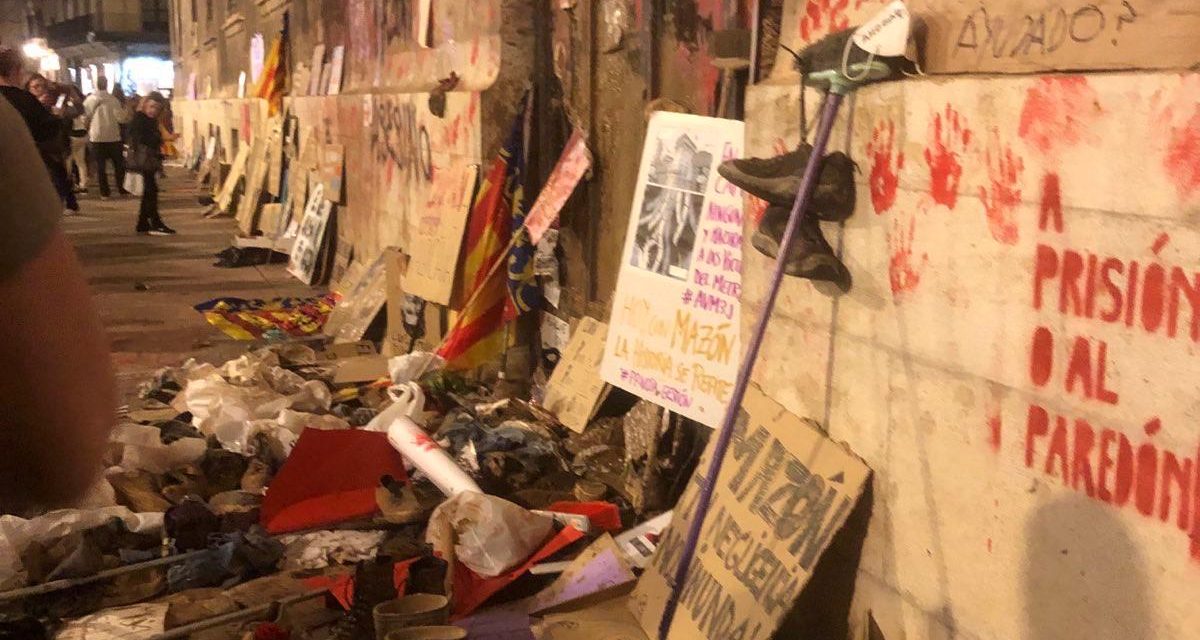
In this regard, another notable episode of this disaster was the popular disapproval of Mazón’s visit on 3 November together with President Pedro Sánchez and King Felipe (for this they did coordinate well). They threw mud at them, but in reality, if it wasn’t for bodyguards and police, they wanted to lynch them. The same thing was heard in all the media and from almost every mouth, justifying the attack and agreeing people acted like that because of their frustration and pain, because of indignation. Because, in addition to the political responsibilities, and the errors and negligence already mentioned, this took place 5 days after the catastrophe occurred.
We appreciate the critical spirit of the people, and the questioning of authority. Although it was later reported that many of the people present did not belong to the community and belonged to extreme right-wing groups, as they later claimed. The extreme right in Valencia is also strong and organised in different groups.

Repetim: ‘Sols el poble salva al poble’ (We repeat: Only the people save the people).
Something is obvious but is not mentioned in any media or by any journalist, it is the social composition of these areas hit by the DANA. They are the outskirts of Valencia. Villages that we had never heard of before and which are on the outskirts of the city, stuck in the metropolis. We all know what the outskirts of the metropolis are like: they are home to the people who maintain the city, its tourism, its works, its cleaning, its ports… the workforce. It is no coincidence that this was the area that was punished, or that so many people died in this area, and that we hear nothing about the centre of Valencia, or Valencia city.
The ex-mayor of Madrid Esperanza Aguirre has once again become a trending topic for praising and remembering the ex-dictator Francisco Franco with the DANA. ‘Thank God and the unmentionable Francisco Franco, who diverted the Turia riverbed, because otherwise it would have been Valencia city too’ were her words. The Plan Sur was a pharaonic work promoted by Franco in 1965 to divert the river Turia as it passed through the city of Valencia, after the flood of 1957. It also included the redevelopment of the city. It was a millionaire project that already had a tremendous territorial, landscape and ecological impact, especially in the Valencian huerta18. We understand that that flood and its subsequent theoretical solution corresponded to a growth of the city without taking into account limits and the function of some areas.
The forecasts were for the city to grow towards the northwest, but the Southern Plan caused the city to grow next to the new canal that acts as a barrier, towards the south. The huerta practically disappeared on both sides of the canal.
In the 1957 floods, 81 people were officially killed, but it is estimated that there were more than 300, because many belonged to those peripheral areas that, like now, were particularly hard hit, and were not counted or not included.
Before the DANA, town councils such as Aldaia asked the regional authorities to take up the project for another hydrological diversion, that of the La Saeta ravine, and also for it to be drained. This was one of the basins that overflowed. On the one hand, the city was built without taking lood-prone areas into account, and on the other hand, very close to the riverbedand on the other. In addition, we understand that other watercourses were diverted into this ravine, which increased its flow.
Plan Sur was also an urban redevelopment project that involved the displacement and relocation of thousands of people. We all know who these displaced people were and we can all imagine where they were relocated to. To begin with, in the suburbs. They call that area ‘the dumping ground of the city’. ‘There are people who have been displaced, evicted up to three times in their lives. They are taken from one place to another’, explains Rolando Morán. These were the areas hit by the DANA. These are the people who have been punished now.
Yesterday (7th November), the people of Perifèries, like so many others, went to help the people of Parc Alcosa, in Alfafar. This is an area that has been particularly hard hit by the floods but which has not been so often mentioned. This is a working class neighbourhood that has felt abandoned for decades. Here self-organisation is the way of life, the way to survive19. ‘Sols El Poble Salva Al Poble’ is not a new slogan. And now, it is this self-management that serves them to face the calamity. The Koordinadora de Kol-lectius del Parke Alcosa20 brings together different cooperatives and social organisations, and is a reference point in the fight against poverty and social exclusion in the Valencian community, and beyond. These days, its premises have become a logistics centre, where donations and volunteers are coordinated.
According to Toni Valero, a member of the Kol-lectius Coordinating Committee of Parke Alcosa, interviewed by Vilaweb, ‘this has not been a problem of neglect. It has been a problem of not respecting, not cleaning, not maintaining the infrastructures, which are the ones that have burst, and this is what has produced this misfortune. There was the possibility of evacuating the people if it had been said. They didn’t evacuate, they didn’t want to say so, and this has to do with the pressure that multinationals put on municipalities’.

Identitat
Another reading we can make of the DANA, and of slogans such as ‘Sols el Poble…’ is that never before has Valencia’s relationship with its language been so evident. The Valencian language is close to Catalan and for many people, the same thing, which is why it is the object of controversy when it is called one way or the other. But what is certain, as has been demonstrated with the DANA, is that it is their language, the language of Valencia (city, province, region), and, after years and efforts to undermine it (like the other minority languages of the Spanish state), it is a living language on which this society is based. The thousands of messages sent to the people of Valencia have also had this language as a vehicle, something unthinkable years ago. Undoubtedly a step towards accepting and coexisting with diversity.
Now, in their desperation to discredit this organised people and this generalised feeling, they return to the same thing, accusing it of having been infiltrated by the Catalanist horde.
Catastrophism?
In the desolation, the media also coincide in calling the situation apocalyptic21 21, as if these images corresponded to the end of the world. This brings me to a discussion that has arisen among people who move and act in the fields of environmentalism, anti-development and degrowth (as if they were different spheres, or at least for different people, and above all, they do have different connotations) in the face of the ways of confronting and, above all, communicating these crises that affect us (climatic, health, ecological, economic, energy) and their specific expressions (DANA, fires, droughts, etc), and which correspond to what we understand as the collapse of civilisation.
One of the proposals is that, given the dramatic nature of the scenario and the urgency to react, we must be careful how we convey the message22, otherwise people become frightened and, far from reacting, they ignore the reality. This may be the case. The truth is, as we have already seen, that 1.5º C degrees are already here, that extreme weather phenomena are already here, global pandemics are already here, wars are already here, waves of refugees are already here, the depletion of many resources is already here… and we have to react. We have to act.
Faced with the images of the effects of the DANA, I don’t know if we can paint things any worse than the DANA has painted them. We may not want to be too catastrophic, but the results are there. Nothing like reality to put us in our place.
It is also true that the coronavirus crisis put many things in their place, and made society react. But one year later it seems that we have forgotten all that and are back to business as usual, back to growth, cosumerism, unbridled tourism, etc.

Isolationism
Most of us, however, see these images from afar, without knowing what they really mean. Without having lived through that terror. Without having suffered the loss, without suffering the pain. But that is who we are. When we are still in shock about what happened in Valencia, it sounds harsh, but climate change and the extreme weather events it causes or intensifies cause multi-billion dollar deaths and losses around the world23. When this has happened in Valencia, it seems that this only happens to us. This also contributes to denying this drama as a consequence of something more general, something bigger, something global.
However, the DANA occurred weeks after another disaster in the United States, Hurricane Helene, which devastated the southeast of the United States. In A Planeta we have published an article written by a mother and climate activist who lived through the disaster, including the flooding (Published by Mother Pelican in English).
We also translated and then published another article, as part of our collaboration with CrimethInc., which is an anarchist response to that disaster (‘The eye of every storm’). In this case, another sad fact coincides with Valencia: more than 230 people were killed and many disappeared, compared to 217 in Valencia. They also agree that the government’s response to the disaster was ‘painfully slow and inadequate’. They also agree on the propagation of hoaxes and disinformation, often blaming marginalised sectors and migrants, and also, there too, on the use of the extreme right of the disaster with different objectives.
Another coincidence, without a doubt, were all those experiences of mutual aid that also occurred in this case. On the basis of these experiences, they trace what they propose as an ‘anarchist response’, which is perhaps the most interesting thing, as it is their proposal of how to act in these situations. The first piece of advice is obvious: ‘Start preparing now – there is no better time than the present to organise’. This brings to mind the groups that were set up in almost every town and city during the pandemic, but which later disbanded.
Pre-organisation, organisation before the disaster, is therefore the fundamental step. For this, as they say, it is also essential to ‘break the spell (…) of normality in which we live’. And vice versa, they also propose how to channel that feeling experienced by thousands of people, ‘the joy of coming out of the shell of isolated individualism and immersing oneself in the euphoria and sense of purpose that collective action offers’, in order to continue and build together communities and societies that are truly based on solidarity and equality. The analysis continues: ‘Suddenly, people see that we are better off when we work in cooperation with each other, and that there are enough resources to meet everyone’s needs when we collaborate rather than compete’.
After writing this, 12 days after the Valencia DANA (on the 13th another one hit again!), on 11 November, heavy rains caused flooding in Colombia. The Colombian government has declared a national disaster. One of the worst hit areas is Chocó, one of the most abandoned areas of the country, where at least 30,000 families are affected. Also La Guajira in the Caribbean and the capital Bogotá. The government has already mobilised emergency funds and disaster assistance.
Because that part of the planet, the Caribbean, like many others, is continually hit. Perhaps the damage in countries with such a fragile economy as Haiti, or Cuba – only in 2022 it was hit simultaneously by a tropical cyclone, hurricane Ian, and by a very long drought – goes unnoticed. Add here something very present in global climate policies since their inception: these countries, in turn, have contributed less to the climate emergency than industrialised countries. And in turn, in these situations, it is always the most vulnerable sectors that are the hardest hit.
Puerto Rico is the country most affected by extreme weather events, according to the Global Climate Risk Index (CRI). Cyclones, of very similar atmospheric origin to those of the DANA, are repeated year after year, causing multi-million dollar losses and, obviously, irreparable environmental impacts. Because of the frequency and the devastating results. These countries are already developing measures to protect themselves directly and indirectly from these phenomena (see ‘The Battle For Paradise: Puerto Rico and Disaster Capitalism’ by Naomi Klein).

Brazil has also been hit in recent years by heavy flooding. Some of these have resulted in the bursting of dams and mining tailings (sludge) deposits, causing major disasters. The worst were the Brumadinho and Mariana floods, the former in 2019 with 272 deaths and the latter in 2015 with 19 deaths. But since then the floods have become more frequent and more virulent.
The latest, this May (2024) the state of Rio Grande do Sul, in southern Brazil, suffered the worst floods in its history with more than 149 people dead, more than 100 missing, and two million people affected. Reading the chronicle of those days, in addition to the number of deaths (there were surely more), we find another parallel with what happened in Valencia: ‘The volume of rainfall in the last few days reached 800 millimetres’. The other coincidence is the construction and occupation of river flood zones.
In Brazil, there is also the coincidence that one of the biggest climate deniers, Jair Bolsonaro, governed for four years (2019-2023). He also dismantled many institutions and services central to the climate crisis. Brazilian climatologist Carlos Nobre also declared that reducing greenhouse gas emissions is not an option, not a choice, but ‘absolutely mandatory’.
At the end of 2021 and the beginning of 2022, the rainy season in the southeast of Brazil and in parts of the northeast caused major floods. Our MAB colleague Antônio Claret spoke of the ‘great solidarity ’ to remove the lama (mud), something that reminds us of what has now happened in Valencia. For Claret, the floods were a product of the ‘model of exploitation of nature’, or, as we have already said here, they were intensified by it, or this model contributed to making their effects more serious.
MAB, given its national articulation and experience, has deployed solidarity and aid management in all these cases. The appeals have been international, although, without wishing to reproach, I am not aware that they have got much echo here or reciprocity from other organisations. Now, however, the MAB did remember the people affected in Valencia: ‘Toda nossa solidariedade ao povo espanhol ’.
Last May, experts from several countries, including Spain, discussed the impact of extreme hydrometeorological phenomena at the Meteorology 2024 Convention in Havana (Cuba).

People’s verdict
On Saturday 9 November, after days of work clearing mud, after days in mourning, the people took a break to demand the resignation of Carlos Mazón. Reproducing one of the posters carried by a demonstrator, indignation flooded the city of Valencia. The government’s delegate put the turnout at 130,000 people. The images leave no room for doubt, the turnout was total. And it surpassed that massive demo of 19 October for the right to housing, the defence of the territory and against touristification. Surely, all the people who were at that one would were at this one again, because they had already predicted the drama.
Mazón declared the next day (10 November) that he respected the social expression, but rejected his resignation. And he gave a new date for his appearance in parliament: 14 November (two weeks since the DANA). Meanwhile, a week later (21 November) Mazón dismissed the councillor of Justice and Interior (responsible for emergencies), Salomé Pradas.
On the same day (9 November) thousands also demonstrated in Malaga, Seville and Cadiz against tourism and for decent housing.

It will be hard to restore normality in Valencia and overcome the trauma, although, as we said in the Covid crisis, what we must not overcome is that normality that facilitated all this to happen.
SEMPRE ENDAVANT! (ALWAYS FORWARD!)
- Solidarity fund for those affected by the DANA in Valencia:
https://cnt-sindikatua.org/eu/berriak/kutxa-solidarioa-valenciako-danak-kaltetutakoekin
Some other articles:
- Sobre la catástrofe capitalista en Valencia (Panfletos Subversivos)
-
Inundaciones y capitalismo. Una reflexión anarquista sobre la inundación en el Levante (Portal Libertario OACA)
* * * * * * * * * * * * * * *
NOTES
(*) The hydrological revolution: paraphrasing Carlos Mazón and how he referred to the meteorological phenomenon of the DANA (Depresión Aislada en Niveles Altos)
1Valencia is both the name of the city, the province and the region, which is currently called Comunitat Valenciana in the Spanish administrative division. Its main administrative body is the Generalitat Valenciana.
L’Horta de València is just that, the Huerta de Valencia, but it is the name given to this region in which the city of Valencia and more than 40 neighbouring municipalities are located. This area is also the last stretch of the River Turia, with the floodable areas of its fertile plain. It is also home to the Albufera, a shallow coastal lagoon (average depth of 1 m) of 23.94 km², traditionally dedicated to the cultivation of rice, vegetables and citrus fruits. Today, this horticultural activity continues, but the use of the land for this activity has been relegated to the background. Nowadays l’Horta de València is heavily urbanised and industrialised, with a population of 1.82 million inhabitants (71.9% of the population of the province of Valencia and 36.8% of the Valencian Community).
2Neven in Rebelión we were not so blunt: ‘Although we will have to wait for the attribution studies to establish what degree of direct relationship climate change has’ (It is not just a DANA: it is an escalation of extreme events due to a “maddened” atmosphere https://rebelion.org/no-es-solo-una-dana-es-una-escalada-de-eventos-extremos-por-una-atmosfera-enloquecida)
3https://rebelion.org/la-temperatura-media-anual-del-planeta-supera-el-umbral-de-15-oc-fijado-en-el-acuerdo-de-paris
5‘In my country the rain doesn’t know how to rain/it rains too little or it rains too much/if it rains too little it’s a drought/if it rains too much it’s a catastrophe’.
7 Laurence Peter and Raymond Hull) The Peter Principle. Tribuna (Plaza Janes Editores), 1996 (1969).
8Not building more cycle lanes or dismantling them would be an acceptable proposal if it meant eliminating motorised traffic, and using the roads already built for non-polluting transport.
10In only 10 years, from 1996 to 2006, an artificial surface equivalent to a third of the total area built throughout history was constructed (‘Spain, the “brickyard” that never went away’ www.lavanguardia.com).
12L’Horta de València is just that, the Huerta de Valencia, but it is the name given to this region in which the city of Valencia and more than 40 neighbouring municipalities are located. This area is also the last stretch of the River Turia, with the floodable areas of its fertile plain. It is also home to the Albufera, a shallow coastal lagoon (average depth of 1 m) of 23.94 km², traditionally dedicated to the cultivation of rice, vegetables and citrus fruits. Nowadays, this horticultural activity is maintained, but the use of its soil for this purpose has been relegated to the background. Nowadays, l’Horta de València is heavily urbanised and industrialised, with a population of 1.82 million inhabitants (71.9% of the population of the province of Valencia and 36.8% of the Valencian Community).
14See Veïnat en Perill d’Extinció https://rebelion.org/vecinos-y-colectivos-reivindican-el-derecho-a-la-vivienda-en-el-centro-historico-de-valencia
15 ‘Valencia 2024, Welcome to the new climate’. La Sexta Columna (8-11-2024). La Sexta.
https://www.lasexta.com/temas/lasexta_columna_valencia_dana_2024-1
17Or it could be a song by Obrint Pas, or Zoo, or Aspencant, or La Fúmiga, or El Diluvi, or Xavi Sarrià… or Ovidi; or the great song by Dr. Calypso ‘Sempre Endavant!
18For more information see Half a century of Plan Sur, the pharaonic Francoist intervention that changed the physiognomy of the city of Valencia https://www.eldiario.es/comunitat-valenciana/valencia/plan-sur-faraonica-intervencion-valencia_1_1127194.html and the thesis by Iván Portugués: ‘La metamorfosis del río Túria en València (1897-2016): de cauce torrencial urbano a corredor verde metropolitano’ (The metamorphosis of the river Túria in Valencia (1897-2016): from urban torrential riverbed to metropolitan green corridor).
19See Laura Escartí’s article ‘El Parc Alcosa: l’autoorganització com a única manera de sobreviure’.
https://www.vilaweb.cat/noticies/parc-alcosa-autoorganitzacio-unica-manera-sobreviure
21In this regard, it is also interesting to note what author Cara Judea Alhadeff says in ‘Apocalypse in Appalachia – My Son Caught in the Eye of the Storm’: ‘We have confused Apocalypse with Armageddon. Unlike Armageddon, a decisive (albeit illusory) battle between good and evil, Apocalypse refers to revelation or unveiling’.
22That way of conveying, also raised here ‘Apocalypse in Appalachia – My Son Caught in the Eye of the Storm’.
23According to Germanwatch, between 1999 and 2018, 495,000 people died as a direct consequence of more than 12,000 extreme weather events and the economic losses amounted to some $3.54 billion.
